
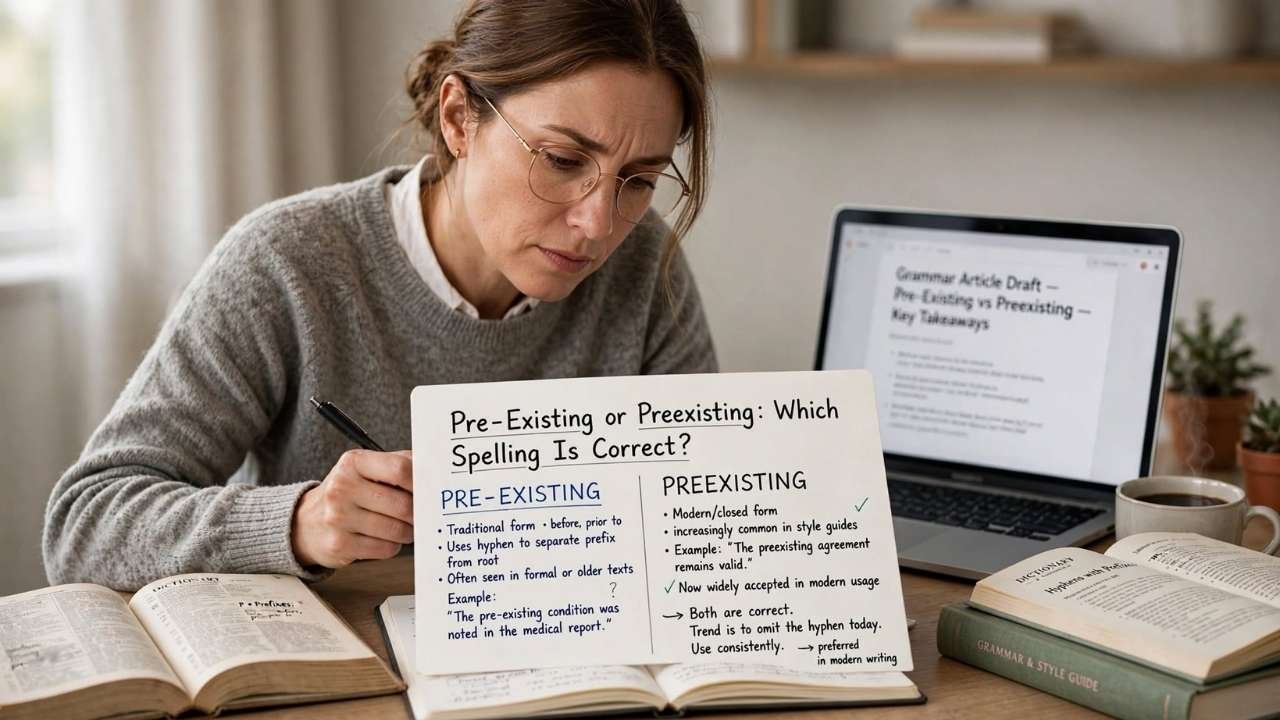
Choosing between pre-existing and preexisting can be confusing because both spellings appear in dictionaries, style guides, and everyday writing. If you’ve ever wondered “pre-existing or preexisting: which is correct?”, you’re not alone.
The good news is that both forms are accepted, but the right choice often depends on grammar rules, hyphenation, your preferred writing style, and the context in which you’re using the word. For example, pre-existing condition is widely recognized in healthcare and insurance, while preexisting is also listed as a correct spelling in modern dictionaries.
In this guide, you’ll learn the pre-existing meaning, understand when to use the hyphen, explore real-life examples, compare American and British English usage, and discover practical tips to help you choose the correct spelling with confidence in any piece of writing.
Quick Answer
Both pre-existing and preexisting are correct spellings, and they have the same meaning. The hyphenated form (pre-existing) is traditionally more common, especially in medical, legal, and insurance writing, while preexisting appears in many modern dictionaries and publications. The best choice depends on your style guide and audience, but whichever form you choose, use it consistently throughout your writing.
What Does “Pre-Existing” Mean?

The term pre-existing means something that already existed before a particular event, situation, or time. It is formed by combining the prefix “pre-“, meaning “before,” with the word existing. You may also see the closed form preexisting, which carries the same meaning.
For example, a pre-existing condition is a medical condition a person had before getting health insurance or receiving treatment. This word is commonly used in healthcare, insurance, legal documents, business, and everyday English.
If you’re wondering “pre-existing or preexisting: which is correct?”, the answer is that both spellings are accepted. The choice often depends on your style guide, audience, or company preference. The most important rule is to stay consistent throughout your writing.
Pre-Existing vs. Preexisting at a Glance
Although pre-existing and preexisting look different, they mean exactly the same thing. The difference is only in hyphenation. The table below makes the comparison easy to understand.
| Feature | Pre-Existing | Preexisting |
| Meaning | Existing beforehand | Existing beforehand |
| Spelling | Hyphenated | One word |
| Grammar | Correct | Correct |
| Common Usage | Medical, insurance, legal writing | Modern dictionaries and general writing |
| Best Practice | Traditional style | Modern style preference |
Both forms are considered correct spelling choices. Some dictionaries list preexisting as the main entry, while many publications still prefer pre-existing for better readability. Similar spelling differences appear in words like Traveler or Traveller, where the preferred form depends on regional English and editorial style rather than meaning.
Which Spelling Is Correct?
If you ask, “Is pre-existing or preexisting correct?”, the answer is both are correct. Modern dictionaries, including Merriam-Webster, recognize preexisting as a valid word, while resources such as Cambridge Dictionary commonly show the hyphenated form.
Neither spelling changes the meaning, so the decision usually depends on the writing style you follow. Many editors prefer pre-existing because the hyphen makes the word easier to read, especially in formal writing.
Others choose preexisting because English often drops hyphens as words become more common over time. Whether you’re writing an article, report, or business document, choose one form and use it consistently from beginning to end for a polished and professional result.
When Should You Use the Hyphen?
The hyphen is helpful when it improves clarity or follows a particular style guide. In many cases, pre-existing is preferred when the word acts as a compound adjective before a noun, such as pre-existing condition, pre-existing agreement, or pre-existing injury.
Some publishers and organizations keep the hyphen in formal documents because it makes the phrase easier to read. Others remove it and write preexisting, especially if their editorial rules favor closed compounds.
The important point is that both forms have the same meaning. If you’re writing for a company, school, or publication, check its style guide first. Otherwise, choose one version and use it consistently throughout your document.
What Do Major Style Guides Recommend?
Different style guides and dictionaries may recommend different spellings, which is why both forms appear in published writing. Cambridge Dictionary commonly uses pre-existing, while Merriam-Webster includes preexisting as a standard spelling.
Editorial guides such as AP Style and The Chicago Manual of Style often focus more on consistency than choosing one spelling over the other unless a publication has its own preference.
If your workplace or publisher has a house style, follow that rule throughout the document. This is similar to other grammar choices, such as Appendices or Appendixes, where both forms are accepted but one may be preferred depending on the style guide or audience.
Pre-Existing vs. Preexisting in Medical and Insurance Writing
One of the most common places you’ll see this word is in medical and insurance writing. The phrase pre-existing condition refers to a health condition that existed before a person applied for insurance or received certain medical coverage.
Because this phrase is widely recognized, many healthcare providers, insurance companies, and legal documents continue to use the hyphenated form. However, some organizations now write preexisting condition because modern spelling trends favor closed compounds.
Both versions are generally accepted as long as they are used consistently. If you’re preparing professional documents related to healthcare, insurance, or law, always check your organization’s preferred style before deciding which spelling to use.
American vs. British English Usage
When comparing American English and British English, there is no major difference between pre-existing and preexisting. Both forms are understood and accepted on both sides of the Atlantic.
However, many British publishers and formal organizations continue to favor the hyphenated spelling, while some American publications are more likely to use the closed form, preexisting, as English evolves. This is a matter of editorial preference, not grammar. If you’re writing for an international audience, either spelling is correct.
The key is to follow the style guide you have chosen and use the same version throughout your document. Consistency helps your writing look professional and prevents readers from becoming distracted by mixed spellings.
Common Mistakes Writers Make
Many writers make small mistakes when using pre-existing and preexisting. The most common error is switching between both spellings in the same article or document. Although both are correct, using one version in one paragraph and another later can make your writing appear inconsistent.
Another mistake is believing that only one spelling is grammatically correct. In reality, both spellings have the same meaning. Some writers also add or remove the hyphen without checking their style guide. If you’re writing for work, school, or publication, always follow the preferred editorial style.
A final mistake is confusing pre-existing with unrelated words that simply begin with pre-. Always focus on clarity, consistency, and the expectations of your audience.
Example Sentences in Different Contexts
Seeing the word in real sentences makes it easier to understand when to use pre-existing or preexisting. Here are a few examples:
- The patient disclosed a pre-existing condition before starting treatment.
- The company reviewed all preexisting agreements before signing the new contract.
- A pre-existing injury affected the athlete’s performance during the season.
- The lawyer examined every preexisting legal record related to the case.
- Our team identified several pre-existing issues before beginning the project.
Each sentence is grammatically correct because both spellings are accepted. Simply choose the form that matches your style guide and keep that choice consistent throughout your writing.
Words Like “Pre-Existing” That Follow Similar Hyphen Rules
Many English words with the prefix “pre-“ follow similar hyphenation patterns. Some are commonly written with a hyphen, while others have become single words over time. Examples include pre-approved, prearranged, prepaid, prewar, preemployment, and preorder.
Whether a hyphen is used often depends on dictionary entries, editorial style, and how familiar the word has become. As language changes, many compounds gradually lose their hyphen and become closed words.
That is why both pre-existing and preexisting are accepted today. If you’re unsure which form to choose, consult your preferred dictionary or style guide and use that spelling consistently in your document.
FAQs
Is pre-existing or preexisting correct?
Both spellings are correct. The choice depends on your style guide, audience, or editorial preference.
Is preexisting one word?
Yes. Preexisting is a recognized one-word spelling in modern dictionaries, including Merriam-Webster.
What does pre-existing mean?
It describes something that already existed before another event, situation, or point in time.
Should I always use a hyphen?
No. The hyphen is optional in many cases. Some style guides prefer pre-existing, while others accept preexisting.
Which spelling is more common in healthcare?
The phrase pre-existing condition remains very common in medical and insurance writing, although preexisting condition also appears in many publications.
Do the two spellings have different meanings?
No. Pre-existing and preexisting have exactly the same meaning. Only the spelling differs.
Which spelling should I use?
Choose the version recommended by your style guide or organization, then use it consistently throughout your writing.
Conclusion
So, pre-existing or preexisting—which spelling is correct? The answer is simple: both are correct. They share the same meaning and are accepted by respected dictionaries and many professional writers. The main difference is hyphenation, not definition.
The hyphenated form is still common in medical, legal, and insurance writing, while the closed form appears frequently in modern dictionaries and general publications. Rather than worrying about which spelling is universally better, focus on following your chosen style guide and maintaining consistency from beginning to end.
By understanding the grammar rules, using the correct form for your audience, and applying it consistently, you can write with confidence and keep your content clear, professional, and easy to read.