
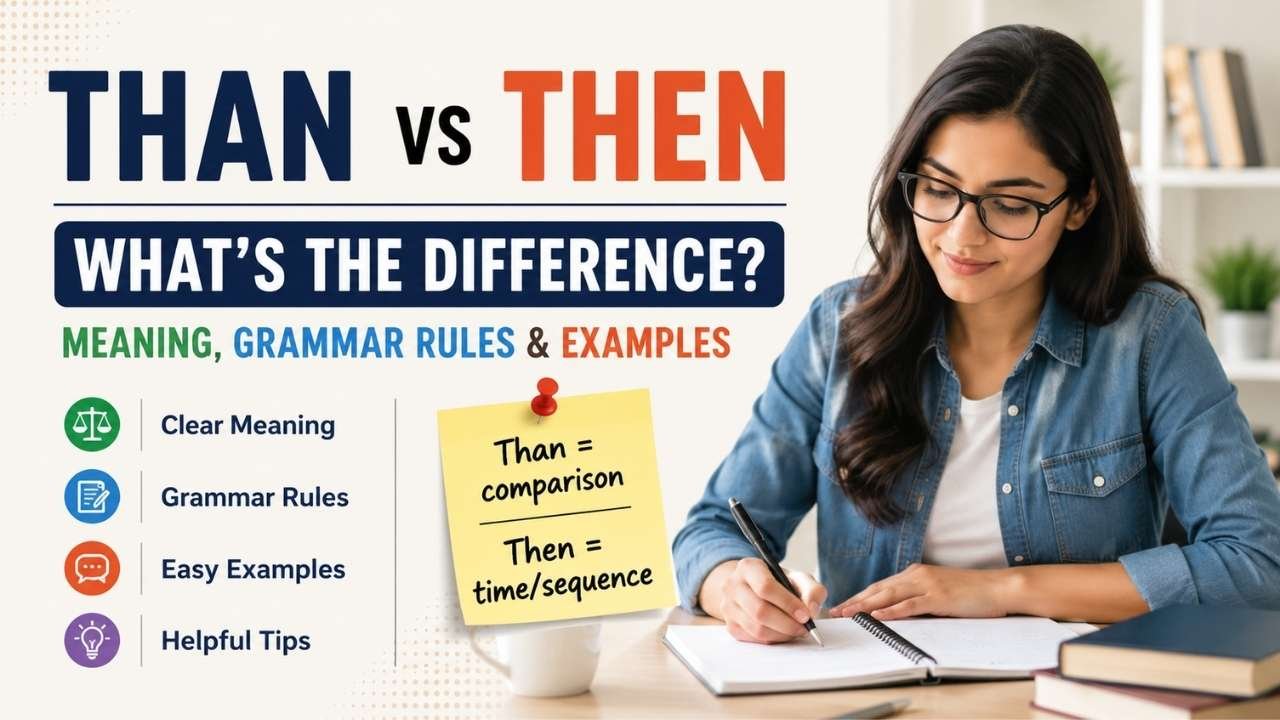
Many English learners confuse than vs then because the two words look and sound similar. However, they have different meanings and grammar rules, and using the wrong one can change the meaning of your sentence. If you’ve ever wondered when to use than and then, you’re not alone.
This guide explains the difference between than and then in a simple, practical way with clear examples you can use in everyday writing. You’ll learn the meaning of than, the meaning of then, common grammar mistakes, and easy memory tricks to remember the correct word.
Whether you’re writing an email, completing schoolwork, or improving your English grammar, this article will help you understand than vs then with confidence and avoid one of the most commonly confused words in English.
Quick Answer
The difference between than and then is simple: than is used for comparisons, while then refers to time, order, or what happens next. For example, She is taller than her brother compares two people, while We finished dinner and then watched a movie shows a sequence of events. Remember: than = comparison, then = time or sequence.
Than vs Then at a Glance (Comparison Table)
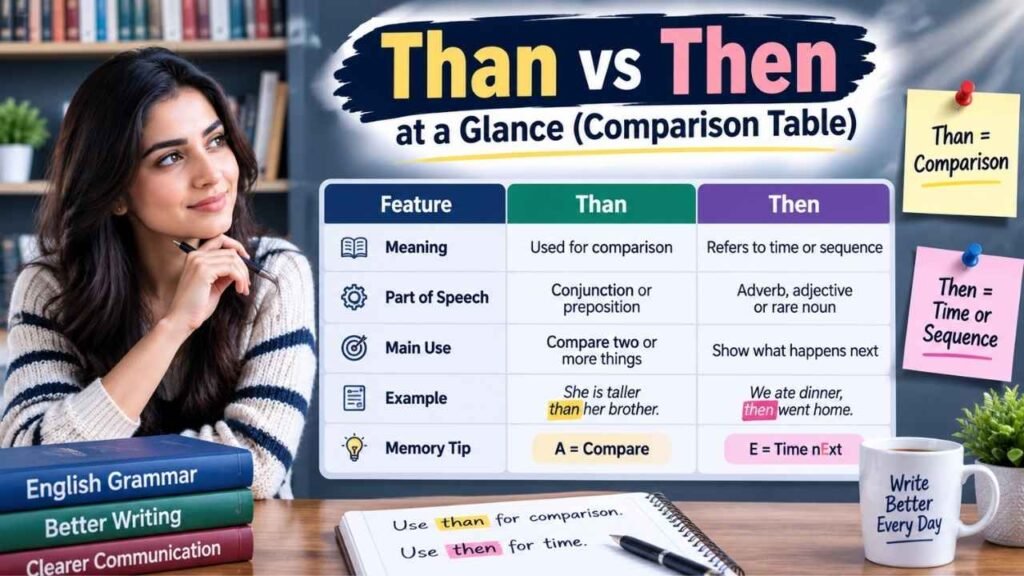
Many people mix up than and then because the words look almost the same. However, they serve different purposes in English grammar. Than is mainly used for comparisons, while then refers to time, order, or the next step in a sequence.
Knowing this simple difference can help you avoid one of the most commonly confused words in English. Before looking at the grammar rules in detail, the table below gives you a quick overview.
If you enjoy learning about confusing English words, you may also like our guide on Motif vs Theme, which explains another pair of terms that people often misunderstand. Use this comparison as a handy reference whenever you’re unsure which word is correct.
| Feature | Than | Then |
| Meaning | Used for comparison | Refers to time or sequence |
| Part of Speech | Conjunction or preposition | Adverb, adjective, or noun (rare) |
| Main Use | Compare two or more things | Show what happens next |
| Example | She is taller than me. | We ate dinner, then went home. |
| Memory Tip | A = Compare | E = Time nExt |
What Does “Than” Mean?
Than is a word used to make comparisons between people, places, ideas, or things. It often appears after comparative adjectives like bigger, smaller, faster, better, and more. If you are comparing one thing with another, than is almost always the correct choice.
For example, This book is more interesting than the last one. Here, the sentence compares two books. Understanding the meaning of than is the first step toward avoiding common grammar mistakes. Think of than as the word that connects two things being compared.
If you are deciding between than or then, ask yourself whether you are making a comparison. If the answer is yes, than is the correct word.
What Does “Then” Mean?
Unlike than, then is connected with time, order, or sequence. It tells readers when something happened or what happened next. You can use then to describe events in the correct order, give instructions, or explain the result of an action.
For example, Finish your homework, then watch television. The word shows which action comes first and which comes after. The meaning of then is easy to remember because it helps move a story or process forward. If you are wondering when to use then, think about whether you are talking about time or the next step.
Readers who enjoy grammar guides may also find our article on Axle or Axel helpful for avoiding another common spelling mistake.
Than vs Then: Key Differences Explained
The difference between than and then becomes much clearer when you focus on their purpose. Than is used for comparisons, while then is used to describe time, order, or what happens next.
Compare these examples: Emma is taller than Sarah compares two people, while Emma finished her work and then went home describes a sequence of events. A simple question can help you choose the right word.
Are you comparing two things? Use than. Are you talking about time or the next action? Use then. This easy rule works in most situations and helps you avoid one of the most common grammar mistakes in everyday writing.
When to Use “Than”
Use than whenever your sentence compares two or more people, objects, ideas, or actions. It usually follows comparative words such as better, more, less, older, faster, higher, or smarter.
For example, My new laptop is faster than my old one compares the speed of two laptops. You will also see than in phrases like more than, less than, rather than, and other than. If you are unsure when to use than instead of then, look for a comparison in the sentence.
If one thing is being measured against another, than is the correct choice. Remember this simple grammar rule, and you’ll make fewer writing mistakes.
When to Use “Then”
Use then whenever you want to show time, order, or the next step in a process. It often appears in stories, instructions, conversations, and recipes because it helps readers understand what happens next.
For example, Mix the flour, then add the eggs clearly explains the correct order of actions. You can also use then in expressions like back then, until then, every now and then, and then again.
If you’re asking yourself when to use than and then, remember that then never compares two things. Instead, it connects events in a logical sequence. This simple rule makes choosing the correct word much easier and improves your overall English grammar.
Common Mistakes People Make with Than and Then
Even experienced writers sometimes confuse than and then, especially when typing quickly. One common mistake is using then in a comparison, such as She is taller then her sister. The correct sentence is She is taller than her sister.
Another mistake is using than when talking about time, for example, We finished lunch than went shopping. The correct word is then because the sentence describes what happened next.
These errors may seem small, but they can make your writing look less polished. Before finishing your work, read each sentence carefully and ask yourself whether it shows a comparison or a sequence of events. This quick check helps you choose the correct word every time.
Easy Memory Tricks to Remember Than vs Then
A simple memory trick can help you remember the difference between than and then. Look at the letters in each word. Than has the letter A, just like the word compare contains an a sound. This can remind you that than is used for comparisons.
Then has the letter E, which you can connect with events that happen one after another. Another easy trick is to ask yourself a question before writing. Are you comparing two things?
Use than. Are you talking about time or the next action? Use then. With a little practice, these memory tricks become natural, making it much easier to avoid confusing these commonly mistaken words.
Than vs Then in Real-Life Sentences
Seeing than and then in everyday sentences makes the grammar rules easier to remember. Here are a few examples. Than: This phone is cheaper than the older model. I would rather walk than drive today.
Learning English is easier than many people think. Then: We packed our bags and then left for the airport. Finish your report, then send it to your manager. Back then, we didn’t have smartphones.
Notice that than always compares people, ideas, or things, while then shows time or order. Reading and writing similar examples regularly will help you build confidence and use the correct word naturally in school, work, and daily conversations.
Grammar Rules for Than and Then
Understanding a few basic grammar rules makes choosing between than and then much easier. Use than after comparative adjectives and adverbs such as better, more, less, fewer, older, and faster. It connects the two things being compared.
Use then to describe time, sequence, or the result of an earlier action. It often appears in instructions, stories, and conditional statements like If you finish early, then you can leave.
Avoid replacing one word with the other because they perform different grammar functions. By remembering these simple rules and checking the meaning of your sentence, you can improve both your writing accuracy and your confidence in English.
Mini Quiz: Can You Choose the Correct Word?
Test your understanding by choosing than or then in each sentence.
- My brother is older _____ me.
- We cleaned the kitchen and _____ watched a movie.
- This puzzle is harder _____ the last one.
- Finish your homework, _____ go outside.
- She would rather read _____ watch television.
- I called my friend and _____ sent an email.
- This road is longer _____ the other one.
- We arrived early and _____ found good seats.
- His new job pays more _____ his old one.
- Eat your dinner, _____ you can have dessert.
Answers: 1. than 2. then 3. than 4. then 5. than 6. then 7. than 8. then 9. than 10. then
Common Expressions Using Than and Then
Both than and then appear in many everyday expressions. Learning these phrases helps you use each word naturally. Common expressions with than include more than, less than, rather than, other than, and no sooner than.
These all involve a comparison or contrast. Popular expressions with then include back then, every now and then, until then, then again, and if…then. These phrases refer to time, sequence, or a possible result.
Reading books, articles, and conversations will help you notice these expressions more often. The more examples you see, the easier it becomes to recognize whether than or then is the correct choice.
FAQs
Is it “better than” or “better then”?
The correct phrase is better than because it compares two things.
Can “then” be used to compare two things?
No. Then refers to time, order, or the next event, not comparisons.
Why do people confuse than and then?
They look similar, sound alike in fast speech, and are both common words in everyday English.
How can I remember the difference?
Remember that than is for comparisons, while then is for time or sequence.
Is “than” a conjunction?
Yes. Than is commonly used as a conjunction in comparative sentences, although it can also function as a preposition.
Can “then” start a sentence?
Yes. For example: Then we realized we had taken the wrong road.
Which word is more common in comparisons?
Only than should be used in comparisons.
Is using the wrong word a grammar mistake?
Yes. Mixing up than and then changes the meaning of a sentence and is considered a common grammar error.
Conclusion
The difference between than and then is easy to understand once you know what each word does. Than is used for comparisons, while then refers to time, order, or what happens next. Whenever you are unsure, ask yourself a simple question:
Am I comparing two things, or am I describing a sequence of events? The answer will guide you to the correct word. Reading examples, practicing with short exercises, and using easy memory tricks will help you avoid common mistakes.
With regular practice, choosing between than and then will become natural, making your writing clearer, more accurate, and more professional.