

Have you ever wondered whether you should write add vs ad? Although these two words sound alike, they have completely different meanings and serve different purposes in English. Add is a verb that means to join, increase, or include something, while ad is a noun and the shortened form of advertisement.
Because they are pronounced the same, many people mix them up in everyday writing, text messages, and online posts. Understanding the difference between add and ad will help you avoid common spelling mistakes and communicate more clearly.
In this guide, you’ll learn the meaning of add and ad, discover when to use each word, compare them with easy examples, explore common grammar mistakes, and pick up simple memory tricks that make it easier to remember the correct word every time.
Quick Answer
Add is a verb that means to join, increase, or include something. Ad is a noun and the shortened form of advertisement, referring to a promotional message for a product, service, or event. Although they sound the same, they have different meanings and uses. Knowing the difference between add and ad helps you avoid common spelling mistakes and write with confidence.
Add vs Ad at a Glance (Comparison Table)
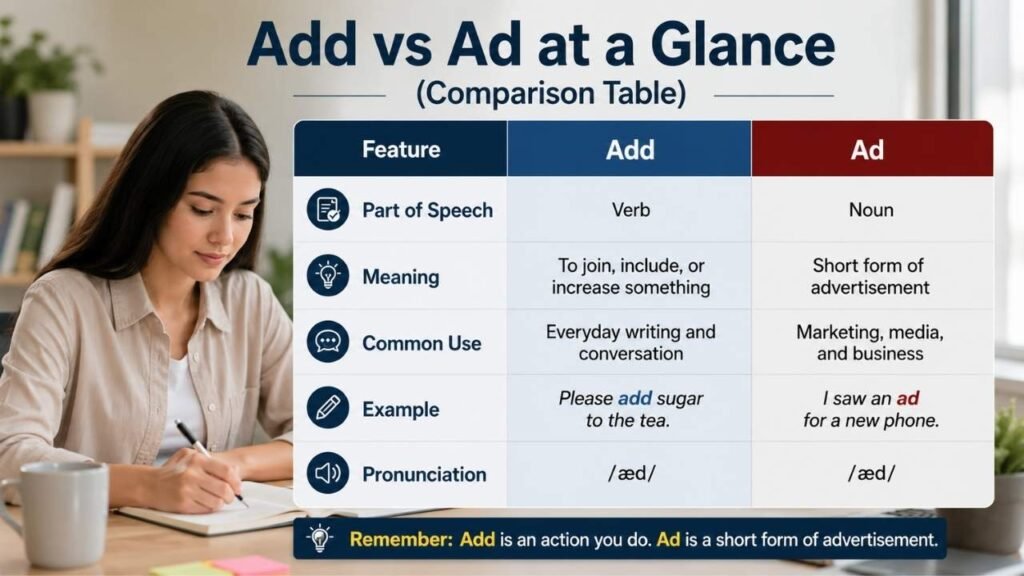
Understanding the difference between add and ad becomes much easier when you compare them side by side. Although these words sound exactly the same, they belong to different parts of speech and have different meanings.
Add is a verb that means to join, increase, or include something. Ad is a noun and the shortened form of advertisement, referring to a promotional message about a product, service, or event.
Many people confuse them because they are homophones, but using the correct word depends on the sentence. The comparison below gives you a quick overview before we explore each word in detail.
| Feature | Add | Ad |
| Part of Speech | Verb | Noun |
| Meaning | To join, include, or increase something | Short form of advertisement |
| Common Use | Everyday writing and conversation | Marketing, media, and business |
| Example | Please add sugar to the tea. | I saw an ad for a new phone. |
| Pronunciation | /æd/ | /æd/ |
What Does “Add” Mean?
The word add is a verb that means to join, include, or increase something. You can use it in many situations, such as adding numbers, adding ingredients to a recipe, or adding information to a document. It is one of the most common verbs in English and appears in both formal and informal writing.
For example, you might add a new contact to your phone or add an extra sentence to an email. Remember that add always describes an action, which makes it different from ad, a noun.
If you enjoy learning about commonly confused words, you may also find our guide on Than vs Then helpful for avoiding another frequent English mistake.
Examples
- Please add your name to the list.
- She forgot to add salt to the soup.
- Can you add these numbers together?
- I’d like to add one more point before we finish.
What Does “Ad” Mean?
An ad is a noun and the shortened form of advertisement. It refers to a message created to promote a product, service, business, or event. You can see ads almost everywhere, including websites, television, newspapers, magazines, social media platforms, and mobile apps.
Companies use advertisements to attract customers and encourage them to buy or learn more about what they offer. Unlike add, which describes an action, ad names a thing. Knowing this simple difference will help you choose the correct spelling every time.
If you enjoy improving your grammar skills, you may also like our article on Motif vs Theme, which explains another pair of commonly confused terms in clear, simple language.
Examples
- I watched an interesting ad during the game.
- That online ad promoted a travel company.
- The magazine featured several colorful ads.
- We created a new ad for our latest product.
Key Differences Between Add and Ad
The difference between add and ad is easy to remember once you know the role each word plays. Add is a verb, so it shows an action, such as joining, increasing, or including something.
Ad, on the other hand, is a noun that means advertisement. Although both words are pronounced the same, they cannot replace each other in a sentence. For example, you can add more details to a report, but you cannot write an ad more details.
Likewise, you may watch an ad on YouTube, but you cannot watch an add. Paying attention to the sentence structure will help you pick the correct word every time.
| Add | Ad |
| A verb | A noun |
| Means to include or increase | Means advertisement |
| Shows an action | Names a thing |
| Used in daily tasks | Used in marketing and media |
Add vs Ad in Sentences
Reading examples is one of the best ways to understand when to use add and when to use ad. Since these words sound alike, seeing them in complete sentences makes their meanings much clearer.
Notice how add always describes an action, while ad refers to an advertisement. Practicing with simple examples can improve your writing and help you avoid common spelling mistakes. The more often you use each word correctly, the easier it becomes to remember the difference.
Examples with Add
- Please add another chair to the room.
- Don’t forget to add your email address.
- We need to add more facts to the report.
Examples with Ad
- I skipped the ad before the video.
- That ad caught my attention immediately.
- The company launched a new online ad today.
Common Mistakes People Make
A common mistake is using add when you actually mean ad, or writing ad instead of add. This usually happens because both words have the same pronunciation. Many people type quickly on social media, in text messages, or while writing emails, which increases the chance of choosing the wrong spelling.
One simple way to avoid this error is to ask yourself whether the sentence needs an action or an advertisement. If it describes doing something, use add. If it refers to a promotional message, use ad.
Taking a few extra seconds to proofread your writing can prevent this small but noticeable grammar mistake and make your communication look more professional.
Why Are Add and Ad So Easy to Confuse?
Many people confuse add and ad because they are homophones, which means they have the same pronunciation but different meanings and spellings. When speaking, there is no difference in how these words sound, so listeners understand them from the context.
However, when writing, choosing the wrong word can change the meaning of a sentence. Another reason for the confusion is that ad is simply a shortened form of advertisement, while add is a common verb used in everyday English.
Fast typing, autocorrect, and spelling habits can also lead to mistakes. Once you remember that add shows an action and ad refers to an advertisement, using the correct word becomes much easier.
Memory Trick to Remember the Difference
A simple memory trick can help you remember the difference between add and ad. Think of the extra letter “d” in add as representing “do.” Since add is something you do, it is a verb that describes an action, such as adding numbers or adding information.
Now think of ad as the short form of advertisement. If you hear someone mention an ad, imagine a commercial on TV, a banner on a website, or a poster promoting a product.
This easy connection helps you choose the right spelling without stopping to think too long. Practicing this trick a few times will make the correct usage feel natural.
Related Words You Shouldn’t Confuse
Besides add and ad, there are several related words that learners sometimes mix up. Added is the past tense and past participle of add, while adds is the third-person singular form used with subjects like he, she, or it.
Addition is a noun that refers to the act of adding or something that has been added. Advertisement is the full form of ad, and advertise is the verb that means to promote a product or service.
Learning these related words helps you build a stronger vocabulary and understand how they work together. Knowing their meanings also reduces spelling mistakes and improves your confidence in everyday writing.
Regional and Style Guide Usage
The words add and ad are used the same way in both American English and British English. There is no spelling difference between the two varieties of English.
However, style guides usually recommend writing advertisement in formal documents when clarity is important, while ad is widely accepted in newspapers, magazines, websites, emails, and everyday conversation.
In marketing, journalism, and digital media, the shorter form ad is much more common because it is quick and easy to read. On the other hand, add always keeps its original meaning as a verb. Understanding the writing style and audience will help you decide whether to use ad or advertisement.
Mini Practice Quiz
Test your understanding of add vs ad with these simple questions. Choose the correct word before checking the answers. This quick exercise will help you remember when to use add and when to use ad in real-life situations.
Questions
- Please _____ your phone number to the form.
- I saw an interesting _____ on YouTube yesterday.
- Can you _____ these two numbers together?
- The company released a new television _____.
- Don’t forget to _____ your name to the list.
Answers
- Add
- Ad
- Add
- Ad
- Add
If you answered all five correctly, you now understand the difference between these commonly confused words.
FAQs
Is “ad” short for “advertisement”?
Yes. Ad is the standard shortened form of advertisement and is widely used in everyday English.
Is “add” a verb?
Yes. Add is a verb that means to join, include, or increase something.
Can I use “add” instead of “ad”?
No. Although they sound the same, add and ad have different meanings and cannot replace each other.
Why do people confuse add and ad?
They are homophones, meaning they have the same pronunciation but different spellings and meanings.
How can I remember the difference?
Remember that add is an action you do, while ad is short for advertisement.
Which word is more common in marketing?
Ad is commonly used in marketing, advertising, social media, and business communication.
Are add and ad pronounced differently?
No. Both words are pronounced the same, so context is important for understanding their meaning.
Conclusion
Understanding add vs ad is simple once you know what each word means. Add is a verb used when you want to join, increase, or include something. Ad is a noun and the shortened form of advertisement, referring to a promotional message.
Even though these words sound identical, they have completely different roles in English. Remember to look at the sentence and ask whether it describes an action or an advertisement.
With regular practice, real-life examples, and the memory trick shared in this guide, you’ll avoid common spelling mistakes and use both words correctly with confidence in school, work, and everyday communication.