
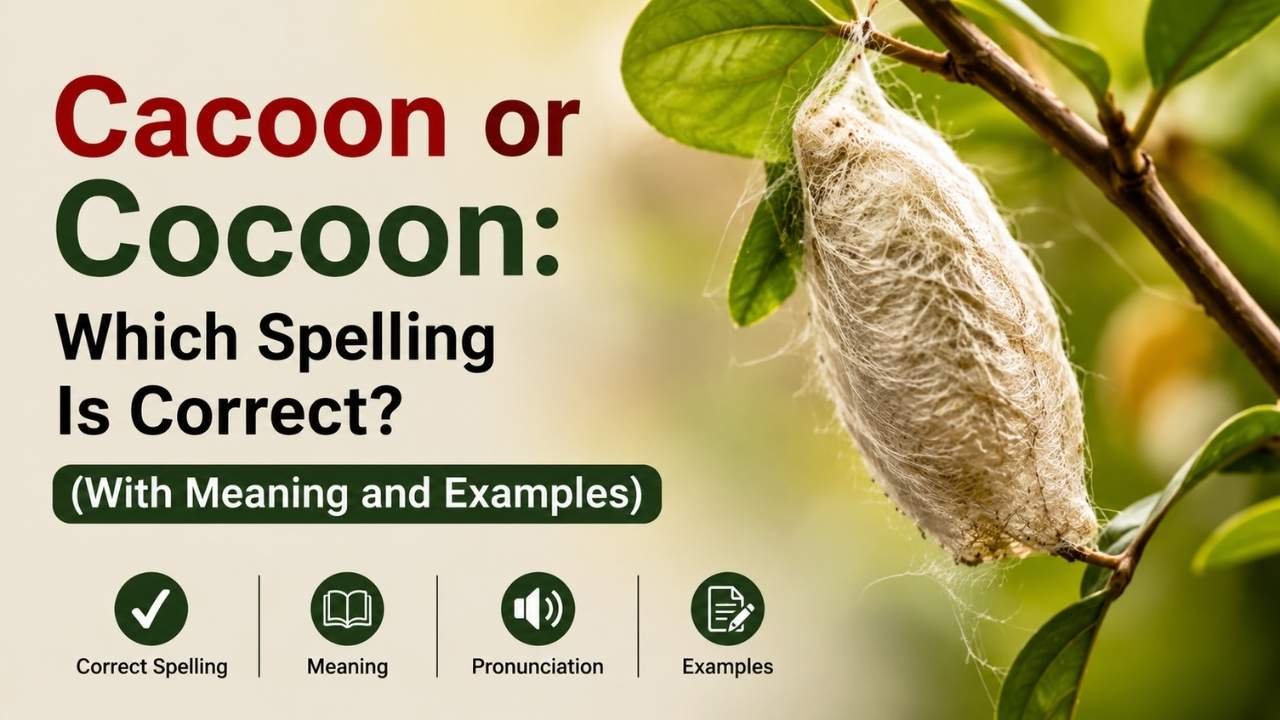
If you’ve ever typed “cacoon” instead of “cocoon,” you’re not alone. Many English learners and even native speakers wonder which spelling is correct. The simple answer is that “cocoon” is the correct spelling, while “cacoon” is a common misspelling.
A cocoon is a protective silk covering made by the larvae of many moths and other insects before they transform into adults. The word is also used figuratively to describe a safe, comfortable, or isolated place.
In this guide, you’ll learn the correct spelling, the meaning of cocoon, its pronunciation, and how to use it correctly in everyday writing. We’ll also explain why people confuse cacoon vs cocoon, provide clear sentence examples, and compare cocoon with similar terms like chrysalis so you can use the word with confidence.
Quick Answer
Cocoon is the correct spelling, while cacoon is a common misspelling and is not recognized as a standard English word. A cocoon is a protective silk case made by the larvae of many moths and other insects during metamorphosis. The word can also describe a safe or isolated state. If you’re wondering how to spell cocoon, the answer is cocoon.
Why “Cacoon” Is a Common Misspelling

Many people accidentally write “cacoon” when they actually mean “cocoon.” This mistake happens because the two words sound similar when spoken quickly, making it easy to confuse the vowels. However, “cacoon” is not a correct English word and does not appear in standard dictionaries.
The correct spelling is always “cocoon.” English has many words that cause similar spelling confusion. For example, people often search for Canceled vs. Cancelled because both spellings are accepted in different varieties of English.
In contrast, cacoon has no accepted use. If you’re wondering how to spell cocoon or comparing cacoon vs. cocoon, remember that cocoon is the only correct spelling to use in both formal and everyday writing.
What Does “Cocoon” Mean?
A cocoon is a protective silk covering made by the larvae of many moths and some other insects before they become adults. During this stage of metamorphosis, the insect stays inside the cocoon while its body changes.
Beyond its biological meaning, cocoon also has a figurative meaning. It can describe a person or place that feels safe, comfortable, or protected from the outside world. For example, someone may cocoon themselves at home during cold weather to relax and avoid distractions.
Learning the meaning of cocoon helps you understand both its scientific and everyday uses. Whether you’re writing about insects or personal comfort, cocoon is the correct word to choose.
Origin and Etymology of the Word “Cocoon”
The word “cocoon” has an interesting history. It comes from the French word cocon, which referred to the silky case made by insects. Over time, the word entered the English language and kept almost the same meaning.
Today, cocoon is used around the world in both scientific and everyday English. As the language evolved, people also began using it in a figurative sense to describe safety, warmth, or privacy. Although some people mistakenly write “cacoon,” the spelling has never been accepted as standard English.
Understanding the origin of cocoon can make the correct spelling easier to remember. Like other commonly confused words, knowing a word’s history often helps you avoid mistakes and write with greater confidence.
How to Pronounce “Cocoon”
The correct pronunciation of “cocoon” is /kəˈkuːn/, which sounds like “kuh-KOON.” The stress falls on the second syllable, making it easy to remember once you hear it a few times.
Many people spell the word as “cacoon” because they rely on how it sounds instead of checking the correct spelling. A good way to remember it is to connect the pronunciation with the spelling: co + coon.
Reading the word aloud and using it in sentences can also improve your confidence. Just as people often look up Pick Up vs. Pickup vs. Pick-Up to learn the correct form for different situations, checking the pronunciation and spelling of cocoon helps you avoid common writing mistakes.
“Cocoon” as a Noun
As a noun, a cocoon refers to the silky covering that protects the larvae of many moths and other insects while they develop into adults. It acts as a safe shelter during metamorphosis, allowing the insect to grow before emerging in its new form. Here are a few examples:
- The caterpillar spun a cocoon before becoming a moth.
- Scientists studied the cocoon to understand the insect’s life cycle.
- The child found an empty cocoon on a tree branch.
The word cocoon can also be used as a noun in a figurative way. For example, someone might describe their quiet home as a cocoon of comfort, meaning it feels peaceful, safe, and protected from the outside world.
“Cocoon” as a Verb
The word “cocoon” can also be used as a verb. When used this way, it means to wrap, protect, or isolate someone or something from the outside world. It often describes creating a safe, warm, or comfortable environment. This meaning is common in everyday conversations, books, and news articles. For example, parents may cocoon a newborn baby with soft blankets, or someone may cocoon themselves at home to relax after a busy week. Here are a few examples:
- She cocooned herself in a warm blanket during the storm.
- The family cocooned the baby to keep him comfortable.
- He cocooned himself indoors to enjoy a peaceful weekend.
Using cocoon as a verb adds a vivid image of protection and comfort.
Examples of “Cocoon” in Sentences
Reading examples is one of the best ways to understand the correct use of cocoon. Below are sentences showing both its literal and figurative meanings.
- The moth remained inside its cocoon until it was ready to emerge.
- The children found a small cocoon hanging from a branch.
- She wrapped herself in a blanket and felt cocooned from the cold.
- The quiet cabin became a cocoon where the family could relax.
- The thick sleeping bag cocooned the campers on a chilly night.
- Scientists observed the cocoon during the insect’s transformation.
These examples show that cocoon can describe both a real protective silk case and a feeling of warmth, safety, or privacy. Remember, “cacoon” should never be used because it is an incorrect spelling.
Common Mistakes When Using “Cocoon”
One of the most common mistakes is writing “cacoon” instead of “cocoon.” Since the words sound similar, many people rely on pronunciation and accidentally choose the wrong spelling. Another mistake is confusing a cocoon with a chrysalis, even though they are different stages in the life cycle of certain insects.
Some writers also use cocoon in the wrong context or forget that it can be both a noun and a verb. To avoid these errors, double-check your spelling, understand the word’s meaning, and read it in different examples. A simple memory trick is to remember that cocoon contains two “o” letters, just like the soft, rounded shape of the protective covering itself.
Cocoon vs. Chrysalis: What’s the Difference?
Although many people use these words as if they mean the same thing, cocoon and chrysalis are different. A cocoon is a silk covering spun by the larvae of many moths and some other insects before they become adults. A chrysalis, however, is the hard outer stage of a butterfly during its transformation.
Butterflies do not spin cocoons. Instead, they form a chrysalis directly from their skin. Knowing this difference helps you use the correct word in both everyday and scientific writing. If you are describing a moth’s protective case, use cocoon. If you are talking about a butterfly’s transformation stage, the correct term is chrysalis.
Figurative Meaning of “Cocoon” in Everyday English
Besides its scientific meaning, cocoon is often used figuratively to describe a feeling of comfort, safety, or privacy. People use the word when talking about creating a peaceful space away from stress or noise. For example, someone might say they cocooned themselves at home with a good book and a warm blanket after a long day.
A cozy room, a quiet cabin, or even a supportive family can be described as a cocoon because they provide protection and comfort. This figurative use is common in books, magazines, and everyday conversations. Understanding both the literal and figurative meanings will help you use cocoon naturally and confidently in different situations.
Words Commonly Confused with “Cocoon”
Because English contains many similar-sounding words, cocoon is sometimes confused with other terms. The most common mistake is “cacoon,” which is simply a misspelling and not a valid English word. People may also confuse cocoon with chrysalis or pupa, even though each has a different meaning in an insect’s life cycle.
Another source of confusion is using cocoon only as a noun, forgetting that it can also function as a verb. Learning the correct spelling, pronunciation, and meaning helps prevent these mistakes. Whenever you are unsure, check a trusted dictionary and remember that cocoon is the only correct spelling accepted in standard English.
FAQs
Is “cacoon” a real word?
No. “Cacoon” is not a standard English word. It is a common misspelling of “cocoon.”
How do you spell cocoon correctly?
The correct spelling is cocoon with two “o” letters in the middle.
Can “cocoon” be used as a verb?
Yes. As a verb, cocoon means to wrap, protect, or isolate someone or something in a safe or comfortable way.
What animals make cocoons?
Many moths and some other insects produce cocoons as part of their life cycle. Butterflies form a chrysalis instead of a cocoon.
Conclusion
The answer is simple: “cocoon” is the correct spelling, while “cacoon” is an incorrect spelling that should be avoided. A cocoon is a protective silk covering made by many moth larvae during metamorphosis, and the word can also describe a feeling of comfort, safety, or isolation.
It functions as both a noun and a verb, making it useful in scientific writing and everyday English. Understanding its meaning, pronunciation, and correct usage will help you avoid common mistakes and write with confidence.
Whenever you are unsure whether to use cacoon or cocoon, remember that cocoon is the only correct choice recognized in standard English.