
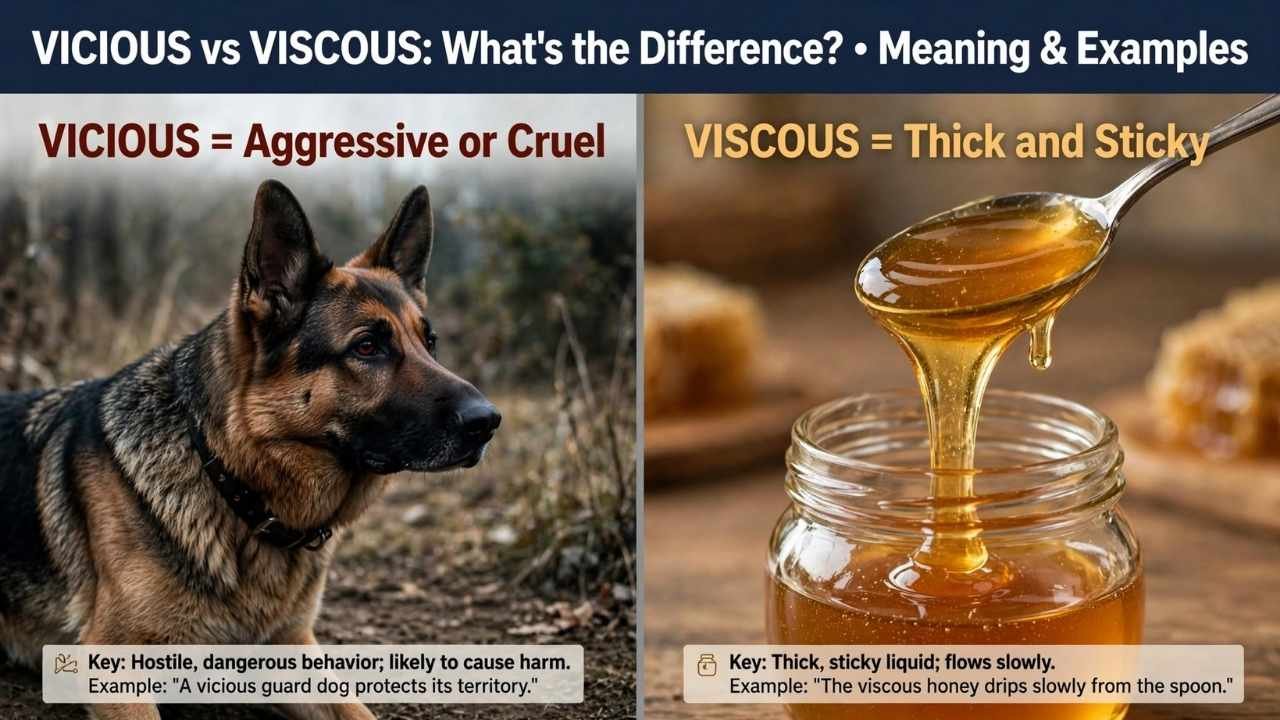
Have you ever paused while writing because you weren’t sure whether to use vicious vs viscous? You’re not alone. These two words look similar and even sound somewhat alike, which is why many English learners and native speakers mix them up.
However, they have completely different meanings and are never interchangeable. Vicious describes someone or something that is cruel, violent, or intentionally harmful, while viscous refers to a thick, sticky liquid that flows slowly, such as honey or motor oil.
Understanding the difference between vicious and viscous will help you avoid common writing mistakes and choose the correct word with confidence. In this guide, you’ll learn the meaning of vicious and viscous, their pronunciation, simple grammar tips, practical example sentences, and an easy memory trick to remember which word fits the right situation every time.
Quick Answer
Quick Answer: Vicious means cruel, violent, or deliberately harmful, while viscous means thick, sticky, and slow-flowing, usually describing liquids like honey, syrup, or motor oil. Although the words look and sound similar, they have completely different meanings and should never be used interchangeably. Remember: vicious relates to harmful behavior, whereas viscous describes a liquid’s consistency.
Vicious vs. Viscous at a Glance
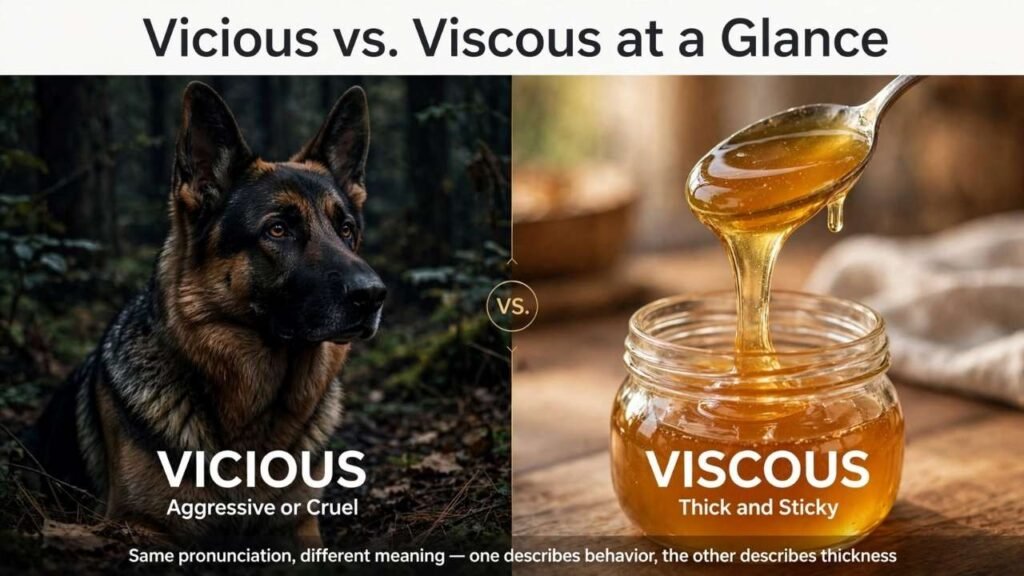
At first glance, vicious and viscous look almost the same, which is why many people confuse them. However, these two words have completely different meanings and are used in different situations.
Vicious describes someone or something that is cruel, violent, or intentionally harmful. You can use it to describe a vicious dog, a vicious attack, or even a vicious rumor that hurts someone’s reputation. In contrast, viscous describes a thick, sticky liquid that flows slowly, such as honey, syrup, glue, or motor oil.
Even though the words have similar spellings and somewhat similar pronunciations, they are never interchangeable. Understanding the difference between vicious and viscous will help you choose the correct word with confidence. If you enjoy learning about confusing word pairs, you may also find our guide on Long Term or Long-Term helpful.
What Is the Difference Between Vicious and Viscous?
The difference between vicious and viscous is simple once you understand what each word describes. Vicious is used to talk about people, animals, actions, or behavior that are cruel, aggressive, or meant to cause harm.
For example, a person can make a vicious comment, or a dog can become vicious if it feels threatened. Viscous, on the other hand, is used only for liquids. It describes a liquid that is thick, sticky, and slow to flow, such as honey, glue, or engine oil.
Although these words are often mixed up because of their similar spelling, they are not interchangeable. Learning their meanings and using them in the right context will improve your vocabulary and help you avoid common writing mistakes.
What Does “Vicious” Mean?
The word vicious is an adjective that describes someone or something that is cruel, violent, or deliberately harmful. It is commonly used when talking about dangerous behavior, harsh actions, or words intended to hurt others.
For example, a vicious attack is a violent attack, while a vicious rumor is a false story spread to damage someone’s reputation. Another common expression is vicious cycle, which refers to a problem that keeps repeating itself and becomes difficult to escape. You can also describe an aggressive animal as vicious if it is likely to attack people or other animals.
Learning the meaning of vicious will help you use this word correctly in both speaking and writing. If you’d like to improve your grammar further, be sure to read our article on the Past Tense of Panic.
What Does “Viscous” Mean?
Viscous is an adjective used to describe a thick, sticky liquid that does not flow easily. A liquid with high viscosity moves more slowly than a thin liquid like water. Everyday examples of viscous liquids include honey, syrup, glue, shampoo, paint, and motor oil.
This word is commonly used in science, engineering, cooking, and everyday conversations when describing the texture or flow of a liquid. For example, cold honey becomes more viscous because it pours more slowly than warm honey. Similarly, fresh paint and engine oil are often described as viscous because of their thick consistency.
Unlike vicious, which describes harmful behavior, viscous is always used to describe the texture or flow of a liquid, making the difference between the two words easy to remember.
Vicious vs. Viscous: Side-by-Side Comparison
Although vicious and viscous look alike, they have very different meanings and uses. The easiest way to tell them apart is to remember that vicious describes harmful behavior, while viscous describes the thickness of a liquid.
A vicious person, animal, or action is cruel, violent, or intended to cause harm. In contrast, a viscous substance is thick, sticky, and flows slowly. For example, you can say, “The dog became vicious after being provoked,” but you would say, “The honey is too viscous to pour quickly.”
Using the wrong word can change the meaning of your sentence completely, so it is important to understand the difference before using either term in your writing.
| Feature | Vicious | Viscous |
| Meaning | Cruel, violent, or harmful | Thick, sticky, and slow-flowing |
| Used For | People, animals, actions, behavior | Liquids and fluids |
| Example | A vicious attack | Viscous motor oil |
| Part of Speech | Adjective | Adjective |
Pronunciation Differences
Another reason people confuse vicious and viscous is that they sound somewhat similar. However, there is a small difference in pronunciation. Vicious is pronounced /ˈvɪʃ.əs/ (VISH-us), while viscous is pronounced /ˈvɪs.kəs/ (VIS-kus).
Notice that vicious has a “sh” sound in the middle, whereas viscous has a clear “sk” sound. Paying attention to this difference can help you choose the correct word when speaking or writing. Reading the words aloud a few times is an easy way to remember them.
Once you become familiar with their pronunciation, you are much less likely to confuse these commonly mixed-up English words.
Common Mistakes People Make
One of the most common mistakes is using vicious when talking about a thick liquid or using viscous to describe harmful behavior. Because the words are spelled similarly, many writers accidentally choose the wrong one.
For example, writing “The syrup was vicious” is incorrect because syrup cannot be cruel or violent. The correct sentence is “The syrup was viscous.” Likewise, saying “The dog was viscous” is incorrect because a dog’s behavior is not described by the thickness of a liquid. The correct sentence is “The dog was vicious.”
Taking a moment to think about whether you are describing behavior or a liquid will help you avoid this common grammar mistake.
Memory Tricks to Remember the Difference
A simple memory trick can make it much easier to remember the difference between vicious and viscous. Think of the letter “S” in viscous as standing for “sticky.” Since viscous describes thick and sticky liquids, this connection is easy to remember.
For vicious, think of the word “violence.” Both words begin with the letter “V”, reminding you that a vicious person, animal, or action involves harm or aggression. You can also picture honey slowly pouring from a jar whenever you hear viscous, and imagine an angry barking dog whenever you hear vicious. These simple word associations will help you remember the correct meaning and use the right word every time.
Synonyms and Antonyms
Learning synonyms and antonyms is another helpful way to understand these words. Vicious has several synonyms, including cruel, violent, savage, brutal, malicious, and hostile. Its common antonyms include kind, gentle, peaceful, friendly, and compassionate.
On the other hand, viscous has synonyms such as thick, sticky, gummy, syrupy, and glue-like. Depending on the context, antonyms for viscous include thin, watery, runny, and fluid.
Looking at these related words makes it easier to understand how each adjective is used in everyday English. It also helps expand your vocabulary and improves your writing by giving you more word choices when expressing your ideas.
FAQs
What is the difference between vicious and viscous?
The main difference between vicious and viscous is their meaning. Vicious describes someone or something that is cruel, violent, or harmful, while viscous describes a thick, sticky liquid that flows slowly. Although the words look similar, they are never interchangeable.
What does “vicious” mean?
Vicious means cruel, aggressive, or deliberately harmful. It is commonly used to describe people, animals, actions, or behavior. For example, you can say a vicious attack, a vicious dog, or a vicious rumor.
What does “viscous” mean?
Viscous means thick, sticky, and slow-flowing. It is used to describe liquids such as honey, syrup, glue, paint, or motor oil. A viscous liquid does not flow as easily as water.
Are vicious and viscous pronounced the same?
No. They sound similar but are pronounced differently. Vicious is pronounced “VISH-us” (/ˈvɪʃ.əs/), while viscous is pronounced “VIS-kus” (/ˈvɪs.kəs/). Paying attention to the middle sound makes them easier to tell apart.
Can vicious and viscous be used interchangeably?
No. These words have completely different meanings. Vicious refers to harmful behavior, while viscous refers to the thickness of a liquid. Using one in place of the other will make your sentence incorrect.
Why do people confuse vicious and viscous?
People often confuse vicious and viscous because they have similar spellings and somewhat similar pronunciations. However, their meanings are entirely different, so understanding the context is the best way to choose the correct word.
How can I remember the difference between vicious and viscous?
A simple memory trick is to associate viscous with sticky substances like syrup or honey. For vicious, think of violence or harmful behavior. This easy association helps you remember the correct meaning of each word.
What are some examples of vicious and viscous in sentences?
Here are a few examples:
- The wolf became vicious when it felt threatened.
- Spreading vicious rumors can hurt people’s feelings.
- The honey was so viscous that it poured very slowly.
- Cold engine oil is more viscous than warm oil.
Is honey viscous or vicious?
Honey is viscous, not vicious. It is a thick, sticky liquid that flows slowly, making viscous the correct word to describe its texture.
Is a vicious dog the same as a viscous dog?
No. A vicious dog is aggressive or dangerous, while viscous can only describe the thickness of a liquid. Therefore, “viscous dog” is grammatically incorrect.
Conclusion
Understanding the difference between vicious and viscous is easier once you know what each word describes. Vicious refers to someone or something that is cruel, violent, or harmful, while viscous describes a thick, sticky liquid that flows slowly.
Although these words have similar spellings and somewhat similar pronunciations, they have completely different meanings and should never be used interchangeably. Remember that vicious is about harmful behavior, whereas viscous is about the consistency of liquids like honey, syrup, or motor oil.
By learning their meanings, pronunciation, and usage with examples, you can avoid common mistakes and use both words with confidence. Whenever you’re unsure, think “violence” for vicious and “sticky” for viscous to quickly choose the correct word.