
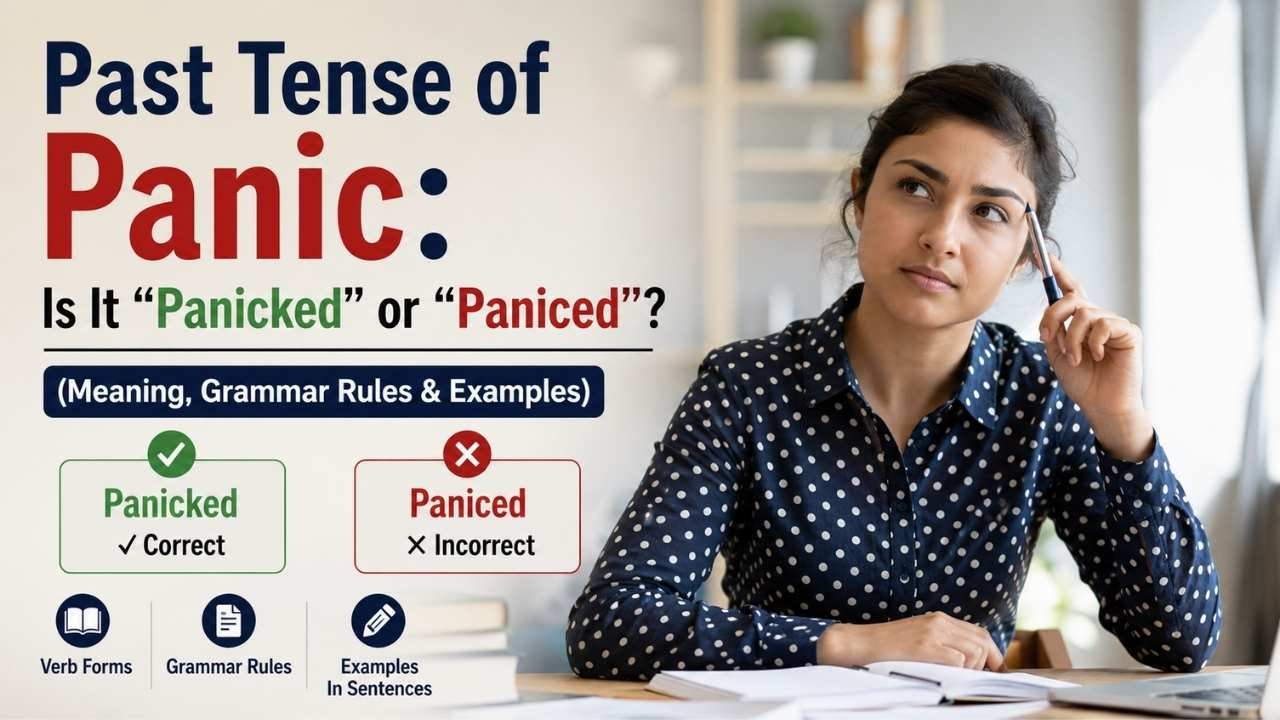
If you’ve ever wondered what is the past tense of panic, you’re not alone. Many English learners and even native speakers get confused between panicked and paniced. The correct past tense of panic is panicked, and the past participle of panic is also panicked.
Although panic is a regular verb, it follows a special spelling rule that adds a “k” before -ed and -ing, giving us panicked and panicking. In this guide, you’ll learn the verb forms of panic, understand why panicked is the correct spelling, and see plenty of real-life examples.
We’ll also explain the grammar rule, cover common mistakes, and answer frequently asked questions. By the end, you’ll know exactly how to use panic correctly in both speaking and writing with confidence.
Quick Answer
The past tense of panic is panicked, and the past participle of panic is also panicked. Although panic is a regular verb, it follows a spelling rule that adds a “k” before -ed and -ing because the verb ends in -c. Therefore, panicked is correct, while paniced is incorrect. The present participle is panicking.
What Is the Past Tense of “Panic”?

The past tense of panic is panicked. It is also the past participle of panic, so the same form is used in perfect tenses. Although panic is a regular verb, its spelling changes slightly when adding -ed. Because the word ends with the letter c, English spelling rules require adding a k before -ed, making the correct form panicked.
The spelling paniced is incorrect and should not be used. If you are asking, “What is the past tense of panic?”, the answer is always panicked.
Learning the correct panic verb forms helps you write and speak more accurately. If you enjoy learning grammar rules, you may also like our guide on the Past Tense of Tear, which explains another commonly confused verb.
Is “Panicked” or “Paniced” Correct?
Many learners wonder whether panicked or paniced is the correct spelling. The answer is simple: panicked is correct, while paniced is not a real English word. This confusion happens because most regular verbs simply add -ed to form the past tense. However, panic follows a special spelling rule because it ends with the letter c.
Before adding -ed, you must add a k, resulting in panicked. The same rule applies when forming panicking.
Using the correct spelling makes your writing look more professional and grammatically accurate. If you want to keep your grammar knowledge Up to Date or Up-to-Date, understanding spelling patterns like this is a great place to start.
Why Does “Panic” Add a “K” Before “-ed”?
The word panic ends with the letter c, and English spelling rules say that verbs ending in c usually add a k before suffixes such as -ed and -ing. That is why we write panicked instead of paniced, and panicking instead of panicing.
This extra k helps keep the hard /k/ sound in the word. Without it, the pronunciation would change. The same spelling rule appears in other English verbs, making it easier to remember once you understand the pattern. Instead of memorizing one word at a time, learning this grammar rule helps you spell many similar words correctly and avoid common writing mistakes.
Verb Forms of “Panic”
Knowing the verb forms of panic makes it easier to use the word correctly in different tenses. Here are the main forms:
| Verb Form | Word |
| Base Form | panic |
| Third-Person Singular | panics |
| Present Participle | panicking |
| Simple Past | panicked |
| Past Participle | panicked |
These panic verb forms follow regular English grammar, with only a small spelling change before adding -ed or -ing. Whether you are writing about something that happened yesterday or describing an ongoing situation, using the correct verb form makes your sentences clear and accurate. Keeping these forms in mind will also help you avoid common spelling mistakes.
Is “Panic” a Regular or Irregular Verb?
Many people ask whether panic is a regular or irregular verb. The answer is that panic is a regular verb. Regular verbs form their past tense and past participle by adding -ed. In the case of panic, an extra k is added first because of the spelling rule for words ending in c. So, the correct forms are panicked and panicking.
Even though the spelling changes slightly, the verb still follows the regular pattern. This is why panic is not considered an irregular verb. Once you understand this rule, you will find it much easier to spell and use panic correctly in everyday writing and conversation.
How to Use “Panicked” in Sentences
Using panicked correctly becomes easy once you know that it is the past tense of panic. It describes someone who felt sudden fear or lost control because of a stressful situation. Here are a few examples:
- She panicked when she couldn’t find her passport.
- The driver panicked after seeing the warning light.
- We panicked during the unexpected power outage.
- He panicked before giving his presentation, but everything went well.
- The children panicked when they heard the loud noise outside.
These examples show how panicked is used to describe actions that already happened. Reading and practicing sentences like these will help you remember the correct form and use it naturally in your own writing.
How to Use “Panicking” Correctly
Panicking is the present participle of panic. It is used in continuous tenses to describe an action that is happening right now or was happening at a certain time in the past. Like panicked, it follows the spelling rule that adds a “k” before -ing because the base verb ends in c.
For example, you can say, “She is panicking before the interview,” or “They were panicking when the fire alarm went off.” You can also use panicking as a gerund, such as in the sentence, “Panicking rarely helps solve a problem.” Learning when to use panicking correctly will improve both your grammar and your confidence in everyday English.
Common Mistakes When Using “Panic”
One of the most common grammar mistakes is writing paniced instead of panicked. Remember, the correct past tense of panic is always panicked. Another mistake is writing panicing instead of panicking.
Since panic ends with the letter c, you must add a “k” before -ed and -ing. Some learners also think panic is an irregular verb because of the spelling change, but it is actually a regular verb. Another error is using the wrong verb form in a sentence, such as saying, “She has panic yesterday.”
The correct sentence is “She panicked yesterday” or “She has panicked before.” Avoiding these mistakes will make your writing more accurate and natural.
Similar Verbs That Follow the Same Spelling Rule
The spelling rule used in panic also applies to several other English verbs that end with the letter c. Before adding -ed or -ing, these verbs also need an extra “k.” Here are some common examples:
- Picnic → Picnicked → Picnicking
- Mimic → Mimicked → Mimicking
- Traffic → Trafficked → Trafficking
- Frolic → Frolicked → Frolicking
All of these words follow the same pattern as panic → panicked → panicking. Once you understand this simple spelling rule, you can apply it to many other verbs without guessing. Learning words in groups instead of one at a time is an easy way to improve your English spelling and remember grammar rules for longer.
Pronunciation of “Panic,” “Panicked,” and “Panicking”
Correct pronunciation is just as important as correct spelling. Panic is commonly pronounced as PAN-ik (/ˈpænɪk/). When you add -ed, panicked is pronounced PAN-ikt (/ˈpænɪkt/). The word panicking is pronounced PAN-ik-ing (/ˈpænɪkɪŋ/).
Notice that the extra “k” in the spelling does not change the original sound. Instead, it helps keep the hard /k/ sound before the endings -ed and -ing.
Reading these words aloud several times can help you become more comfortable using them in conversations. Listening to native speakers and repeating after them is another excellent way to improve your pronunciation naturally.
Quick Tips to Remember the Correct Spelling
A simple trick to remember the correct spelling is to think of this rule: If a verb ends in “c,” add “k” before “-ed” or “-ing.” This means panic becomes panicked and panicking, never paniced or panicing. You can also remember other similar words like picnic, mimic, and frolic, which follow the same pattern.
Another helpful tip is to read your writing carefully before submitting it. If you see paniced, you will know it needs a “k.” The more you practice writing these words, the easier they become to remember. Small grammar rules like this can make a big difference in clear and correct English writing.
FAQs
What is the past tense of panic?
The past tense of panic is panicked.
What is the past participle of panic?
The past participle of panic is also panicked.
Is “paniced” a real word?
No. Paniced is an incorrect spelling. The correct form is panicked.
Why is there a “k” in “panicked”?
English spelling rules require verbs ending in c to add a “k” before -ed and -ing.
Is panic a regular or irregular verb?
Panic is a regular verb because it forms its past tense by adding -ed, following a spelling rule.
What is the present participle of panic?
The present participle is panicking.
Conclusion
The past tense of panic is panicked, and the past participle of panic is also panicked. Although panic is a regular verb, it follows a special spelling rule that adds a “k” before -ed and -ing. That is why panicked and panicking are correct, while paniced and panicing are incorrect.
Learning the verb forms of panic, understanding the spelling rule, and practicing with real-life examples will help you avoid common mistakes.
Whenever you are unsure, remember this simple rule: verbs ending in “c” usually add “k” before adding “-ed” or “-ing.” With regular practice, using panic correctly in speaking and writing will soon become second nature.