
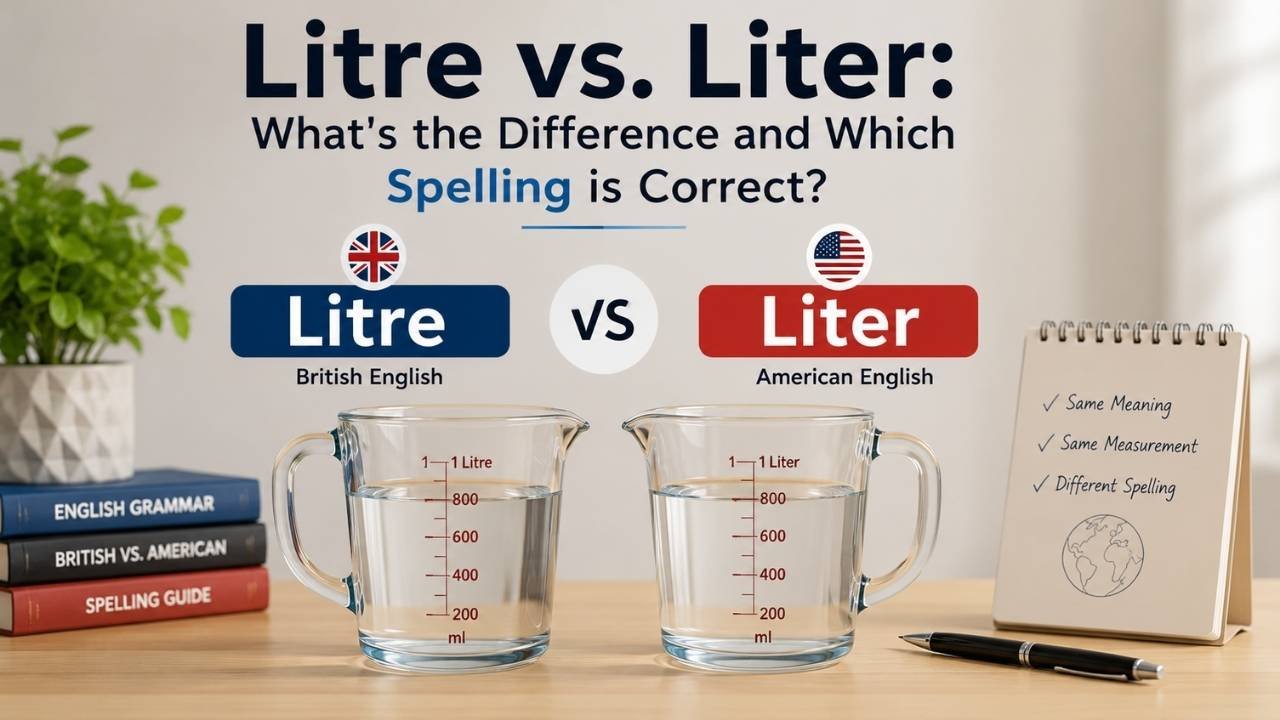
Have you ever wondered whether litre vs liter is the correct spelling? If so, you’re not alone. Many students, writers, and English learners search for the difference between litre and liter because both forms appear in books, websites, and product labels.
The good news is that both spellings are correct. The only real difference is the variety of English being used. Litre is the preferred spelling in British English and many Commonwealth countries, while liter is standard in American English.
They both refer to the same metric unit and unit of volume used to measure liquids and other substances. In this guide, you’ll learn what a litre (or liter) means, where each spelling is used, practical examples, common mistakes, and tips to help you choose the right spelling with confidence.
Quick Answer
Litre and liter are two correct spellings of the same metric unit of volume. The only difference is regional usage. Litre is the standard spelling in British English and most Commonwealth countries, while liter is used in American English. Both represent the same measurement, have the same pronunciation, and can be used correctly when you follow the spelling style of your intended audience.
Litre vs. Liter at a Glance
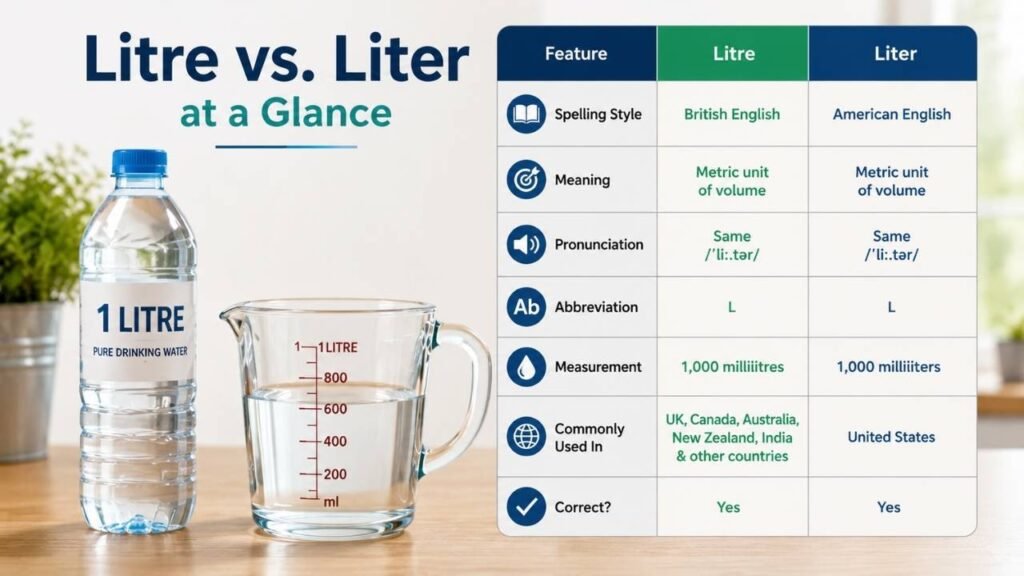
Although litre and liter look different, they have exactly the same meaning. Both refer to a metric unit of volume used to measure liquids and other substances. The only difference is the spelling. Litre is the preferred form in British English, while liter is the standard spelling in American English.
Both words are pronounced the same way and use the abbreviation L. Whether you are reading a science book, buying a bottle of water, or writing an article, the measurement stays the same. The table below makes the difference between litre and liter easy to understand.
| Feature | Litre | Liter |
| Meaning | Metric unit of volume | Metric unit of volume |
| Spelling Style | British English | American English |
| Pronunciation | Same | Same |
| Abbreviation | L | L |
| Measurement | 1,000 millilitres | 1,000 milliliters |
| Correct? | Yes | Yes |
What Is the Difference Between Litre and Liter?
The difference between litre and liter is only the spelling, not the meaning. Both words describe the same unit of volume in the metric system. A litre and a liter are equal to 1,000 millilitres (milliliters) or one cubic decimetre.
The spelling you choose depends on your audience. If you are writing for readers in the United Kingdom, Australia, or many other Commonwealth countries, litre is the correct choice. If your audience is in the United States, liter is the standard spelling.
This is similar to other British and American spelling differences. If you enjoy grammar topics, you may also like our guide on High Quality or High-Quality, which explains another common writing question.
Why Are There Two Spellings?
Many English words have different spellings because British English and American English developed their own writing styles over time. The same is true for litre and liter.
The spelling litre follows British conventions and is widely used in countries such as the United Kingdom, Australia, New Zealand, and India. Liter became the preferred spelling in the United States through American spelling reforms. Even though the spellings differ, they both describe the same metric unit. Neither spelling is more correct than the other.
The best choice is to stay consistent throughout your writing. If you are interested in similar grammar topics, you can also read our article on Full Time or Full-Time to improve your writing accuracy.
Which Countries Use “Litre” and Which Use “Liter”?
Knowing which countries use litre and which use liter can help you write for the right audience. Litre is the standard spelling in the United Kingdom, Canada, Australia, New Zealand, India, and most other Commonwealth countries.
On the other hand, liter is the accepted spelling in the United States. Despite this regional difference, both spellings represent the same measurement and are understood around the world.
International companies often choose the spelling that matches the market they serve. If your readers are global, it is best to select one spelling and use it consistently. This simple approach makes your content clear, professional, and easy to follow.
| Spelling | Commonly Used In |
| Litre | United Kingdom, Canada, Australia, New Zealand, India, South Africa |
| Liter | United States |
hat Does a Litre (or Liter) Measure?
A litre or liter measures volume, which is the amount of space a liquid or another substance occupies. It is one of the most common units in the metric system and is used every day around the world.
For example, you might buy a 1-litre bottle of juice, a 2-liter bottle of soft drink, or see fuel sold by the litre in many countries. One litre is equal to 1,000 millilitres, making it easy to convert between units.
Scientists, teachers, businesses, and shoppers all rely on this measurement because it is simple and accurate. Whether you write litre or liter, the quantity never changes—only the regional spelling does.
Examples of Litre and Liter in Sentences
Seeing litre and liter in real sentences makes it easier to understand when each spelling should be used. In British English, you might write, “She bought a 2-litre bottle of milk from the supermarket.” In American English, the same sentence becomes, “She bought a 2-liter bottle of milk from the grocery store.”
Both sentences describe the same unit of volume, but the spelling matches the audience. You may also read, “The car uses 6 litres of fuel per 100 kilometres” in the UK, while an American writer may say, “The container holds 5 liters of water.” These examples show that litre vs. liter is simply a regional spelling difference.
Common Mistakes to Avoid
One of the most common mistakes is thinking that litre and liter have different meanings. In fact, they are exactly the same metric unit of volume. Another mistake is mixing both spellings in the same article, report, or assignment.
For example, writing litre in one paragraph and liter in the next can confuse readers and make your writing look inconsistent. Some people also believe that one spelling is more correct than the other, but that is not true.
The right choice depends on whether you are using British English or American English. Before publishing your work, check your spelling carefully and keep it consistent from beginning to end.
When Should You Use Litre or Liter?
The spelling you choose should always match your audience and the style guide you are following. Use litre if you are writing for readers in the United Kingdom, Canada, Australia, New Zealand, or other countries that follow British English.
Choose liter if your readers are in the United States, where American English is the standard. Businesses, schools, and publishers usually follow one spelling style throughout their documents to keep everything consistent.
If your audience is international, either spelling is acceptable, but it is important not to switch between them. Consistent writing helps readers trust your content and makes your message easier to understand.
Related British vs American Spelling Differences
The difference between litre and liter is just one example of how British English and American English use different spellings. You may also come across colour and color, centre and center, metre and meter, or travelling and traveling.
These words have the same meanings, but their spellings change depending on the region. Learning these differences can improve your writing and help you communicate with readers from different countries.
Whether you are writing a blog post, school assignment, or business document, choosing the spelling that matches your audience creates a more professional impression and avoids unnecessary confusion.
FAQs
Is litre or liter correct?
Both are correct. Litre is used in British English, while liter is the standard spelling in American English.
What is the difference between litre and liter?
There is no difference in meaning. The only difference is the regional spelling.
Is a litre the same as a liter?
Yes. A litre and a liter are exactly the same unit of volume and both equal 1,000 millilitres.
Which countries use litre?
Countries such as the United Kingdom, Canada, Australia, New Zealand, and India commonly use litre.
Which countries use liter?
The United States uses liter as its standard spelling.
How many millilitres are in one litre?
One litre or liter equals 1,000 millilitres (milliliters).
Can I use litre and liter in the same document?
It is better to choose one spelling style and use it consistently throughout your writing.
Conclusion
The debate over litre vs liter is simple once you understand the reason behind the two spellings. Both words refer to the same metric unit of volume, have the same pronunciation, and represent the same measurement.
The only difference is regional preference. Litre is the standard spelling in British English and many Commonwealth countries, while liter is used in American English. When writing, always consider your audience and stay consistent with the spelling you choose.
By following this simple rule, your content will look more professional and easier to read. Whether you write litre or liter, you will be using a correct and widely accepted term.