
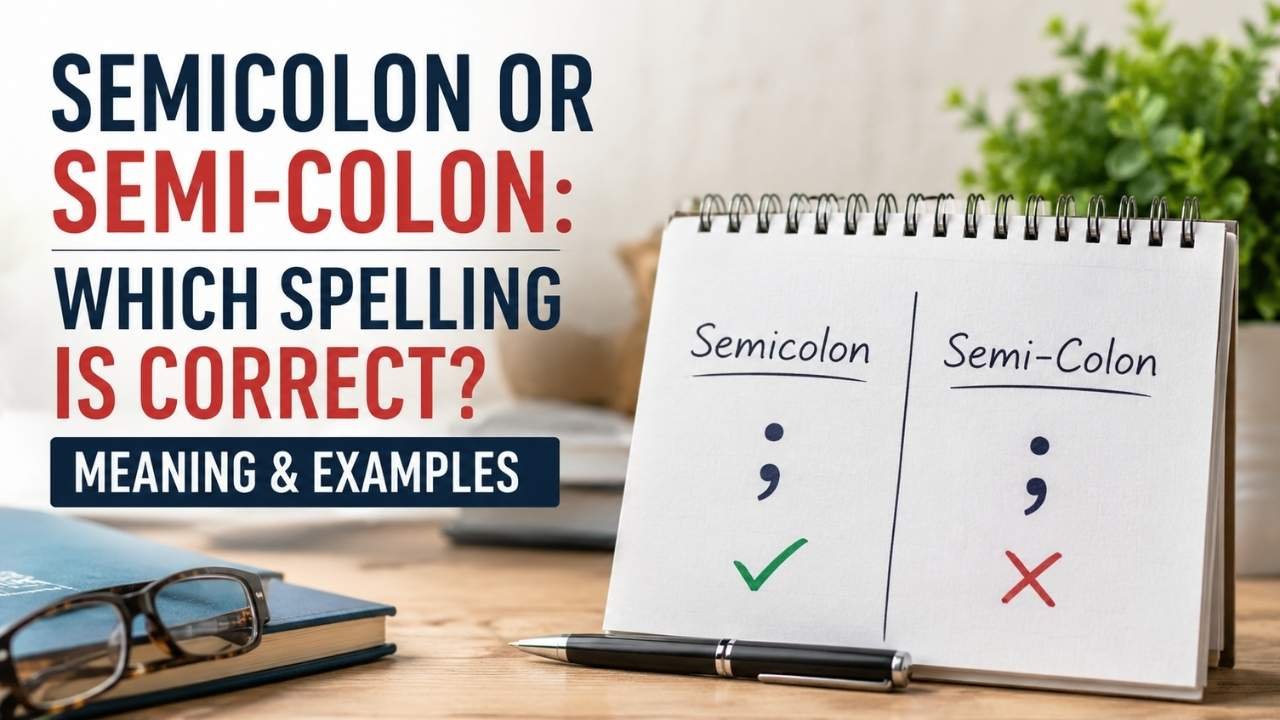
Have you ever wondered whether the correct spelling is semicolon or semi-colon? You’re not alone. Many writers, students, and professionals search for the correct spelling of semicolon because both forms appear online and in older texts.
The simple answer is that semicolon is the standard modern spelling, while semi-colon is an uncommon and largely outdated variant. Knowing the difference can help you write with greater confidence and avoid common grammar mistakes.
In this guide, you’ll learn why “semicolon” is written as one word, whether semi-colon is ever acceptable, and how to use a semicolon correctly in your writing. We’ll also cover clear semicolon grammar rules, practical semicolon punctuation examples, and comparisons with other punctuation marks so you can use this essential punctuation mark with confidence.
Quick Answer
Semicolon is the correct modern spelling and is accepted by major dictionaries and style guides. While semi-colon may appear in older publications, it is now considered an uncommon variant. If you’re wondering is it semicolon or semi-colon, choose semicolon in both British and American English. It is the preferred spelling for academic, professional, and everyday writing.
What Is a Semicolon?

A semicolon is a punctuation mark (;) that connects two independent clauses that are closely related. It shows a stronger pause than a comma but a weaker break than a period. Learning the semicolon meaning is important because it helps you write smoother and clearer sentences.
Many people search for what is a semicolon or semicolon definition when they first learn English grammar. Besides joining complete sentences, a semicolon can also separate items in a complex list where commas might cause confusion.
Understanding this semicolon punctuation mark makes your writing look more organized and professional. If you’re interested in improving your writing further, you may also enjoy our guide on High Quality or High-Quality, which explains another common grammar question.
Why Is “Semicolon” Written as One Word?
Many writers ask, “Why is semicolon one word?” or “Should semicolon have a hyphen?” The answer lies in the way English words change over time. The word semicolon began as a combination of semi and colon, but it gradually became a closed compound word, meaning the two parts joined together without a hyphen.
Today, major dictionaries and style guides recognize semicolon as the correct spelling. Although you may still see semi-colon in older books or documents, it is no longer the preferred form.
Using semicolon in academic, business, and everyday writing follows modern English conventions and helps your writing appear polished and up to date.
Is “Semi-Colon” Ever Correct?
If you’ve come across semi-colon, you may wonder whether it is wrong. The answer is that semi-colon is not completely incorrect, but it is considered an older and uncommon spelling.
Most modern dictionaries, editors, and publishers recommend writing semicolon as one word. The hyphenated form may still appear in historical texts or older printed materials because spelling conventions have changed over time.
If you’re asking “Is semi-colon acceptable?” or “Is semi-colon outdated?”, the safest choice is semicolon. Whether you’re writing an essay, an email, or a report, using the standard spelling helps your work look more professional and consistent with today’s English grammar rules.
Dictionary and Style Guide Recommendations
Leading dictionaries and writing style guides agree that semicolon is the standard spelling. Merriam-Webster, Cambridge Dictionary, Oxford English Dictionary, and Collins Dictionary all list semicolon as the preferred form.
Popular style guides, including APA Style, The Chicago Manual of Style, and MLA Handbook, also use semicolon without a hyphen. These trusted sources support the same modern spelling in both formal and informal writing.
When you follow dictionary and style guide recommendations, you improve the accuracy and consistency of your work. If you’re interested in another punctuation and spelling topic, check out our guide on Full Time or Full-Time, where we explain when to use the hyphen correctly.
British vs American English: Is There Any Difference?
Some people believe that semicolon is an American spelling while semi-colon is used in British English, but that is a common misconception. In reality, both British English and American English use semicolon as the accepted modern spelling.
Major dictionaries and publishers on both sides of the Atlantic follow this standard. While you might occasionally find semi-colon in older British publications, it is now rare and generally avoided in modern writing.
So, if you’re wondering “Is it semicolon or semi-colon in British English?”, the answer is still semicolon. Using the standard spelling keeps your writing clear, consistent, and suitable for readers around the world.
How to Use a Semicolon Correctly
Knowing how to use a semicolon is just as important as knowing its correct spelling. One of the main semicolon grammar rules is to connect two closely related independent clauses without using a coordinating conjunction.
For example: The meeting ended early; everyone went home. You can also place a semicolon before conjunctive adverbs such as however, therefore, or moreover when joining complete sentences. Another common use is separating items in a complex list that already contains commas.
Learning these semicolon punctuation examples will help you write more clearly and avoid common grammar mistakes. With regular practice, using a semicolon becomes simple and natural.
Semicolon vs Colon vs Comma vs Dash
Many writers confuse a semicolon, colon, comma, and dash because they all separate ideas, but each has a different purpose. A semicolon joins two closely related independent clauses without using a conjunction.
A colon introduces a list, explanation, or example. A comma separates short ideas, items in a list, or clauses when used with conjunctions like and or but. A dash adds emphasis or introduces extra information in a sentence.
Understanding these punctuation marks helps you choose the right one every time. If you’re unsure whether to use a semicolon vs colon or semicolon vs comma, think about how closely the ideas are connected and what you want the sentence to communicate.
Common Mistakes People Make
Even experienced writers sometimes make mistakes with semicolon punctuation. One common error is using a semicolon to join a complete sentence with a sentence fragment.
Remember, both sides of the semicolon should usually be independent clauses. Another mistake is replacing every comma with a semicolon, which makes writing look unnatural. Some people also write semi-colon instead of the accepted spelling semicolon.
Others misuse a semicolon before words like however or therefore without making sure both parts of the sentence can stand alone. Learning these semicolon grammar rules and checking your work carefully will help you avoid these errors and make your writing clearer, smoother, and more professional.
Real-Life Examples of Correct Semicolon Usage
Seeing semicolon examples in real sentences is one of the easiest ways to understand how this punctuation mark works. In academic writing, you might write: The experiment was successful; the results matched the original hypothesis.
In business writing: The proposal was approved; the project will begin next week. In everyday writing: I wanted to go for a walk; it started raining instead. A semicolon can also separate items in a detailed list, such as: The conference included speakers from Paris, France; Berlin, Germany; and Rome, Italy.
These semicolon punctuation examples show how the mark improves clarity and connects related ideas without making sentences difficult to read.
Why Writers Still Get Confused
Many people continue to wonder is it semicolon or semi-colon because they occasionally see both spellings online or in older books. This can create unnecessary confusion.
Another reason is that semicolons are used less often than commas or periods, so many writers have fewer chances to practice using them. Some also confuse semicolons with colons because the punctuation marks look similar.
In reality, they perform different jobs in a sentence. Learning the correct spelling of semicolon, understanding its purpose, and reading well-written examples can quickly remove this confusion. Once you know the basic rules, using a semicolon becomes much easier and more natural
Quick Decision Guide: Which Form Should You Use?
If you’re still deciding between semicolon and semi-colon, the answer is simple. Choose semicolon in almost every situation. It is the spelling recognized by leading dictionaries, respected style guides, schools, publishers, and professional editors.
The hyphenated form semi-colon may appear in historical texts, but it is not the preferred choice in modern English. Whether you’re writing an essay, a report, a blog post, or an email, semicolon is the form you should use.
When it comes to punctuation, use a semicolon only when it follows the proper semicolon grammar rules. This simple approach will keep your writing accurate, consistent, and easy for readers to understand.
FAQs
Is it semicolon or semi-colon?
Semicolon is the correct modern spelling. Semi-colon is an older variant that is rarely used today.
Should semicolon have a hyphen?
No. Modern English treats semicolon as a closed compound word without a hyphen.
Is semi-colon incorrect?
It is not entirely incorrect, but it is considered outdated and is generally avoided in current writing.
When should I use a semicolon?
Use a semicolon to connect closely related independent clauses or to separate items in a complex list.
Is the spelling the same in British and American English?
Yes. Semicolon is the standard spelling in both British and American English.
Can a semicolon replace a comma?
Sometimes, but only in specific situations, such as joining two related independent clauses or separating complex list items.
What is the easiest way to remember the correct spelling?
Remember that all major dictionaries and style guides use semicolon as one word, making it the safest choice for every type of writing.
Conclusion
If you’ve been wondering whether to write semicolon or semi-colon, the answer is clear. Semicolon is the correct spelling recognized by modern dictionaries, grammar experts, and style guides.
Although semi-colon may still appear in older publications, it is no longer the standard form and is best avoided in today’s writing. Beyond spelling, understanding how to use a semicolon correctly can improve the clarity and flow of your sentences.
Whether you’re writing for school, work, or personal projects, following the accepted spelling and proper punctuation rules will help you communicate more confidently. Keep practicing with real examples, and using a semicolon will soon become a natural part of your writing.