
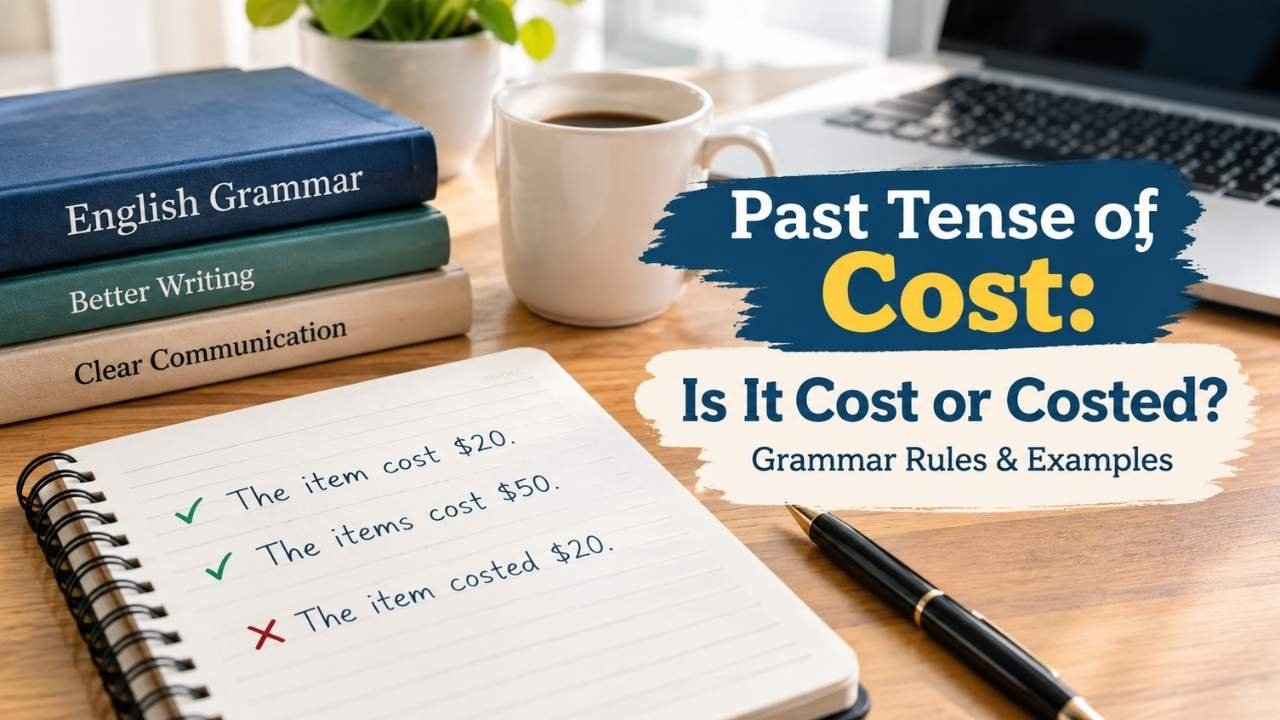
Have you ever wondered whether the past tense of cost is cost or costed? You’re not alone. Many English learners and even native speakers get confused because both words exist, but they are not used in the same way.
In everyday English, the past tense of “cost” is usually cost, making it an irregular verb that does not change form. However, costed is also a real word, but it is mainly used in business, accounting, manufacturing, and project management when talking about calculating or estimating expenses.
In this complete English grammar guide, you’ll learn the verb forms of cost, understand the difference between cost vs. costed, explore simple grammar rules, and see plenty of real-life examples. By the end, you’ll know exactly when to use cost and when to use costed with confidence.
Quick Answer
The past tense of “cost” is usually cost, and the past participle of cost is also cost. Since cost is an irregular verb, it normally does not change in the past tense. However, costed is also correct in specific business, accounting, and project management contexts when referring to calculating or estimating the cost of a project, product, or service.
What Is the Past Tense of “Cost”?
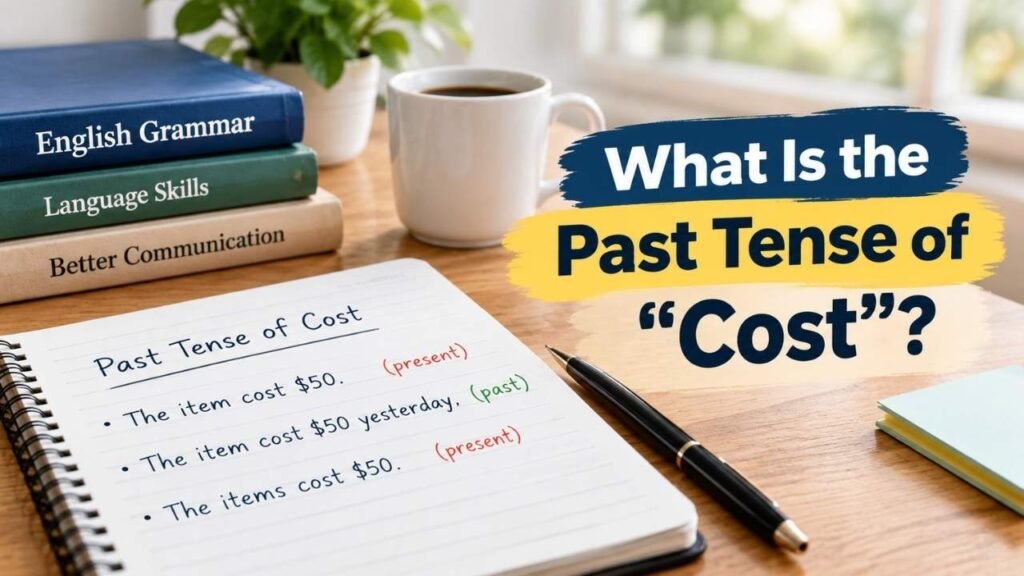
The past tense of “cost” is cost in standard English. This often surprises learners because many verbs add -ed in the past tense, but cost is an irregular verb that usually keeps the same form.
For example, you can say, “The laptop cost $900 last year,” not “The laptop costed $900.” The past participle of cost is also cost, so you would say, “The repairs have cost us a lot of money.” In everyday conversation and writing, cost is the correct choice when talking about the price of something in the past.
If you enjoy learning grammar rules, you may also like our guide on Afterward vs Afterwards, which explains another common English usage difference.
Is “Cost” an Irregular Verb?
Yes, cost is an irregular verb because it does not follow the usual rule of adding -ed to form the past tense. Instead, the verb stays the same in the present tense, past tense, and past participle.
This pattern is shared by several other English verbs, making it easier to remember once you know the rule. For example, “The meal costs $20 today,” and “The meal cost $20 yesterday.” Even though the time changes, the verb does not.
Learning irregular verbs helps you avoid common grammar mistakes and makes your writing sound more natural. As you build your grammar skills, you might also find our article on the Plural of Journey useful for mastering another frequently confused English rule.
Verb Forms of “Cost”
Understanding the verb forms of cost makes it much easier to use the word correctly in different tenses. Unlike many verbs, cost changes very little. Here is a simple table to remember:
| Verb Form | Word |
| Base Form | Cost |
| Third-Person Singular | Costs |
| Present Participle | Costing |
| Past Tense | Cost |
| Past Participle | Cost |
These forms are used in everyday English. For example, “The phone costs too much,” “The phone cost me $500,” and “The phone has cost me more than I expected.” Keeping this table in mind will help you choose the correct form without hesitation.
Why Does the Past Tense Stay “Cost”?
Many learners ask why the past tense of cost remains cost instead of becoming costed. The answer is that cost belongs to a group of irregular verbs whose forms stay the same in both the present and the past.
English has several verbs that follow this pattern because of how the language developed over time. You do not need to memorize the history to use the verb correctly, but knowing the rule can prevent mistakes.
A simple memory trick is this: when you are talking about the price of something, use cost in both the present and the past. This rule works in almost every everyday situation and is accepted in both American and British English.
Is “Costed” a Correct Word?
Yes, costed is a real English word, but it has a special meaning. It is not normally used as the past tense of cost when talking about price. Instead, costed means calculated, estimated, or planned the cost of something.
This usage is common in accounting, manufacturing, engineering, construction, and project management. For example, “The finance team costed the new project before asking for approval.” In this sentence, costed means they worked out the expected expenses, not that the project had a certain price.
Knowing the difference between cost and costed will help you write more accurately and avoid one of the most common grammar mistakes involving this verb.
Cost vs. Costed: What’s the Difference?
The difference between cost and costed depends on the meaning of the sentence. Use cost when talking about the price of something in the present or the past. For example, “The concert ticket cost $75,” is correct because it refers to the amount paid.
Use costed only when someone calculates or estimates expenses, usually in a professional setting. For example, “The manager costed the construction project before work began.” In this case, the team worked out the expected budget. Although both words are correct, they are not interchangeable.
Understanding cost vs. costed helps you avoid common grammar mistakes and choose the right word based on the context.
| Cost | Costed |
| Refers to the price of something | Refers to calculating or estimating costs |
| Used in everyday English | Used in business and finance |
| Past tense and past participle of cost | A specialized verb form |
| Example: The repair cost $300. | Example: The engineer costed the project. |
Example Sentences Using “Cost” Correctly
Reading examples is one of the easiest ways to understand the past tense of cost. Notice how the verb stays the same even when talking about the past.
- The new phone cost me $800 last month.
- The holiday cost more than we expected.
- This mistake has cost the company thousands of dollars.
- How much did the tickets cost?
- The repairs cost less than we planned.
- The course costs $100 today.
- The broken window cost him a lot of money to replace.
In each sentence, cost is the correct form because it refers to the price of something. There is no need to change it to costed in these everyday situations.
Example Sentences Using “Costed”
Although costed is less common, it is the correct choice when talking about calculating or estimating costs. You will often see it in business documents, project plans, and financial reports.
- The accountant costed the new marketing campaign.
- The engineering team carefully costed the bridge project.
- Our manager costed every stage of the product launch.
- The contractor costed the renovation before starting work.
- The finance department costed the annual budget.
- Each design option was costed before approval.
In these examples, costed means someone worked out the expected expenses. It does not describe the actual price that something had in the past.
Common Mistakes with “Cost” and How to Avoid Them
Many English learners confuse cost and costed because most verbs form the past tense by adding -ed. The biggest mistake is writing “It costed $50.” This is incorrect because cost is an irregular verb when it means the price of something.
Here are some common corrections:
- ❌ The shoes costed $90.
- ✅ The shoes cost $90.
- ❌ The trip has costed us too much.
- ✅ The trip has cost us too much.
- ❌ How much did it costed?
- ✅ How much did it cost?
Remember this simple rule: use cost for price and costed only for calculating costs in professional contexts.
Similar Irregular Verbs That Never Change
The verb cost is not the only English verb that keeps the same form in the present and past tense. Learning similar verbs can help you remember this grammar rule more easily.
| Base Form | Past Tense | Past Participle |
| Cost | Cost | Cost |
| Cut | Cut | Cut |
| Put | Put | Put |
| Hit | Hit | Hit |
| Let | Let | Let |
| Set | Set | Set |
These are all irregular verbs, but they are easy to remember because their forms do not change. Once you recognize this pattern, using the past tense of cost correctly becomes much more natural.
Mini Quiz: Can You Choose the Correct Form?
Test your understanding by choosing the correct word in each sentence.
- The laptop ______ me $950 last year.
- The accountant ______ the project before presenting the budget.
- The repairs have ______ us a lot of money.
- The contractor ______ every material needed for the building.
- How much did your new bicycle ______?
Answers
- cost
- costed
- cost
- costed
- cost
If you answered all five correctly, you now understand the difference between cost and costed. Remember, cost refers to the price, while costed means calculated or estimated the cost.
FAQs
Is “costed” a real English word?
Yes. Costed is a real English word, but it is mainly used in business, accounting, manufacturing, and project management to mean calculated or estimated the cost of something.
What is the past tense of “cost”?
The past tense of cost is cost. It is an irregular verb, so it usually does not change form.
What is the past participle of “cost”?
The past participle of cost is also cost. For example, “The repairs have cost us a lot of money.”
Is “cost” an irregular verb?
Yes. Cost is an irregular verb because its base form, past tense, and past participle are usually the same.
When should I use “costed”?
Use costed when talking about calculating or estimating expenses, especially in finance, accounting, engineering, manufacturing, and project management.
Conclusion
The past tense of “cost” is cost, and the past participle is also cost. Because cost is an irregular verb, it normally keeps the same form when referring to the price of something.
Although costed is also correct, it has a different meaning and is mainly used when someone calculates or estimates costs in professional settings. Remember this simple rule: if you are talking about how much something cost, use cost.
If you are talking about working out a budget or estimating expenses, use costed. Keeping this difference in mind will help you write and speak English more accurately and confidently.