
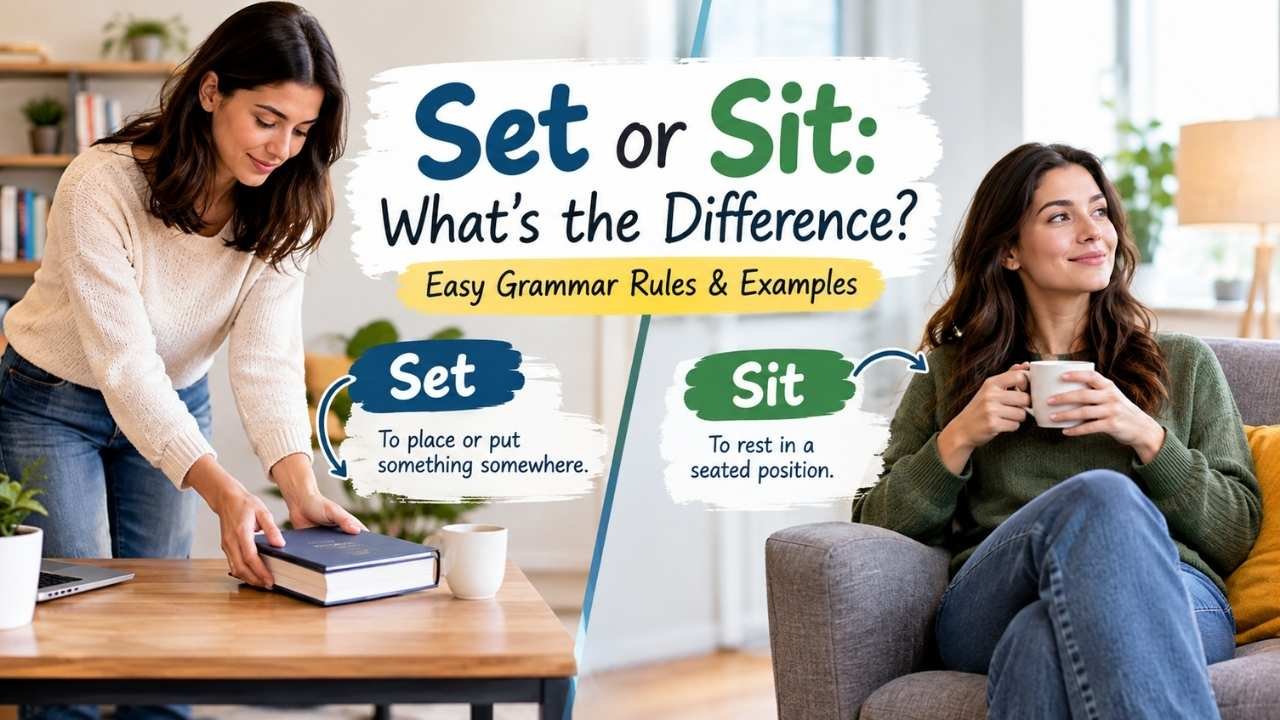
Have you ever wondered whether you should say “set the book on the table” or “sit the book on the table”? You’re not alone. Many English learners and even native speakers get confused by set vs. sit because the two verbs are closely related.
The good news is that the rule is much easier than it first appears. Once you understand the difference between set and sit, choosing the correct word becomes natural. In this guide, you’ll learn when to use set, when to use sit, simple grammar rules, and plenty of set and sit examples from everyday English.
We’ll also cover common mistakes, verb forms, memory tricks, and practice exercises to help you use set or sit correctly and confidently in both speaking and writing.
Quick Answer
The difference between set and sit is simple. Sit means to rest in a seated position and does not usually take a direct object, while set means to place or put something somewhere and requires a direct object. If you’re moving an object, use set. If a person or animal is taking a seat, use sit.
Set vs. Sit at a Glance
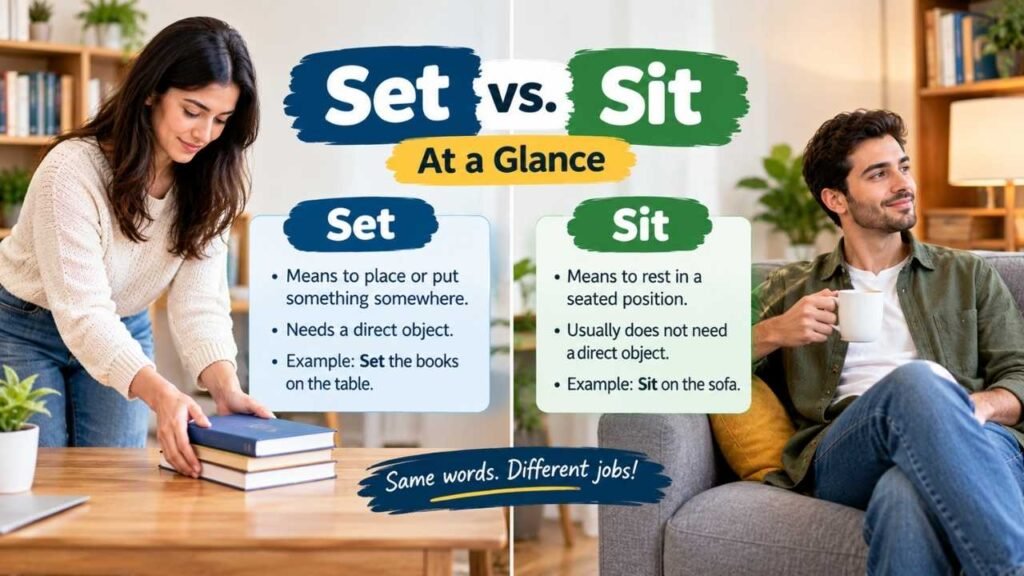
Many people struggle with set vs. sit because both words describe actions involving position or movement. However, they follow different grammar rules. The easiest way to remember the difference between set and sit is this:
sit means to take a seat or rest in a seated position, while set means to place or put something somewhere. In other words, set needs a direct object, but sit usually does not.
For example, you sit on a chair, but you set your bag on the chair. Learning this simple rule will help you decide when to use set and when to use sit correctly in everyday conversations and writing.
| Feature | Sit | Set |
| Meaning | To rest in a seated position | To place something somewhere |
| Verb Type | Intransitive | Transitive |
| Needs a Direct Object? | No | Yes |
| Example | Please sit here. | Please set the book here. |
| Memory Tip | Someone sits. | Someone sets something. |
What Does “Sit” Mean?
The verb sit means to rest your body on a chair, bench, floor, or another surface. It describes the action of being in a seated position, so it usually does not need a direct object.
For example, you can say, “Please sit by the window,” or “The children sat quietly during class.” These sentences show that the person performs the action without placing another object anywhere.
Understanding when to use sit is an important part of English grammar because it helps you avoid common mistakes with set or sit. If you are talking about a person or animal taking a seat, sit is almost always the correct choice. Practice using it in daily conversations to build confidence.
Tip: If no object is being placed, sit is usually the correct verb.
What Does “Set” Mean?
The verb set means to place or put something in a particular position. Unlike sit, set almost always requires a direct object, which means something receives the action. For example, you can say, “Please set the dishes on the table,” or “She set her phone beside the bed.”
In both sentences, an object is being placed somewhere. Knowing when to use set makes it much easier to understand the difference between set vs. sit.
You will hear set in homes, schools, offices, and many everyday situations. If your sentence answers the question “What is being placed?”, then set is probably the right verb to choose.
Tip: If you are placing an object somewhere, use set.
The Main Difference Between Set and Sit
The biggest difference between set and sit is whether the verb acts on an object. Sit describes what a person or animal does when taking a seat, while set describes placing something in a specific location.
A simple question can help: “Am I moving an object?” If the answer is yes, use set. If the answer is no, use sit. For example, “Sit on the sofa” is correct because no object is involved. “Set the keys on the table” is also correct because the keys are being placed somewhere.
This easy rule explains the difference between set and sit and helps you avoid one of the most common English grammar mistakes.
Grammar Rule Explained Simply
A quick way to choose between set or sit is to look for a direct object. If someone is placing an object, use set. If someone is taking a seat, use sit. Think about these examples: “Set the laptop on the desk” and “Sit beside your friend.”
The first sentence includes an object—the laptop—so set is correct. The second sentence has no object being placed, so sit is the right choice. This simple trick works in most situations and makes set vs. sit much easier to remember.
If you enjoy learning about confusing English words, you may also like our guides on Plural of Foreman and Connector or Connecter, which explain other commonly misunderstood grammar topics in simple language.
Verb Forms of Set and Sit
Learning the verb forms of set and sit will help you use them correctly in different tenses. The verb sit is an irregular verb, so its forms change from sit to sat and then sat again as the past participle.
On the other hand, set is unusual because its present, past, and past participle forms are all set. This often confuses English learners, but remembering the pattern makes it easier. Here is a simple comparison:
| Verb | Present | Past | Past Participle | Present Participle |
| Sit | Sit | Sat | Sat | Sitting |
| Set | Set | Set | Set | Setting |
Practice these forms often so you can choose the correct verb naturally.
Common Mistakes and How to Avoid Them
Many learners make mistakes with set vs. sit because the two words sound similar and both relate to position. One common error is saying, “Sit the bag on the chair.” Since the bag is an object being placed somewhere, the correct sentence is “Set the bag on the chair.”
Another mistake is saying, “Set here for a while.” Because no object is involved, it should be “Sit here for a while.” A simple trick is to ask yourself, “Is something being placed?” If the answer is yes, use set.
If someone is simply taking a seat, use sit. This habit will help you avoid common English grammar mistakes.
Real-Life Examples in Everyday English
Seeing set and sit examples in everyday situations makes the grammar rule much easier to remember. At home, you might say, “Please set the plates on the table before dinner.” When welcoming a guest, you would say, “Please sit wherever you like.”
At school, a teacher may say, “Set your books on the desk,” followed by, “Now sit quietly until class begins.” In an office, someone might ask a coworker to set the files on a shelf before everyone sits down for a meeting.
These examples show when to use set and when to use sit in natural conversations. The more you notice these expressions, the more confident your grammar will become.
Memory Tricks to Never Confuse Set and Sit Again
A simple memory trick can help you remember the difference between set and sit forever. Think of the sentence “You sit yourself, but you set something else.” If another object is receiving the action, choose set. If a person or animal is taking a seat, choose sit.
You can also remember that set usually answers the question “What?” For example, What did you set? The answer could be the book, the phone, or the cup. With sit, there is no object to move. Repeating this easy rule whenever you write or speak will make choosing set or sit feel natural over time.
Practice Quiz: Can You Choose the Correct Word?
Test your understanding by choosing the correct word in each sentence.
- Please (set / sit) the flowers on the table.
- We (set / sat) together during the movie.
- Can you (set / sit) your backpack by the door?
- The cat likes to (set / sit) near the fireplace.
- She (set / sat) the plates before dinner.
Answers
- Set
- Sat
- Set
- Sit
- Set
If you answered all five correctly, you have a good understanding of the difference between set and sit. If not, review the grammar rule and try again. Regular practice is the fastest way to build confidence.
Similar Word Pairs You Might Also Confuse
If set vs. sit has ever confused you, you’re not alone. English has many word pairs that look or sound similar but have different meanings. For example, lie vs. lay often causes the same kind of confusion because one verb needs a direct object while the other does not.
Another common pair is rise vs. raise, where raise requires an object but rise does not. You may also come across bring vs. take and affect vs. effect, which are frequently mixed up in writing.
Learning these grammar pairs together helps you recognize patterns, improve your vocabulary, and avoid common mistakes in both spoken and written English.
FAQs
Is it correct to say “sit the book on the table”?
No. Since the book is an object being placed somewhere, the correct verb is set.
What is the easiest way to remember set vs. sit?
Remember this rule: You sit yourself, but you set something else.
Does set always need a direct object?
In most everyday situations, yes. Set usually means placing an object somewhere.
Why is the past tense of set also set?
Set is an irregular verb, so its present, past, and past participle forms are all the same.
What is the past tense of sit?
The past tense and past participle of sit are both sat.
Can animals sit?
Yes. People and animals can sit, but they do not set themselves in normal usage.
How can I stop confusing these words?
Practice with real-life examples, remember the simple grammar rule, and check whether your sentence includes a direct object.
Conclusion
The difference between set and sit is easier than it seems once you know the basic rule. Sit means to take a seat, while set means to place something somewhere. If your sentence includes a direct object, set is usually the correct choice.
If someone is simply sitting down, use sit. Learning the verb forms, studying set and sit examples, and practicing with short exercises will help you avoid common grammar mistakes.
The more you use these verbs in everyday conversations and writing, the more natural they will become. Keep this simple rule in mind, and you’ll be able to choose set or sit with confidence every time.