
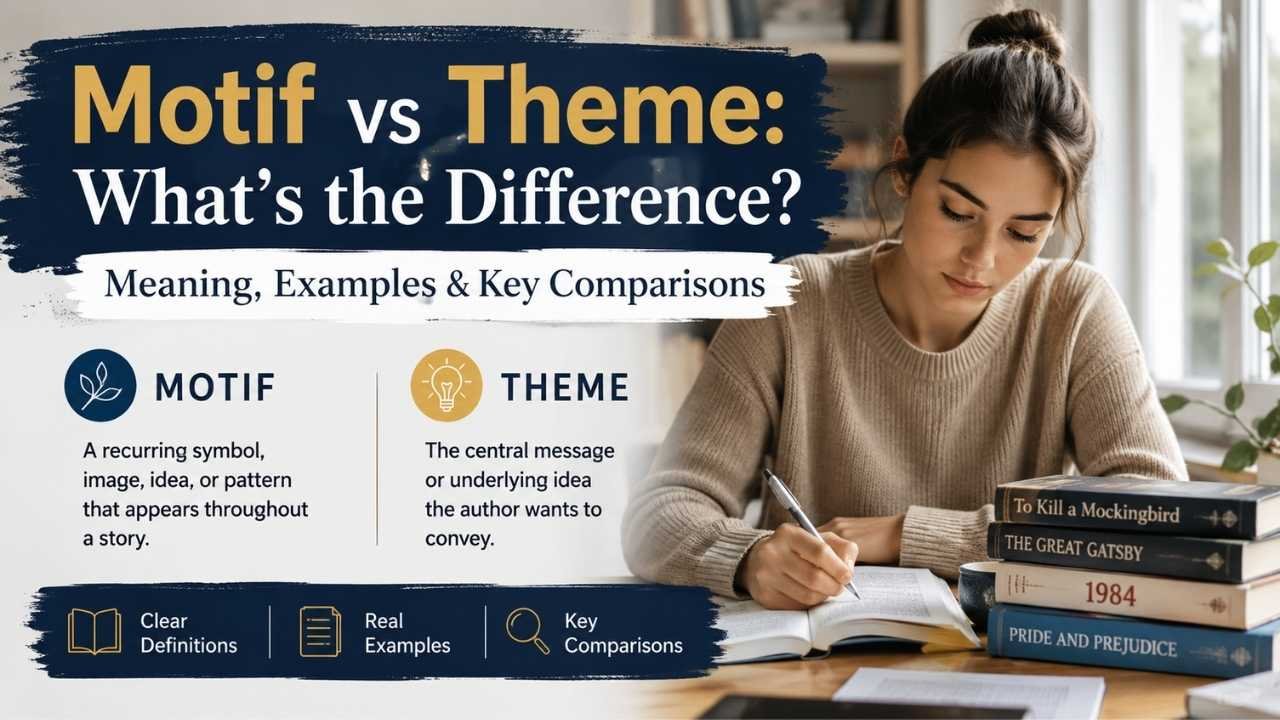
When reading a novel, watching a movie, or studying a poem, you may come across the terms motif vs theme. Because both help shape a story’s meaning, many people think they mean the same thing. In reality, they serve different purposes.
A motif is a recurring image, symbol, idea, or pattern that appears throughout a work, while a theme is the central message or underlying idea the author wants readers to understand. Knowing the difference between motif and theme makes it easier to analyze literature, write stronger essays, and enjoy stories on a deeper level.
In this guide, you’ll learn motif vs theme with simple definitions, clear comparison tables, and examples from literature and movies. You’ll also discover how motifs help develop themes, avoid common mistakes, and confidently identify both in any story.
Quick Answer
A motif is a recurring symbol, image, idea, or pattern that appears throughout a story, while a theme is the central message or underlying meaning the author wants to convey. Simply put, motifs support and reinforce themes through repetition. Understanding the difference between motif and theme helps readers analyze literature, identify literary devices, and better understand an author’s message.
Motif vs Theme at a Glance (Comparison Table)
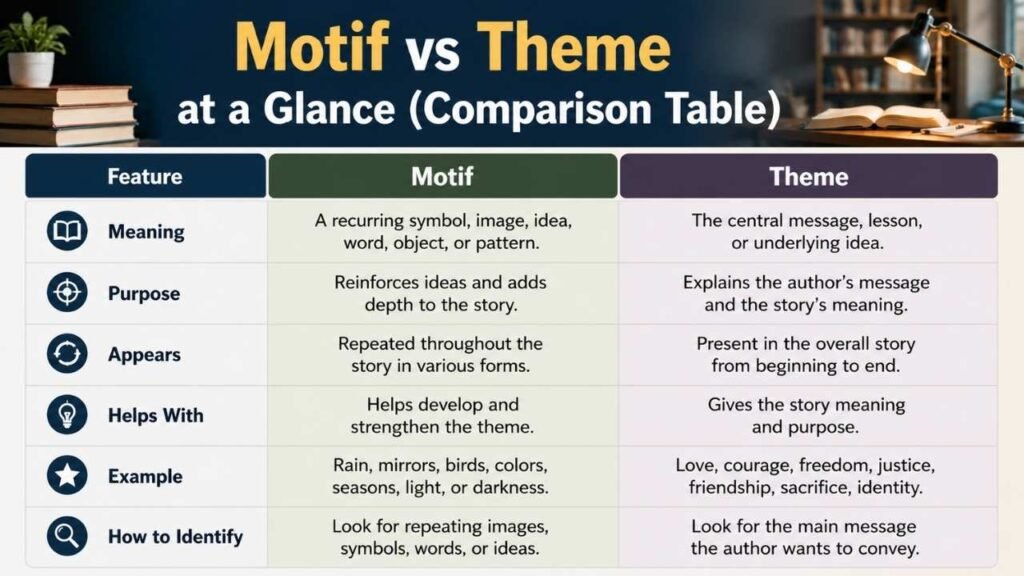
Understanding motif vs theme becomes much easier when you compare them side by side. A motif is a recurring image, symbol, word, object, or idea that appears throughout a story. A theme is the central message or deeper meaning the author wants readers to take away.
While a motif appears repeatedly, a theme expresses the lesson or insight behind the story. In simple words, motifs help develop themes through repetition. For example, repeated images of light may form a motif, while hope overcoming darkness could be the theme.
If you enjoy learning about confusing English words, you may also like our guides on Contractor or Contracter and Axle or Axel, which explain commonly mixed-up terms in a simple way.
| Feature | Motif | Theme |
| Meaning | A recurring symbol, image, idea, or pattern | The central message or underlying idea |
| Purpose | Reinforces the story’s meaning | Explains the author’s message |
| Appears | Repeated throughout the story | Present in the overall story |
| Helps With | Building the theme | Giving the story meaning |
| Example | Repeated birds, colors, or seasons | Love, courage, freedom, or friendship |
What Is a Motif in Literature?
A motif is a recurring image, symbol, sound, object, phrase, or idea that appears several times in a literary work. Authors use motifs to highlight important ideas and connect different parts of the story. Unlike a single symbol, a motif appears repeatedly, making readers notice its importance.
For example, repeated references to storms may represent conflict, while mirrors may reflect identity or self-discovery. These recurring patterns do not always explain the story directly, but they help readers discover its deeper meaning.
Learning what is a motif in literature makes literary analysis much easier because you begin to notice meaningful patterns. Whether you’re reading a novel, poem, or short story, spotting recurring details is the first step toward understanding how the author’s message develops.
What Is a Theme?
A theme is the central message, lesson, or universal idea that a story communicates. Unlike a motif, a theme is not something you can point to in one sentence or object. Instead, it grows through the characters, events, conflicts, and repeated ideas found throughout the story.
Common themes in literature include love, courage, family, friendship, justice, sacrifice, and freedom. Different readers may express the same theme in slightly different words, but the main idea remains the same.
Understanding what is a theme in literature helps readers think beyond the plot and discover the author’s deeper purpose. As you read, ask yourself what message the story leaves behind, because that message is usually its theme.
Key Differences Between Motif and Theme
The difference between motif and theme is simple once you understand their roles. A motif is something you can see repeated, such as a color, object, phrase, or symbol. A theme is the meaning that those repeated elements help communicate.
In other words, motifs support themes, but they are not the same thing. For example, repeated images of birds may form a motif, while the desire for freedom becomes the theme. Another useful way to remember this is that a motif is a pattern, while a theme is a message.
Knowing these differences helps students write stronger essays, answer literature questions more confidently, and avoid confusing one literary device with another during story analysis.
How Motifs Help Develop Themes
Many readers wonder how motifs and themes work together. The answer is that motifs strengthen and reinforce themes by appearing again and again throughout the story. Every time readers notice the recurring image, symbol, or idea, they gain another clue about the author’s message.
For example, in a novel where light appears whenever characters find hope, that recurring image becomes a motif supporting the theme of perseverance. Similarly, repeated references to broken bridges might reinforce a theme about lost relationships.
This connection explains why understanding motif vs theme is so important in literary analysis. Instead of treating motifs as random details, readers should see them as meaningful patterns that gradually reveal the story’s deeper message.
Motif vs Theme vs Symbol
Many readers also confuse a motif, theme, and symbol, but each has a different purpose in literature. A symbol is a person, object, place, or action that represents a deeper meaning. A motif is a recurring symbol, image, or idea that appears many times throughout a story.
A theme is the central message the author wants readers to understand. For example, a rose can symbolize love. If roses appear repeatedly in different scenes, they become a motif.
Together, those repeated roses may help develop a theme such as the power of love or the beauty and pain of relationships. Understanding these three literary terms makes story analysis much easier and more accurate.
Examples of Motifs and Themes in Famous Books and Movies
Looking at real examples is one of the easiest ways to understand motif vs theme. In To Kill a Mockingbird, the mockingbird is a recurring motif that supports the theme of innocence and compassion. In The Great Gatsby, the green light appears several times and becomes a motif representing hope and dreams, while the theme explores ambition and the American Dream.
In Harry Potter, recurring references to love and sacrifice help reinforce the theme that love is a powerful force. Even movies use motifs effectively.
In The Lion King, the circle of life appears repeatedly, helping develop themes of responsibility, family, and personal growth. These examples show how recurring patterns reveal deeper meanings.
How to Identify a Motif and a Theme in Any Story
Learning how to identify a motif and a theme takes practice, but the process is simple. First, look for recurring images, objects, symbols, words, or ideas that appear several times in the story.
These repeated elements are likely motifs. Next, ask yourself what those repeated details suggest about the story’s overall message. That larger message is usually the theme. Don’t focus only on one scene or one character. Instead, consider the entire story and how different events connect.
If a recurring pattern helps explain the author’s message, you’ve probably found a motif supporting a theme. This step-by-step approach makes literary analysis easier for students, teachers, writers, and anyone who enjoys reading.
Common Mistakes Students Make
Students often make the same mistakes when comparing motif vs theme. One common error is thinking that every symbol is automatically a motif. A symbol becomes a motif only when it appears repeatedly throughout the story.
Another mistake is confusing the topic with the theme. For example, friendship may be the topic, while true friendship requires trust and sacrifice is the theme. Some readers also believe a motif has meaning by itself, but motifs gain importance because they help build the story’s message.
Taking time to examine repeated patterns and the overall lesson helps avoid these misunderstandings and leads to stronger literary analysis and better classroom discussions.
Can One Story Have Multiple Motifs and Themes?
Yes, most stories include multiple motifs and multiple themes. Authors often use several recurring images, symbols, or ideas to explore different parts of their message. For example, a novel may use rain, birds, and mirrors as separate motifs.
Each one can support themes such as hope, freedom, identity, or change. Likewise, a story can teach more than one lesson at the same time. A novel might explore themes of family, forgiveness, and courage together.
This is why readers should not search for only one correct answer. Looking at how different motifs connect with different themes provides a richer understanding of the story and the author’s purpose.
Practice Exercise: Can You Spot the Motif or Theme?
Let’s test your understanding with a simple example. Imagine a story where a character repeatedly looks at a broken clock whenever they think about the past. The broken clock is the motif because it appears many times throughout the story.
As the plot develops, readers realize the story teaches that people cannot change the past but can learn from it. That lesson is the theme. Try another example while reading your favorite book. First, find something that appears repeatedly.
Then ask what message those repeated details help explain. This simple method will help you identify motifs and themes more confidently and improve your literature skills.
FAQs
Is a motif the same as a theme?
No. A motif is a recurring image, symbol, object, or idea, while a theme is the central message or lesson of the story. Motifs help develop and reinforce themes.
Can a symbol become a motif?
Yes. A symbol becomes a motif when it appears repeatedly throughout a literary work and contributes to the story’s deeper meaning.
Can one motif support multiple themes?
Yes. A recurring motif may reinforce more than one theme, depending on how it is used throughout the story and what ideas it highlights.
Why are motifs important in literature?
Motifs connect different parts of a story, create patterns, and guide readers toward understanding the author’s message.
How can I identify a theme?
Look beyond the plot and ask what lesson or universal idea the story communicates through its characters, conflicts, and recurring motifs.
Conclusion
Understanding motif vs theme helps you appreciate stories on a much deeper level. A motif is a recurring pattern that appears throughout a work, while a theme is the central message those patterns help express.
Although they are closely connected, they play different roles in literature.Once you learn to recognize recurring symbols, images, and ideas, identifying the theme becomes much easier.
Whether you’re preparing for an exam, writing an essay, or simply enjoying a novel, knowing the difference between motif, theme, and symbol will strengthen your reading and analytical skills. The more stories you explore, the more naturally you’ll spot these literary devices and understand the powerful messages authors weave into their work.