
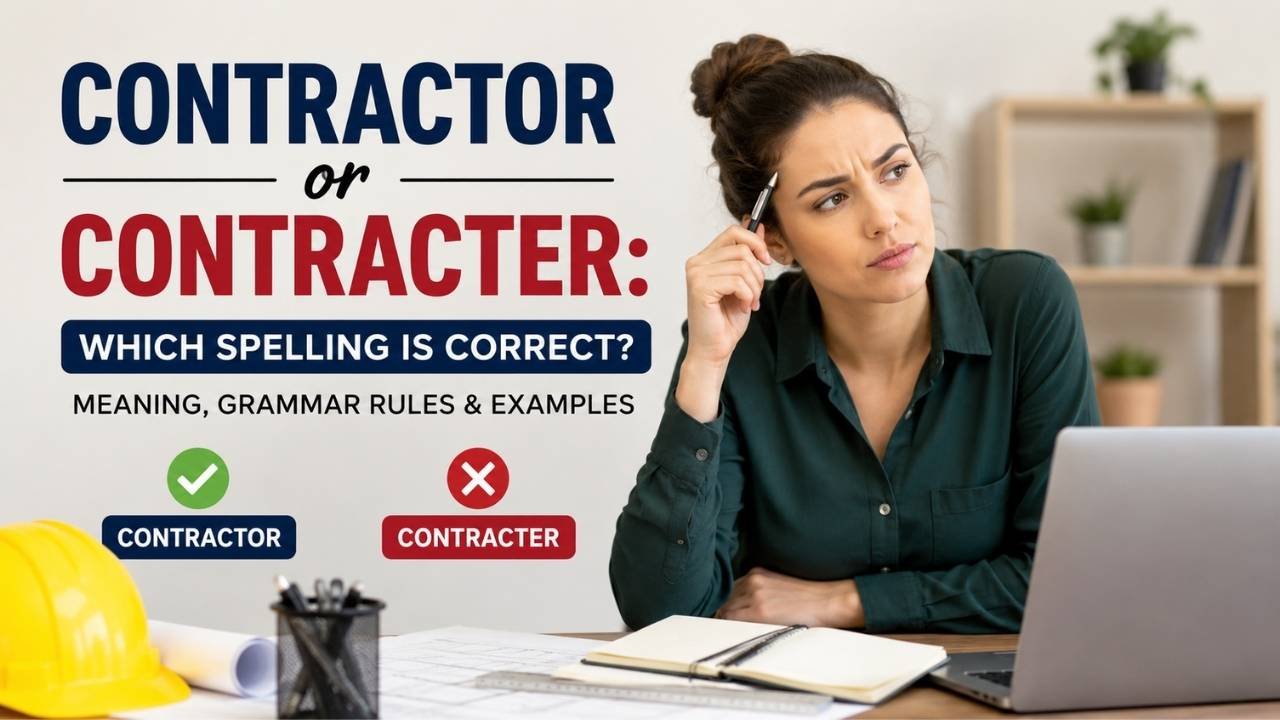
Have you ever wondered whether contractor or contracter is the correct spelling? You’re not alone. Many people search for contractor vs contracter because the two words look similar, but only one is accepted in standard English.
Whether you’re writing a business email, signing a contract, completing schoolwork, or creating professional content, using the correct spelling helps you communicate clearly. In this guide, you’ll learn how to spell contractor, discover the meaning of contractor, and understand why contracter is considered a misspelling.
We’ll also explain the grammar rule behind the correct form, share practical examples, answer common questions like “Is contracter a word?”, and provide simple tips to help you remember the correct spelling. By the end, you’ll know exactly when and how to use contractor with confidence.
Quick Answer
Contractor is the correct spelling in English, while contracter is a misspelling and is not recognized in standard dictionaries. A contractor is a person or company hired to perform work or provide services under a contract. If you’re wondering how to spell contractor or whether contracter is a word, always use contractor in both professional and everyday writing.
Contractor or Contracter: Which Spelling Is Correct?

The correct spelling is contractor, while contracter is a misspelling. If you’re asking, “Is contractor or contracter correct?”, the answer is simple: always use contractor in formal and informal writing.
A contractor is a person or company hired to complete work under a contract, such as building a house, fixing electrical systems, or providing professional services. Although contracter may appear in online searches or typing mistakes, it is not accepted in standard English dictionaries.
Learning the correct spelling helps you write clearly and professionally. Just as many people search for the Plural of Chief to avoid common grammar mistakes, understanding the difference between contractor vs contracter helps improve your writing and prevents spelling errors in everyday communication.
Contractor vs. Contracter at a Glance
The table below makes it easy to understand the difference between contractor and contracter.
| Feature | Contractor | Contracter |
| Spelling | ✅ Correct | ❌ Incorrect |
| Dictionary Status | Accepted in English dictionaries | Not recognized as a standard word |
| Meaning | A person or company hired under a contract | Misspelling of contractor |
| Part of Speech | Noun | Not a standard English noun |
| Professional Use | Yes | No |
| Example | The contractor finished the project on time. | Incorrect usage |
If you are unsure how to spell contractor, remember that contractor is always the right choice. Whether you’re writing a report, an email, or a legal document, using the correct spelling makes your writing more accurate and professional.
What Does “Contractor” Mean?
A contractor is a person, business, or organization hired to complete work according to a legal agreement or contract. Contractors work in many industries, including construction, information technology, healthcare, marketing, and consulting.
For example, a homeowner may hire a building contractor to renovate a kitchen, while a company may hire an IT contractor for a software project. The meaning of contractor always relates to someone providing services for an agreed payment instead of working as a permanent employee.
Knowing this definition also helps you avoid spelling mistakes like contracter. Similar grammar questions often confuse writers, such as Rouse vs Arouse, where two similar-looking words have different meanings and correct usage depending on the context.
Is “Contracter” Ever Correct?
The simple answer is no. Contracter is not considered a correct spelling in modern English and does not appear as the standard form in trusted dictionaries such as Cambridge, Oxford, or Merriam-Webster.
Most people write contracter by mistake because they assume the word follows the common -er ending found in many English nouns. However, the correct spelling has always been contractor. If you notice contracter in emails, blogs, or social media posts, it is almost always a spelling error rather than an accepted alternative.
To write confidently in professional, academic, or everyday situations, always choose contractor and avoid using contracter in any formal document.
Why Is Contractor Spelled with “-or” Instead of “-er”?
Many English words end in either -or or -er, which can make spelling confusing. The word contractor comes from the noun contract and follows a spelling pattern shared by words like actor, creator, director, and editor.
These words traditionally use the -or ending instead of -er. Because English includes both endings, people sometimes assume contracter should also be correct, but that is not how the word developed.
The accepted spelling has remained contractor for many years and is recognized across English-speaking countries. Remembering this spelling pattern makes it easier to choose the correct form whenever you write about business, construction, or professional services.
How to Use Contractor Correctly in Sentences
Using contractor correctly becomes easy once you know its meaning. It should always refer to a person or company hired under a contract to complete specific work or provide services. Here are a few examples:
- The contractor completed the office renovation ahead of schedule.
- We hired an electrical contractor to install new wiring.
- The software contractor delivered the project on time.
- The government selected a contractor through a competitive bidding process.
- Our company works with an independent contractor for graphic design.
These examples show the correct way to use contractor in everyday and professional writing. Avoid replacing it with contracter, as that spelling is incorrect and may reduce the credibility of your work.
Common Mistakes People Make
Many writers accidentally use contracter instead of contractor because the two words sound similar. Another common mistake is confusing a contractor with an employee.
A contractor is usually hired to complete specific work under a contract, while an employee works directly for a company. Some people also capitalize Contractor when it appears in the middle of a sentence, even though it should only be capitalized at the beginning of a sentence or as part of a proper name.
Others believe contracter is an acceptable British spelling, but it is not. To avoid these errors, remember that contractor is the only correct spelling in standard English and should be used in all professional, academic, and everyday writing.
Contractor vs Similar Confusing Words
English contains many words that look alike but have different meanings or spellings. Contractor and contracter are one example, but there are others. For instance, advisor and adviser are both accepted spellings, while traveler and traveller depend on American or British English.
Another pair is contractor and constructor. A contractor is hired to complete work under a contract, while a constructor is someone or something that builds or creates, often used in technical fields like programming.
Knowing these differences improves your writing and helps you avoid common grammar mistakes. When in doubt, check a trusted dictionary to confirm the correct spelling and meaning before using a word.
Pronunciation Guide
The word contractor is pronounced as /kən-TRAK-ter/ in both American and British English, with the main stress placed on the second syllable. Although the ending is spelled -or, it is often pronounced similarly to -er, which is one reason people mistakenly write contracter.
Listening to the correct pronunciation and saying the word aloud can help you remember its proper spelling. Breaking it into syllables—con-trac-tor—also makes it easier to learn.
While pronunciation is helpful, remember that spelling follows established grammar rules, not just the way a word sounds. Keeping this in mind will help you write contractor correctly every time.
Grammar Rule Behind the Spelling
The spelling of contractor follows a common English grammar pattern for agent nouns, which are nouns that describe a person who performs an action or carries out a role. Many of these words end in -or, including actor, editor, director, creator, and inventor.
Although English also has many words ending in -er, the spelling of each word is based on its historical development and accepted usage. This is why contractor is correct and contracter is not.
Instead of trying to guess the ending, learn the standard spelling from reliable dictionaries and use it consistently. Following this simple grammar rule will help you avoid common spelling mistakes in the future.
FAQs
Is contracter a real word?
No. Contracter is considered a misspelling. The correct word is contractor.
How do you spell contractor correctly?
The correct spelling is contractor, ending with -or.
What does contractor mean?
A contractor is a person or company hired to perform work or provide services under a contract.
What is the plural of contractor?
The plural form is contractors.
Is contractor used in both American and British English?
Yes. Contractor is the standard spelling in both American and British English.
Can a company be called a contractor?
Yes. A business or organization hired under a contract can also be referred to as a contractor.
Conclusion
When comparing contractor or contracter, the answer is clear. Contractor is the correct spelling, while contracter is simply a spelling mistake that should be avoided. Whether you are writing a business email, preparing a legal document, completing schoolwork, or creating online content, using contractor shows accuracy and professionalism.
Remember that a contractor is a person or company hired to complete work under a contract, and the word always ends with -or. If you ever feel unsure, check a trusted dictionary or return to this guide for a quick reminder.
By understanding the spelling, meaning, grammar rule, and examples, you can confidently use contractor correctly in every situation.