
Repetition vs parallelism are two powerful literary devices that make writing and speech more memorable, but they are often confused because both create emphasis. If you’ve ever wondered about repetition vs parallelism, you’re not alone.
Many students, writers, and English learners want to understand the difference between repetition and parallelism and when to use each technique. While repetition in writing strengthens a message by repeating words or ideas, parallelism improves clarity by using a consistent grammatical pattern, also known as parallel structure.
Learning how these devices work can help you write more clearly, speak more confidently, and analyze literature with greater accuracy. In this guide, you’ll discover repetition and parallelism definitions, practical examples, key differences, common mistakes, and tips for choosing the right technique in any writing situation.
Quick Answer
Repetition vs parallelism comes down to purpose and structure. Repetition emphasizes a word, phrase, or idea by repeating it, making the message more memorable. Parallelism, also called parallel structure, uses the same grammatical pattern to improve clarity, rhythm, and balance. Although they are different literary devices, writers often use repetition and parallelism together to create stronger, more persuasive writing and speeches.
Repetition vs Parallelism at a Glance (Comparison Table)
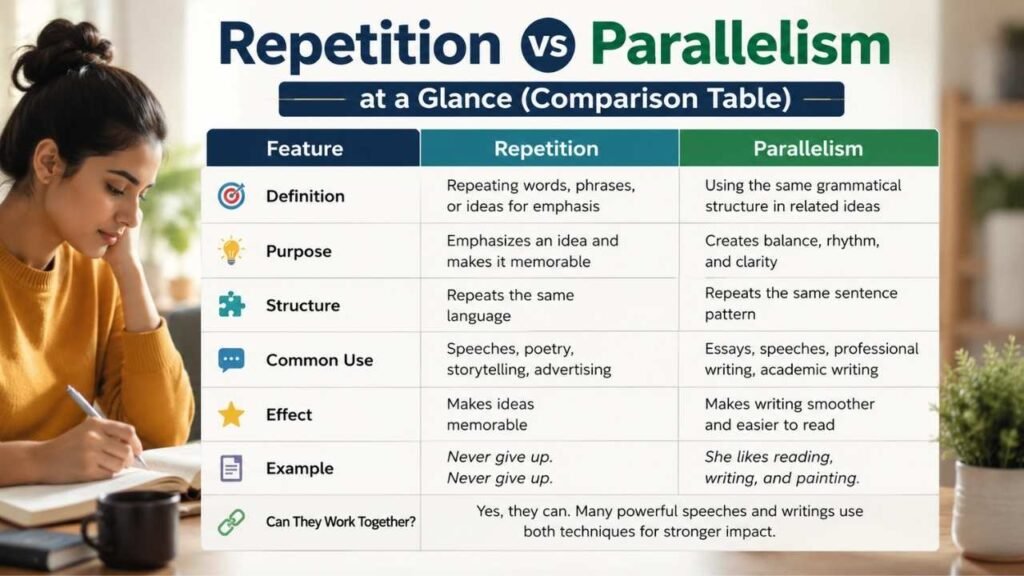
Before exploring each literary device, it helps to compare them side by side. Although both techniques improve writing, they work in different ways. Repetition focuses on repeating the same word, phrase, or idea to create emphasis and make a message memorable.
Parallelism, also known as parallel structure, focuses on using the same grammatical pattern to create balance and improve readability. Understanding this difference between repetition and parallelism helps students, writers, and speakers choose the right technique for every situation.
The table below provides a quick comparison of their meaning, purpose, structure, and examples so you can easily recognize each one while reading or writing.
| Feature | Repetition | Parallelism |
| Definition | Repeating words, phrases, or ideas for emphasis | Using the same grammatical structure in related words or sentences |
| Purpose | Emphasizes an idea and improves memory | Creates balance, rhythm, and clarity |
| Structure | Repeats the same language | Repeats the same sentence pattern |
| Common Use | Speeches, poetry, storytelling | Essays, speeches, professional writing |
| Effect | Makes ideas memorable | Makes writing smoother and easier to read |
| Example | Never give up. Never give up. | She likes reading, writing, and painting. |
| Can They Work Together? | Yes | Yes |
What Is Repetition?
Repetition is a literary and rhetorical device that repeats the same word, phrase, sound, or idea to make it stand out. Writers use repetition in writing to add emphasis, create rhythm, and help readers remember important points. It appears in poems, speeches, advertisements, and everyday conversations because repeating key ideas makes them stronger.
For example, “Practice, practice, practice” highlights the importance of regular effort. Famous speeches also rely on repetition to inspire audiences and make messages unforgettable. While repetition is useful, it should be used carefully because repeating too much can sound unnecessary instead of powerful.
If you enjoy learning about similar language differences, you may also like our guide on Antithesis vs Juxtaposition which explains another commonly confused pair of English terms.
What Is Parallelism?
Parallelism, often called parallel structure, is a writing technique that uses the same grammatical pattern in related words, phrases, or clauses. This structure creates balance, improves readability, and gives sentences a smooth rhythm.
For example, “She enjoys reading, writing, and swimming” follows the same grammatical form, making the sentence clear and natural. Writers use parallelism in essays, speeches, books, and business writing because it keeps ideas organized and easy to follow.
Unlike repetition, which repeats words or ideas, parallelism repeats sentence patterns. This simple technique makes writing sound polished without adding extra words. If you’re interested in other commonly confused English terms, our guide on Base or Bass offers another helpful comparison with practical examples.
Repetition vs Parallelism: What Are the Key Differences?
The main difference between repetition and parallelism is how each technique creates emphasis. Repetition repeats the same words or ideas to strengthen a message and make it memorable. Parallelism repeats a grammatical pattern to improve balance, clarity, and flow.
For example, saying “Work hard. Work smart. Work together.” uses repetition because the word work appears again and again. On the other hand, “She likes reading, cooking, and traveling” uses parallel structure because each activity follows the same grammatical form.
Both techniques improve writing, but they serve different purposes. Understanding repetition vs parallelism helps writers choose the right method for essays, speeches, creative writing, and everyday communication.
Can Repetition and Parallelism Be Used Together?
Yes, repetition and parallelism can work together to create writing that is both memorable and well organized. Many famous speeches use both techniques because they emphasize important ideas while keeping sentences balanced.
For example, “We will learn, we will grow, we will succeed” repeats the phrase we will while following the same grammatical structure. This combination creates rhythm, confidence, and emotional impact. Political speeches, motivational talks, and inspirational writing often use both devices to persuade audiences more effectively.
When used carefully, they make ideas easier to understand and remember. The key is to keep the repetition meaningful and the parallel structure consistent so your writing remains clear, engaging, and natural rather than repetitive or confusing.
Types of Repetition and Parallelism Every Writer Should Know
There are several forms of repetition and parallelism, and each one adds a unique effect to writing. Common types of repetition include anaphora, where the same words begin consecutive sentences, and epistrophe, where repeated words appear at the end of sentences. Writers also use symploce, which combines both techniques.
In parallelism, you may find isocolon, where phrases have a similar length, and tricolon, which groups three parallel ideas together for a strong impact. These techniques appear in speeches, poetry, and persuasive writing because they improve rhythm and clarity.
Learning these forms helps you recognize repetition and parallelism in literature and use them naturally in your own writing.
Examples of Repetition vs Parallelism in Literature and Famous Speeches
Many famous authors and speakers use repetition and parallelism to make their words more powerful. Martin Luther King Jr.’s famous line, “I have a dream,” is an excellent example of repetition because the phrase is repeated to emphasize hope and equality.
Julius Caesar’s words, “I came, I saw, I conquered,” show parallelism because each part follows the same grammatical structure. Charles Dickens and William Shakespeare also used these techniques to create rhythm and emotional impact in their works.
These repetition vs parallelism examples show that both devices can strengthen a message. Studying classic literature and speeches is one of the best ways to understand how skilled writers use these literary devices effectively.
Common Mistakes Writers Make
Many writers confuse repetition with unnecessary repetition, also called redundancy. Useful repetition highlights an important idea, while redundancy repeats information without adding value. Another common mistake is breaking parallel structure by mixing different grammatical forms.
For example, writing “She enjoys reading, to swim, and cycling” is incorrect because the list is not balanced. The correct version is “She enjoys reading, swimming, and cycling.” Some writers also overuse repetition, making their content sound repetitive instead of meaningful.
Understanding the difference between repetition and parallelism helps you avoid these problems. Always read your work carefully to make sure repetition has a purpose and parallelism follows a consistent grammatical pattern.
When Should You Use Repetition or Parallelism?
Knowing when to use repetition or parallelism can make your writing more effective. Use repetition in writing when you want to highlight an important idea, create emotion, or make your message easier to remember.
This works well in speeches, stories, poetry, and marketing content. Use parallelism when you want your sentences to sound balanced, organized, and easy to read. It is especially useful in essays, reports, presentations, and professional writing.
In many situations, combining both techniques creates the strongest result because repetition adds emphasis while parallel structure improves flow. Choosing the right technique depends on your purpose, audience, and the message you want readers to remember.
Memory Trick to Tell Repetition and Parallelism Apart
A simple memory trick can help you remember repetition vs parallelism. Think of repetition as repeating words to strengthen a message. The repeated words catch the reader’s attention and make the idea memorable.
Think of parallelism as repeating patterns instead of words. The sentence structure stays the same, making the writing balanced and easy to follow. An easy way to remember this is: Repetition repeats words, while parallelism repeats structure.
If you can spot repeated wording, it is repetition. If you notice matching grammatical forms, it is parallelism. This quick trick helps students, writers, and English learners identify each literary device with confidence.
FAQs
Is repetition the same as parallelism?
No. Repetition repeats words or ideas for emphasis, while parallelism repeats grammatical patterns to improve balance and clarity.
Can a sentence include both repetition and parallelism?
Yes. Many speeches and literary works combine both techniques to make ideas more memorable and persuasive.
Why do writers use repetition?
Writers use repetition to emphasize important points, create rhythm, and help readers remember key ideas.
Why is parallelism important?
Parallelism improves sentence flow, readability, and organization by keeping related ideas in the same grammatical form.
Which technique is better?
Neither is better than the other. The best choice depends on your writing goal. Repetition creates emphasis, while parallelism creates balance. Many skilled writers use both together for the strongest effect.
Conclusion
Understanding repetition vs parallelism helps you become a clearer and more confident writer. Although both are valuable literary devices, they serve different purposes. Repetition strengthens a message by repeating important words or ideas, while parallelism improves readability by following a consistent grammatical structure.
When used correctly, these techniques make essays, speeches, stories, and everyday writing more engaging and memorable. The best way to master them is through regular practice and by studying examples from great writers and speakers.
As you write, focus on your purpose, use each technique naturally, and avoid overusing either one. With time, you’ll know exactly when to use repetition, parallelism, or a combination of both to communicate your ideas effectively.