
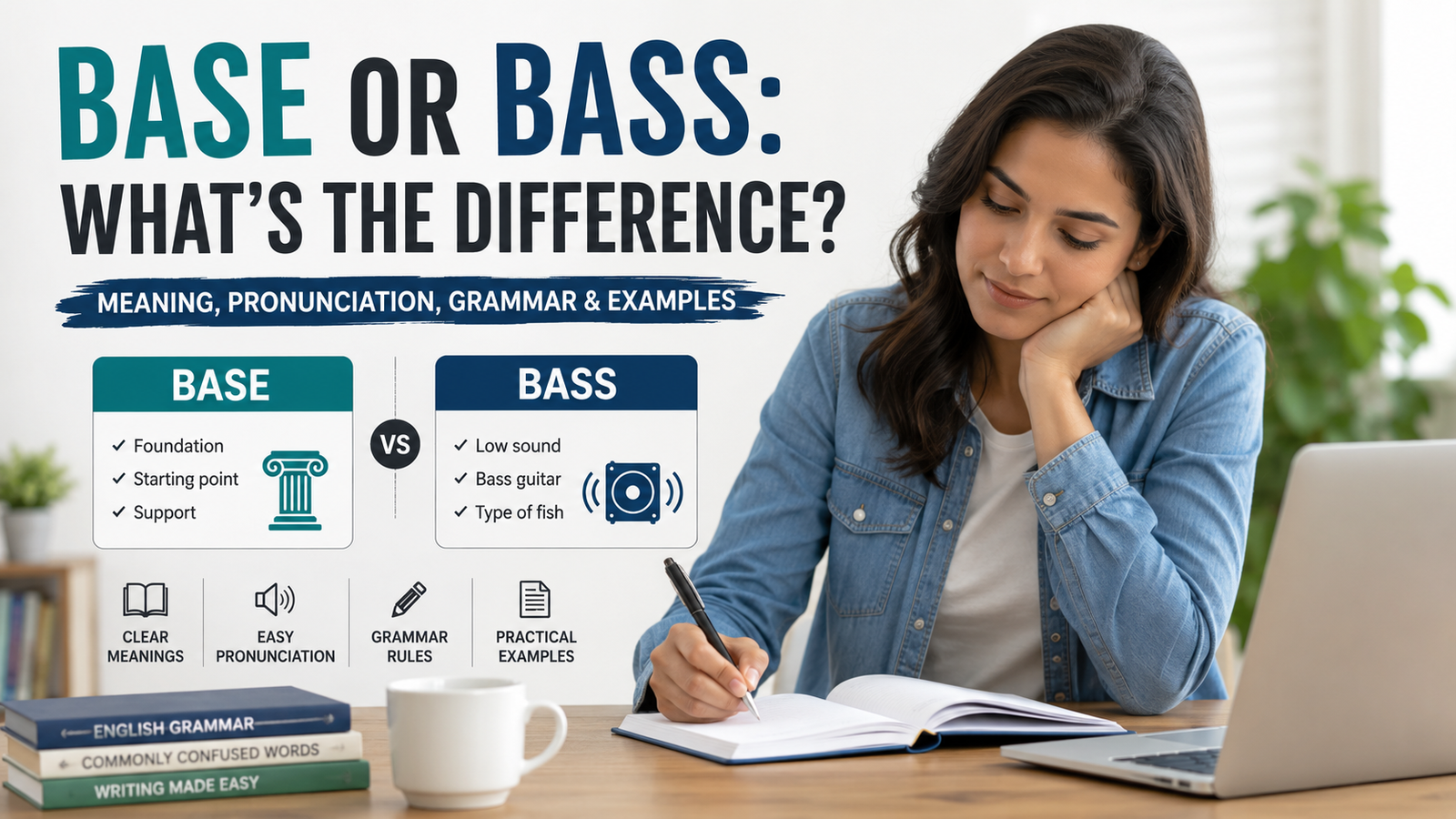
Have you ever paused while writing and wondered whether you should use base or bass? Although these two words look almost identical, they have different meanings, pronunciations, and uses. Choosing the wrong one can confuse your readers, especially when talking about music, fishing, sports, or everyday English.
Understanding the difference between base and bass is easier than it seems once you know the context. In this guide, you’ll learn the meaning of base, the meaning of bass, how to pronounce bass correctly, and when each word is the right choice.
You’ll also find a comparison table, simple grammar tips, practical examples, common mistakes to avoid, and an easy memory trick to help you remember the difference. By the end, you’ll be able to use base and bass confidently in both writing and conversation.
Quick Answer
The difference between base and bass depends on their meaning and pronunciation. Base refers to a foundation, starting point, or support, while bass usually means a low-pitched sound, a bass guitar, a singing voice, or a type of fish. Although they look similar, using the correct word depends entirely on the context of your sentence.
Base vs. Bass at a Glance (Comparison Table)
Many people confuse base and bass because they look similar, but they have different meanings and pronunciations. Knowing the difference helps you avoid spelling and speaking mistakes. The table below gives a quick comparison to make things easier.
| Feature | Base | Bass |
| Meaning | A foundation, starting point, or support | A low musical sound, a musical instrument, a deep singing voice, or a type of fish |
| Pronunciation | /beɪs/ (rhymes with face) | Music: /beɪs/ • Fish: /bæs/ |
| Part of Speech | Mostly a noun; sometimes an adjective or verb | Mainly a noun; sometimes an adjective |
| Common Contexts | Sports, business, science, grammar | Music, audio systems, singing, fishing |
| Example | “The building has a strong base.” | “She plays the bass guitar.” |
If you enjoy learning about commonly confused English words, you may also like our guides on Past Tense of Meet and Antithesis vs Juxtaposition, which explain other language topics in a simple and practical way.
What Does “Base” Mean?
The word base has several meanings, but most are connected to the idea of a foundation or starting point. It may refer to the bottom part of an object, the place where something begins, or the main support of a structure.
In sports, for example, a base is one of the stations a baseball player reaches during a game. In business, the term customer base describes the group of people who buy from a company. Meanwhile, science uses base to describe a substance that reacts with acids.
Because base is used across many different subjects, its meaning depends on the context. Understanding the meaning of base makes it easier to choose the correct word and avoid confusing base with bass.
What Does “Bass” Mean?
The word bass has more than one meaning, and its pronunciation changes depending on the context. In music, bass refers to low-pitched sounds, a bass guitar, or the lowest singing voice. In fishing, bass is the name of several popular freshwater and saltwater fish.
This is why you may hear two different pronunciations. When talking about music, bass sounds like base. When talking about the fish, it is pronounced like “bass” in “class.”
Understanding the meaning of bass makes it much easier to use the right word in everyday writing and conversation. Always look at the sentence to decide which meaning is intended.
How Do You Pronounce Base and Bass?
One reason people mix up base and bass is that pronunciation can be confusing. The word base is always pronounced /beɪs/, which rhymes with face and place. The word bass has two pronunciations.
When discussing music, such as a bass guitar, bass speaker, or bass voice, it is also pronounced /beɪs/. However, when referring to the fish, it is pronounced /bæs/, which rhymes with class and glass.
Although the spellings are almost the same, context tells you which pronunciation is correct. Listening to native speakers and practicing with example sentences can help you remember the difference more easily.
Key Differences Between Base and Bass
Although base and bass look alike, they have very different meanings and uses. Base usually refers to a foundation, starting point, support, or main level of something. It is commonly used in sports, business, science, and everyday English.
Bass, on the other hand, is linked to music, low-frequency sound, deep voices, and certain types of fish. Another important difference is pronunciation. Base is always pronounced /beɪs/, while bass can be pronounced /beɪs/ in music or /bæs/ when talking about fish.
Before choosing either word, think about the sentence and its context. This simple habit will help you avoid mistakes and communicate more clearly.
When Should You Use “Base”?
Use base whenever you are talking about a foundation, starting point, main support, or central location. It appears in many everyday expressions, making it a common English word.
For example, a building stands on a strong base, a company grows its customer base, and a team returns to base after completing a task. In baseball, players run from one base to another. In chemistry, a base is a substance that reacts with acids.
These different meanings all share the idea of something that supports or begins another thing. If your sentence is about a foundation or support rather than music or fish, base is almost always the correct choice.
When Should You Use “Bass”?
Choose bass when your sentence relates to music, sound, singing, or fish. In music, bass describes the lowest range of sound and is used for instruments like the bass guitar or bass drum.
Audio systems often have bass speakers that produce deep, powerful sounds. In singing, a bass is a person with the lowest male vocal range. Outside music, bass also refers to several species of freshwater and saltwater fish that are popular with anglers.
The meaning becomes clear from the context, and so does the pronunciation. If your sentence discusses low-pitched sound, musical instruments, deep voices, or fishing, bass is the correct spelling.
Common Mistakes People Make
Many learners confuse base and bass because the words are similar in spelling and, in some situations, pronunciation. A common mistake is writing base guitar instead of bass guitar.
Another is using bass when talking about the foundation of a building or a company’s customer base. Some people also pronounce every form of bass the same way, forgetting that the fish and the musical term have different pronunciations.
The easiest way to avoid these mistakes is to think about the meaning before you write. Ask yourself whether the sentence is about a foundation, music, or fish. The answer will quickly guide you to the correct word.
Memory Tricks to Remember the Difference
A simple memory trick can help you remember the difference between base and bass. Think of base as the base of a building or the base of a mountain. Both remind you of a foundation or starting point.
For bass, picture a bass guitar, a speaker with deep bass, or a person singing in a deep voice. If you enjoy fishing, imagine catching a bass in a lake. Creating these mental pictures makes the meanings easier to remember.
You can also remember that bass guitar produces low bass sounds, while base supports something from below. These easy associations make choosing the correct word much simpler.
Real-Life Example Sentences
Reading examples is one of the best ways to understand base and bass. Here are a few simple sentences:
- The statue stands on a solid base.
- Our company has a loyal customer base.
- The hikers returned safely to their base camp.
- She plays the bass guitar in a local band.
- The concert hall was filled with deep bass sounds.
- He has a powerful bass singing voice.
- We caught a large bass while fishing at the lake.
- The building’s base was made of strong stone.
These examples show that base usually means a foundation or starting point, while bass relates to music, sound, singing, or fish.
Base vs. Bass Quiz
Test your understanding with this short quiz.
1. The drummer adjusted the ______ before the concert.
- a) base
- b) bass
2. The monument rests on a strong ______.
- a) base
- b) bass
3. We caught a huge ______ during our fishing trip.
- a) base
- b) bass
4. The company has a growing customer ______.
- a) base
- b) bass
Answers: 1–b, 2–a, 3–b, 4–a.
If you answered all four correctly, you now understand the meaning, pronunciation, and usage of base and bass much better.
FAQs
Is it base or bass?
It depends on the meaning. Base refers to a foundation or starting point, while bass refers to low-pitched sound, a musical instrument, a deep singing voice, or a type of fish.
Why is bass pronounced differently?
The word bass has two accepted pronunciations. In music, it sounds like base. When referring to the fish, it is pronounced /bæs/.
Is “base guitar” correct?
No. The correct term is bass guitar because it is a musical instrument that produces low-frequency sounds.
Can base and bass be used interchangeably?
No. They have different meanings and should only be used in their correct contexts.
Conclusion
Understanding the difference between base and bass is easier once you know their meanings and where they are used. Base refers to a foundation, support, or starting point, while bass is connected with music, deep sounds, singing, and certain fish.
Paying attention to the context will help you choose the correct spelling and pronunciation every time. When in doubt, ask yourself what the sentence is describing. If it is about support or a beginning, use base.
If it is about music, audio, voices, or fish, use bass. With regular practice and the examples in this guide, you’ll be able to use both words naturally and confidently in everyday English.