

If you’ve ever wondered about the past tense of meet, you’re not alone. Many English learners ask whether the correct form is met or meeted, and the answer can be confusing if you’re still learning English grammar.
The good news is that the rule is simple once you understand how this irregular verb works. In this guide, you’ll learn the past tense of meet, the past participle of meet, and all the important verb forms in clear, everyday language.
You’ll also find grammar tips, easy examples, common mistakes to avoid, and a helpful comparison of meet and met. Whether you’re a student, teacher, writer, or someone improving your English, this article will help you use meet correctly and confidently in both speaking and writing.
Quick Answer
The past tense of meet is met, and the past participle of meet is also met. Because meet is an irregular verb, it does not become meeted. For example, “I met my teacher yesterday” is correct, while “I meeted my teacher yesterday” is incorrect. Use met for both the simple past and perfect tenses.
Meet at a Glance (Verb Forms Table)
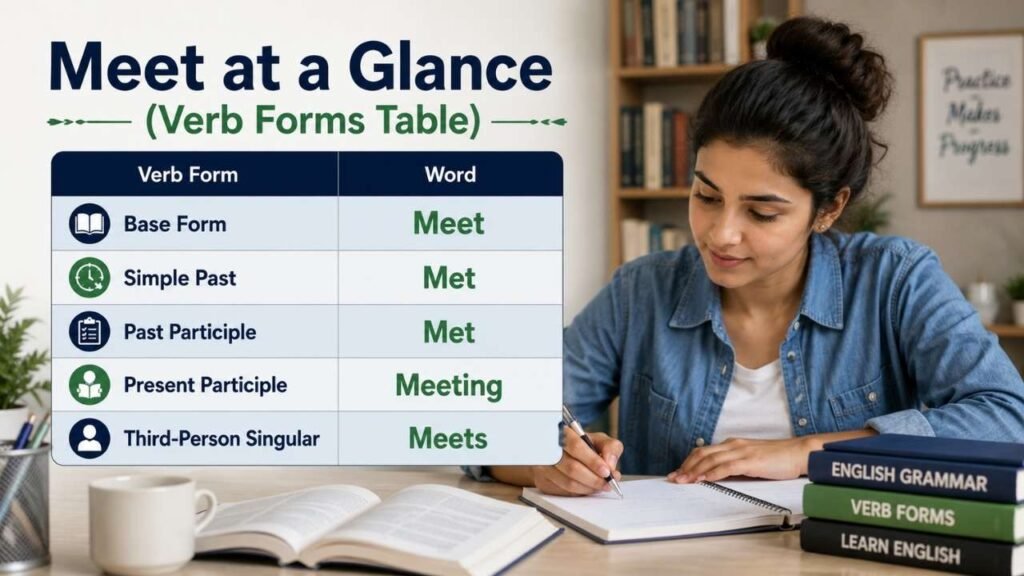
Learning the verb forms of meet is the easiest way to remember how to use this irregular verb correctly. Unlike regular verbs that usually end in -ed, meet changes to met in both the simple past and the past participle.
This is why meeted is never correct. The table below gives you a quick reference whenever you need to use the verb in speaking or writing. Understanding these forms will help you build correct sentences and avoid common grammar mistakes.
| Verb Form | Word |
| Base Form | Meet |
| Simple Past | Met |
| Past Participle | Met |
| Present Participle | Meeting |
| Third-Person Singular | Meets |
Is Meet a Regular or Irregular Verb?
The verb meet is an irregular verb, which means it does not follow the usual grammar rule of adding -ed to form the past tense. Instead, the past tense of meet becomes met, and the past participle of meet is also met.
This pattern is common among many frequently used English verbs. Because the spelling changes, learners sometimes mistakenly write meeted, but that form is incorrect. The best way to remember this rule is through regular practice and reading.
If you’re learning similar grammar topics, you may also enjoy our guide on Coach vs Couch, which explains another pair of commonly confused English words in a simple and practical way.
What Is the Past Participle of Meet?
The past participle of meet is met. It looks the same as the simple past form, but it is used differently in a sentence. You use met with helping verbs such as has, have, or had to create perfect tenses.
For example, “She has met the new manager” and “They had met before the event” are both correct. Knowing the difference between the past tense and the past participle helps you write more accurate English.
Although both forms are met, the helping verb tells you which tense is being used. This simple grammar rule becomes much easier once you see it in everyday examples.
How to Use “Met” Correctly in Sentences
Using met correctly is easy when you know when the action happened. If the meeting already took place, use met as the simple past tense. For example, “I met my classmates after school,” or “We met our neighbors last weekend.”
When using perfect tenses, add a helping verb before met, such as “I have met many helpful people.” Reading and writing complete sentences is one of the best ways to remember this rule.
Just as understanding grammar helps improve your writing, learning literary concepts like Antithesis vs Juxtaposition can also strengthen your overall English skills by showing how different ideas work together in effective communication.
Why “Meeted” Is Incorrect
Many English learners wonder whether meeted is the correct past tense of meet, but it is not. Since meet is an irregular verb, it changes to met instead of adding -ed. The correct sentence is “I met my teacher yesterday,” not “I meeted my teacher yesterday.”
This mistake often happens because many regular verbs follow a different pattern, such as walk → walked or play → played. The easiest way to remember the rule is to practice using met in everyday conversations and writing.
Once you become familiar with the verb forms, using the correct past tense will feel natural and improve both your spoken and written English.
Meet in All Major Tenses (Comparison Table)
Knowing how meet changes in different tenses makes it easier to speak and write with confidence. Although the past tense of meet is met, the verb takes different forms depending on the tense.
The table below shows the most common verb forms and how they are used. Learning these patterns will help you avoid mistakes and improve your English grammar. Practice reading the example sentences aloud to become more familiar with each tense.
| Tense | Example Sentence |
| Present Simple | I meet my friends every Friday. |
| Past Simple | I met my friends yesterday. |
| Present Perfect | I have met many kind people. |
| Past Perfect | I had met her before the conference. |
| Future Simple | I will meet the team tomorrow. |
| Future Perfect | I will have met everyone by next week. |
Common Expressions and Phrases with “Meet”
The verb meet appears in many everyday expressions, making it an important word to learn. These phrases are common in conversations, school, and the workplace.
For example, meet expectations means to do as well as others hoped, while meet a deadline means to finish work on time. You may also hear meet someone halfway, which means both people make a fair compromise. Other useful expressions include meet the requirements, meet in person, and meet the challenge.
Learning these phrases will help you sound more natural when speaking English. Instead of memorizing them one by one, try using each expression in your own sentences to understand how it fits different situations.
Common Mistakes Learners Make with Meet
Even though meet is a common verb, learners often make a few grammar mistakes. The biggest error is writing meeted instead of met. Remember that meet is an irregular verb, so its simple past and past participle are both met.
Another mistake is using the wrong tense, such as “I have met him yesterday.” Since yesterday refers to a finished time, the correct sentence is “I met him yesterday.”
Some learners also confuse meet with meeting, but meeting is the present participle or a noun. Paying attention to the time words in a sentence will help you choose the correct verb form every time.
Meet vs Met: What’s the Difference?
Although meet and met come from the same verb, they are used in different situations. Meet is the base form and is used for the present tense, infinitive, and future tense. For example, “I meet new people every week” and “I will meet my cousin tomorrow.”
Met, on the other hand, is used as both the past tense and past participle. You would say, “I met my cousin yesterday” or “I have met her before.” The easiest way to remember the difference is to think about the time of the action. If the event already happened, met is usually the correct choice.
| Word | When to Use It | Example |
| Meet | Present or future actions | We meet every Monday. |
| Met | Past tense or past participle | We met last Monday. |
Mini Quiz: Test Your Understanding
Now it’s time to check what you’ve learned about the past tense of meet. Try answering these questions before looking at the answers. This short quiz is a great way to remember the correct verb forms.
1. What is the past tense of meet?
- A. Meeted
- B. Met
- C. Meeting
2. Which sentence is correct?
- A. I meeted my teacher yesterday.
- B. I met my teacher yesterday.
- C. I have met yesterday.
3. What is the past participle of meet?
- A. Meet
- B. Meeting
- C. Met
Answers: 1–B, 2–B, 3–C. If you answered all three correctly, you’ve mastered the basic grammar rule.
FAQs
Is met the past tense of meet?
Yes. Met is the correct past tense of meet and is also the past participle.
Is meeted a real word?
No. Meeted is incorrect because meet is an irregular verb.
What is the past participle of meet?
The past participle of meet is met. Use it with has, have, or had.
Is meet a regular or irregular verb?
Meet is an irregular verb because it changes to met instead of adding -ed.
How do I use met in a sentence?
Example: “We met our new neighbors last weekend.”
Can met be used in perfect tenses?
Yes. For example, “She has met the manager before.”
How can I remember the correct form?
Practice using met in daily conversations and remember that meet changes just like many other irregular verbs.
Conclusion
The past tense of meet is met, and the past participle of meet is also met. Since meet is an irregular verb, the form meeted is always incorrect.
By learning the different verb forms, understanding when to use met, and practicing with real-life examples, you can avoid common grammar mistakes with confidence.
Keep the verb table handy, review the example sentences, and use meet in your daily writing and conversations. With regular practice, choosing the correct form will become natural, helping you communicate more clearly and accurately in English.