
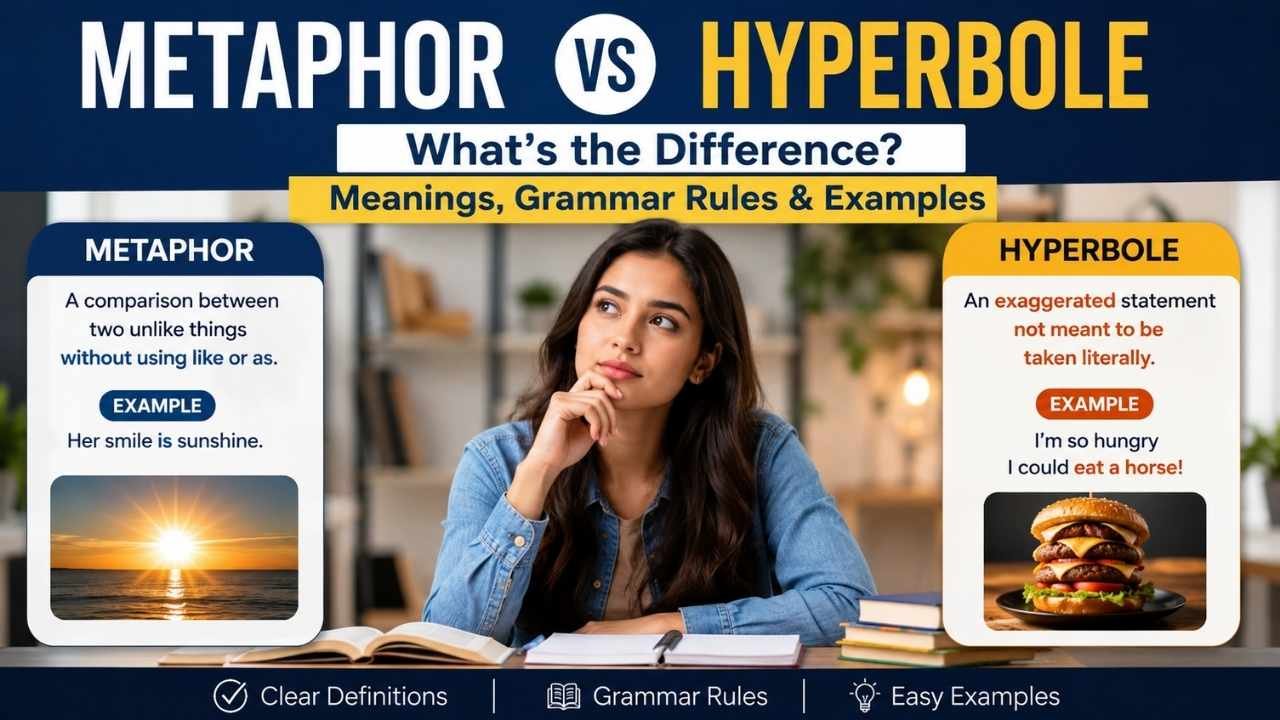
Have you ever wondered about the difference between metaphor vs hyperbole? These two figures of speech are often confused because they both make writing more interesting, but they work in different ways.
A metaphor creates an implied comparison by saying one thing is another, while a hyperbole uses deliberate exaggeration to add emphasis or express strong feelings. Knowing the difference between metaphor and hyperbole can improve your writing, speaking, and reading skills.
Whether you are a student, teacher, writer, or someone learning English, understanding these literary devices will help you recognize them with confidence. In this guide, you’ll find clear metaphor and hyperbole definitions, easy-to-follow explanations, comparison tables, and plenty of metaphor vs hyperbole examples to help you use each one correctly in everyday language and literature.
Quick Answer
The main difference between metaphor and hyperbole is that a metaphor compares two unlike things by saying one thing is another, while a hyperbole uses intentional exaggeration for emphasis. Both are figures of speech used to make writing more engaging, but metaphors create vivid comparisons, whereas hyperboles highlight ideas through dramatic overstatement.
Metaphor vs Hyperbole at a Glance (Comparison Table)
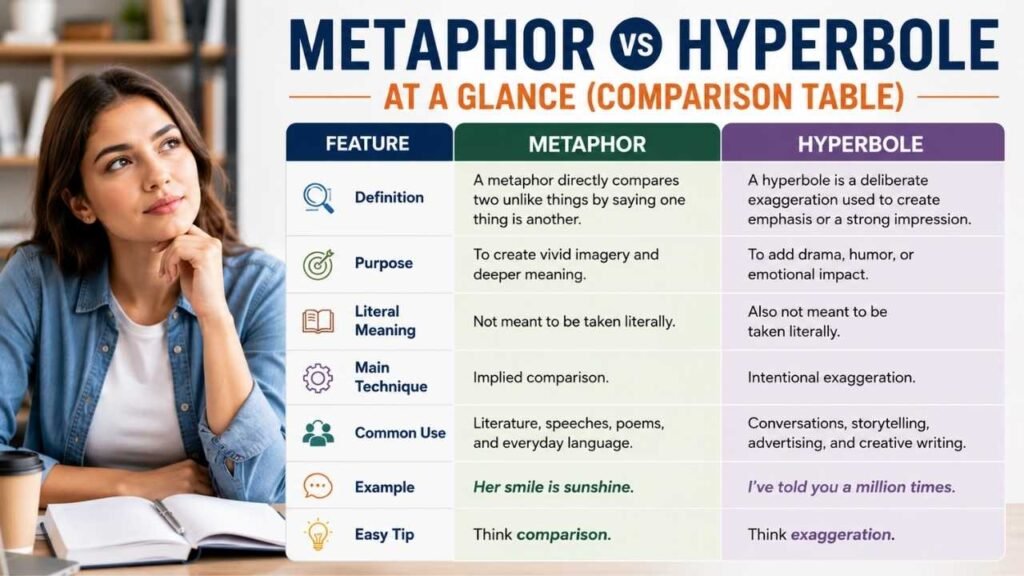
| Feature | Metaphor | Hyperbole |
| Definition | A metaphor directly compares two unlike things by saying one thing is another. | A hyperbole is a deliberate exaggeration used to create emphasis or a strong impression. |
| Purpose | To create vivid imagery and deeper meaning. | To add drama, humor, or emotional impact. |
| Literal Meaning | Not meant to be taken literally. | Also not meant to be taken literally. |
| Main Technique | Implied comparison. | Intentional exaggeration. |
| Common Use | Literature, speeches, poems, and everyday language. | Conversations, storytelling, advertising, and creative writing. |
| Example | Her smile is sunshine. | I’ve told you a million times. |
| Easy Tip | Think comparison. | Think exaggeration. |
What Is a Metaphor?
A metaphor is a figure of speech that compares two different things by saying one thing is another. Instead of using words like “as” or “like,” it creates an implied comparison that helps readers picture an idea more clearly.
For example, saying “Time is a thief” suggests that time quietly takes away moments from our lives. Metaphors make writing more colorful, memorable, and meaningful. They are widely used in books, poems, speeches, songs, and even everyday conversations.
Learning the metaphor definition makes it easier to understand the difference between metaphor and hyperbole. If you’re interested in grammar topics, you may also enjoy learning about the Past Tense of Troubleshoot, another useful guide for improving your English skills.
What Is a Hyperbole?
A hyperbole is a figure of speech that uses intentional exaggeration to emphasize an idea or express strong emotions. Unlike a metaphor, a hyperbole does not compare two things. Instead, it stretches the truth in a way that readers know is not meant to be taken literally.
For example, “I’m so hungry I could eat a horse” simply means someone is very hungry, not that they will actually eat a horse. Writers, speakers, and advertisers often use hyperboles to make their message more exciting or humorous.
Understanding the hyperbole definition is important when comparing metaphor vs hyperbole, as it helps you recognize when exaggeration is being used instead of comparison.
Key Differences Between Metaphor and Hyperbole
The biggest difference between metaphor and hyperbole is how each expresses an idea. A metaphor makes an implied comparison by saying one thing is another, helping readers imagine something in a fresh way. A hyperbole, however, uses obvious exaggeration to create emphasis or strong emotion.
For instance, “The classroom was a zoo” is a metaphor because it compares a noisy classroom to a zoo. On the other hand, “This backpack weighs a ton” is a hyperbole because it exaggerates the backpack’s weight.
Although both are literary devices and forms of figurative language, they serve different purposes. Understanding these differences helps you identify metaphor and hyperbole examples more accurately in writing and speech.
Similarities Between Metaphor and Hyperbole
Although metaphor and hyperbole are different, they also share several similarities. Both are figures of speech that make language more creative and engaging. Neither should be understood literally because each expresses ideas in an imaginative way.
Writers use both devices to capture attention, create stronger emotions, and make descriptions more memorable. You will often find them in novels, poems, speeches, advertisements, and everyday conversations.
Learning these similarities also makes it easier to tell them apart when reading or writing. As you continue improving your English, exploring topics like the Past Tense of Put can also strengthen your grammar knowledge while helping you become a more confident communicator.
Metaphor vs Hyperbole Examples in Everyday English
You can find metaphor vs hyperbole examples almost everywhere, from casual conversations to social media posts. A metaphor creates a direct comparison, while a hyperbole uses exaggeration for effect.
For example, “My phone is my lifeline” is a metaphor because it compares a phone to something essential for survival. In contrast, “My phone battery dies every five seconds” is a hyperbole because it exaggerates how quickly the battery runs out.
People also say “He’s a walking encyclopedia” as a metaphor or “I’ve waited forever” as a hyperbole. Understanding these everyday examples makes it easier to identify metaphor and hyperbole in real life and use each one naturally in your own speaking and writing.
Metaphor vs Hyperbole in Literature and Poetry
Authors often use metaphors and hyperboles to make their writing more powerful and memorable. A metaphor helps readers imagine an idea by making an implied comparison, while a hyperbole adds emotion through dramatic exaggeration.
For example, Shakespeare wrote, “All the world’s a stage,” comparing life to a stage without using like or as. A hyperbole might describe someone’s sadness by saying, “She cried an ocean of tears.”
Readers know this is impossible, but the exaggeration highlights deep emotion. Whether in novels, poems, or speeches, these literary devices make stories more engaging. Learning metaphor vs hyperbole in literature also improves reading comprehension and creative writing skills.
Common Mistakes and How to Avoid Them
One common mistake is thinking every dramatic sentence is a metaphor or every comparison is a hyperbole. Remember that a metaphor compares two unlike things directly, while a hyperbole exaggerates reality.
For example, “The test was a mountain” is a metaphor because it compares the test to a mountain. However, “The test took a thousand years” is a hyperbole because it exaggerates the time.
Another mistake is taking these expressions literally. Since both are forms of figurative language, their meanings go beyond the actual words. Reading more examples and practicing with different sentences will help you recognize the difference between metaphor and hyperbole with greater confidence.
Memory Tricks to Tell Metaphor and Hyperbole Apart
A simple memory trick can help you remember metaphor vs hyperbole without confusion. Think of the letter “M” in Metaphor as standing for Match because it matches or compares two different things.
Then remember the letter “H” in Hyperbole as standing for Huge because it makes something seem much bigger, stronger, or more dramatic than it really is.
Another easy tip is to ask yourself a question: Is this sentence making a comparison or an exaggeration? If it compares, it is probably a metaphor. If it stretches the truth for emphasis, it is a hyperbole. These quick tricks make identifying both figures of speech much easier.
Practice Quiz: Can You Identify the Figure of Speech?
Test your understanding of metaphor and hyperbole with these examples. Decide whether each sentence is a metaphor or a hyperbole before checking the answers.
1. “Her voice is music to my ears.”
2. “I have a mountain of homework.”
3. “The wind whispered through the trees.”
4. “I’m so tired I could sleep for a year.”
Answers:
Sentence 1 is a metaphor because it compares a voice to music.
Sentence 2 is a hyperbole because it exaggerates the amount of homework.
Sentence 3 is a metaphor with imaginative comparison, while
Sentence 4 is a hyperbole because sleeping for a year is impossible.
Related Figures of Speech You Should Know
Understanding metaphor vs hyperbole becomes even easier when you learn other figures of speech. A simile compares two things using like or as, such as “She runs like the wind.”
Personification gives human qualities to non-human things, as in “The flowers danced in the breeze.” An idiom has a meaning that differs from the literal words, such as “Break the ice.”
An analogy explains one idea by comparing it to another in greater detail. Learning these related literary devices helps you recognize different writing styles and choose the right expression when speaking or writing.
FAQs
Is a metaphor the same as a hyperbole?
No. A metaphor makes a direct comparison, while a hyperbole uses deliberate exaggeration. Both are figurative language, but they achieve different effects.
Can a sentence contain both a metaphor and a hyperbole?
Yes. A writer can combine both devices in one sentence to create a stronger image and greater emotional impact.
Why do writers use metaphors?
Writers use metaphors to explain ideas through vivid comparisons, making descriptions more memorable and engaging.
Why do writers use hyperboles?
Hyperboles emphasize emotions, add humor, and make important ideas stand out without being taken literally.
How can I quickly tell them apart?
Ask yourself whether the sentence is making a comparison or an exaggeration. Comparisons usually indicate a metaphor, while exaggerations point to a hyperbole.
Conclusion
Understanding the difference between metaphor and hyperbole helps you become a better reader, writer, and speaker. A metaphor creates meaning through direct comparison, while a hyperbole adds excitement with intentional exaggeration.
Although both are popular literary devices, knowing when and how to use each will make your communication clearer and more effective. The easiest way to master them is by reading examples, practicing regularly, and paying attention to how they appear in books, conversations, and media.
With time, recognizing metaphor and hyperbole examples will become natural, allowing you to use these powerful figures of speech confidently in both everyday English and creative writing.