
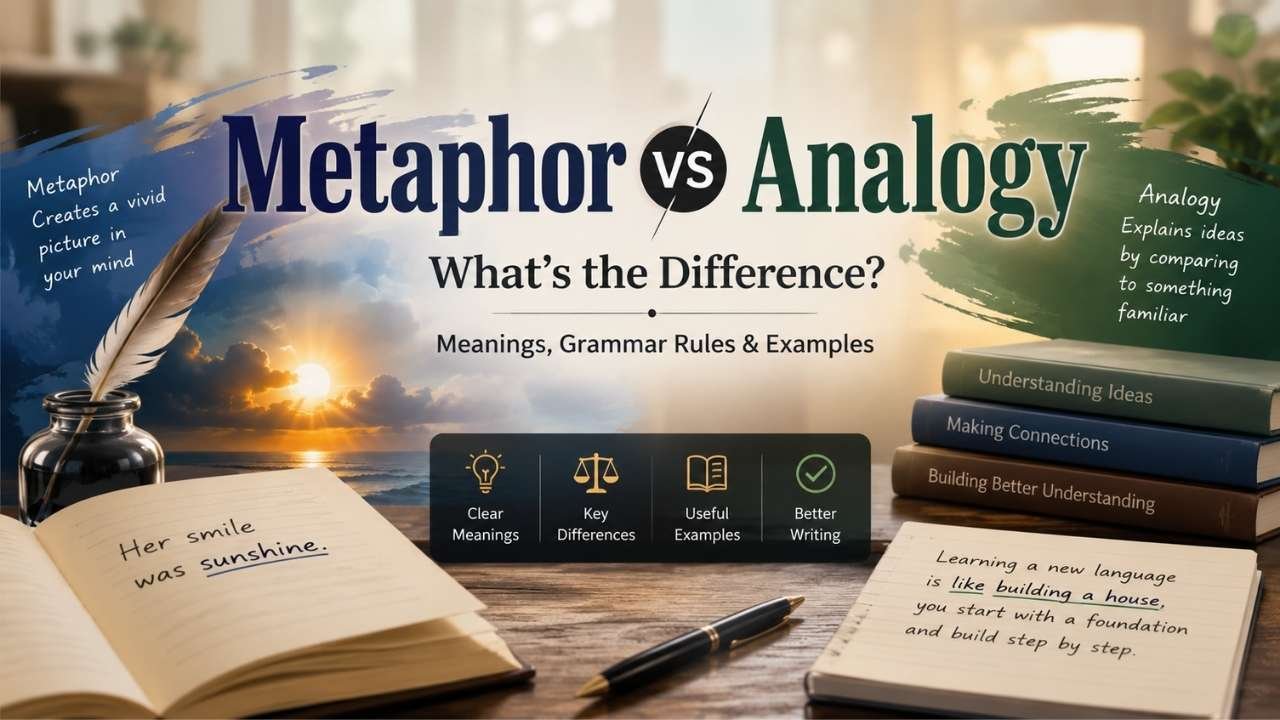
Have you ever wondered about the difference between a metaphor and an analogy? Many people use these terms as if they mean the same thing, but they serve different purposes in writing and speech. Understanding metaphor vs analogy can help you communicate ideas more clearly and make your writing more engaging.
A metaphor creates a vivid comparison by saying one thing is another, while an analogy explains an idea by comparing it with something familiar. Whether you’re a student, writer, teacher, or English learner, knowing when to use a metaphor and when to use an analogy can improve your communication skills.
In this guide, you’ll learn the meaning, definitions, key differences, practical examples, and simple tips to identify and use each correctly with confidence.
Quick Answer
The difference between a metaphor and an analogy is that a metaphor makes a direct figurative comparison by saying one thing is another, while an analogy explains an idea by comparing it to something more familiar. In simple terms, metaphors create imagery, whereas analogies improve understanding. Although a metaphor can be part of an analogy, the two are not the same.
Metaphor vs Analogy at a Glance (Comparison Table)
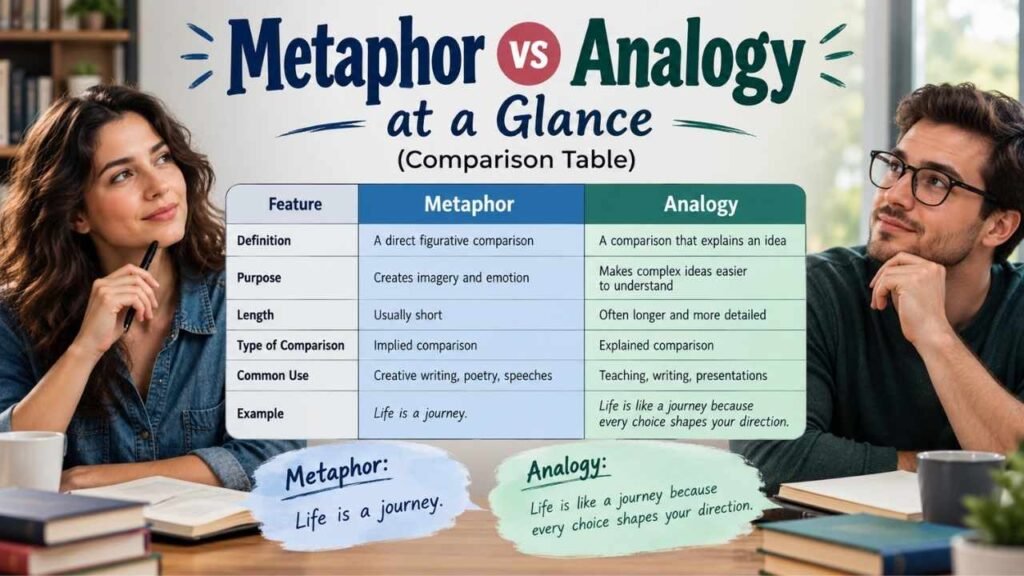
Before exploring each term in detail, it helps to compare metaphor vs analogy side by side. Both are common literary devices used in figurative language, but they have different purposes.
A metaphor creates a direct comparison to add emotion and imagery, while an analogy explains an idea by comparing it with something familiar. Knowing the difference between metaphor and analogy makes it easier to choose the right one for your writing.
If you’re still learning other figures of speech, our guide on Metaphor vs Hyperbole explains another commonly confused pair. The table below gives a quick overview of analogy vs metaphor, including their meanings, uses, and examples.
| Feature | Metaphor | Analogy |
| Definition | A direct figurative comparison | A comparison that explains an idea |
| Purpose | Creates imagery and emotion | Makes complex ideas easier to understand |
| Length | Usually short | Often longer and more detailed |
| Type of Comparison | Implied comparison | Explained comparison |
| Common Use | Creative writing, poetry, speeches | Teaching, writing, presentations |
| Example | Life is a journey. | Life is like a journey because every choice shapes your direction. |
What Is a Metaphor?
A metaphor is a figure of speech that compares two different things by saying one thing is another. It does not use words like “like” or “as.” Instead, it creates a strong image that helps readers understand emotions or ideas in a creative way.
For example, saying “Her smile was sunshine” suggests that her smile was warm and cheerful. Writers often use metaphors in writing to make stories, speeches, and poems more interesting.
A metaphor is not meant to be taken literally because it expresses a deeper meaning. If you’re improving your English skills, understanding grammar is equally important. You can also read our guide on the Past Tense of Put to strengthen your everyday writing alongside learning figurative language.
What Is an Analogy?
An analogy is a comparison that helps explain one idea by relating it to something more familiar. Unlike a metaphor, an analogy usually includes more detail and focuses on making a concept easier to understand rather than creating vivid imagery.
For example, saying “Learning a new language is like building a house because you start with a strong foundation before adding more parts” is an analogy. It explains the learning process through a familiar example.
Analogy meaning is closely connected to explanation and understanding, making it useful in education, business, science, and everyday conversations. Good analogy examples simplify difficult topics, helping readers or listeners understand ideas quickly without feeling confused.
Metaphor vs Analogy: Key Differences Explained
The biggest difference between metaphor and analogy is their purpose. A metaphor creates a direct figurative comparison that adds emotion, creativity, and strong imagery. An analogy, however, uses comparison to explain an idea clearly and logically.
A metaphor is usually short, while an analogy is often longer because it develops the comparison in more detail. For example, “Knowledge is a key” is a metaphor because it creates an image.
“Knowledge is like a key because it opens new opportunities” is an analogy because it explains the comparison. Understanding metaphor vs analogy examples helps writers choose the right technique for storytelling, teaching, presentations, and everyday communication.
Can a Metaphor Be Part of an Analogy?
Yes, a metaphor can be part of an analogy, which is one reason many people confuse the two. An analogy often includes one or more metaphors to make its explanation stronger and easier to remember.
However, not every metaphor is an analogy, and not every analogy depends on a metaphor. Think of an analogy as a complete explanation and a metaphor as one tool that can support it.
For example, saying “A good leader is a lighthouse” is a metaphor. Expanding that idea by explaining how a lighthouse guides ships through storms turns it into an analogy. This simple relationship makes analogy and metaphor explained much easier to understand.
When Should You Use a Metaphor Instead of an Analogy?
Use a metaphor when you want your words to create emotion, vivid imagery, or a memorable picture in the reader’s mind. Metaphors work well in stories, poems, speeches, advertisements, and creative writing because they make ideas feel more powerful.
Choose an analogy when your goal is to teach, explain, or simplify a difficult concept. Teachers, trainers, and business professionals often rely on analogies to make information easier to understand.
Before deciding which one to use, think about your audience and purpose. If you want readers to imagine something, use a metaphor. If you want them to understand something step by step, an analogy is usually the better choice.
Common Mistakes People Make
Many people make mistakes when using metaphors and analogies because both involve comparisons. The most common mistake is thinking they are exactly the same. A metaphor creates a direct figurative comparison, while an analogy explains an idea through a more detailed comparison.
Another mistake is confusing a metaphor with a simile, which uses words like “like” or “as.” Some writers also force comparisons that do not make sense, making their message confusing instead of helpful.
To avoid these errors, always ask yourself whether you want to create vivid imagery or explain an idea clearly. Understanding this simple difference will help you write naturally and communicate with confidence.
Real-Life Examples of Metaphors and Analogies
Seeing metaphor vs analogy examples in everyday life makes the difference much easier to understand. A metaphor might be, “The classroom was a zoo,” suggesting the students were noisy and energetic.
An analogy could be, “Managing a classroom is like conducting an orchestra because every student has a different role, but they must work together.” In business, someone might say, “Time is money,” which is a metaphor.
A manager explaining that saving time is like saving money because both are valuable resources is using an analogy. These practical examples show how both techniques improve communication, but each serves a different purpose depending on the situation.
Metaphor vs Analogy vs Simile
People often compare metaphor vs analogy vs simile because all three involve making comparisons. However, they work in different ways. A metaphor says one thing is another to create imagery.
A simile compares two things using “like” or “as,” making the comparison more direct and easier to recognize. An analogy is broader because it explains a concept by showing how two things are similar in several ways.
For example, “Her voice is music” is a metaphor, “Her voice is like music” is a simile, and explaining why her voice comforts people just as music does becomes an analogy. Knowing these differences strengthens your writing and speaking skills.
Tips for Identifying Metaphors and Analogies Quickly
You can quickly identify a metaphor by checking whether one thing is described as another without using “like” or “as.” If the comparison creates an image or emotion, it is likely a metaphor.
To recognize an analogy, look for a longer explanation that helps clarify an idea by comparing it with something familiar. Ask yourself a simple question: Is this comparison meant to paint a picture or explain something? If it paints a picture, it is probably a metaphor.
If it teaches or explains, it is an analogy. Practicing with everyday examples from books, speeches, movies, and conversations will help you identify both naturally and use them with greater confidence.
FAQs
Is a metaphor the same as an analogy?
No. A metaphor creates a direct figurative comparison, while an analogy explains an idea through a more detailed comparison.
Can an analogy include a metaphor?
Yes. An analogy can include one or more metaphors to make its explanation stronger and easier to understand.
Which is longer, a metaphor or an analogy?
A metaphor is usually short, while an analogy is often longer because it explains the relationship between two ideas.
Is a simile an analogy?
Not always. A simile is a type of comparison using “like” or “as,” while an analogy is a broader explanation that may include similes or metaphors.
Why do writers use metaphors?
Writers use metaphors to create vivid imagery, express emotions, and make their writing more memorable.
Why are analogies useful?
Analogies simplify complex ideas, making them easier for readers or listeners to understand.
How can I tell the difference quickly?
Remember this simple rule: metaphors create imagery, while analogies create understanding.
Conclusion
Understanding metaphor vs analogy is easier once you know the purpose behind each comparison. A metaphor brings ideas to life through vivid imagery and emotion, while an analogy explains unfamiliar concepts by comparing them with something familiar. Although they are closely related and sometimes work together, they are not interchangeable.
Learning the difference between metaphor and analogy will help you write more clearly, communicate your ideas effectively, and avoid common mistakes.
Whether you’re writing an essay, giving a presentation, or improving your everyday English, choosing the right comparison makes your message stronger. Keep practicing with original examples, and you’ll soon recognize when to use a metaphor, an analogy, or even a simile with confidence.