

Have you ever paused while writing and wondered whether you should use follow up, follow-up, or followup? You’re not alone. This is one of the most common questions in English grammar because each form has a different purpose. Choosing the correct spelling depends on whether you’re using the term as a verb, noun, or adjective.
Understanding these grammar rules can improve your business writing, email writing, academic work, and everyday communication. In this guide, you’ll learn the difference between follow up and follow-up, discover when hyphenated words are necessary, and see plenty of real-life examples.
We’ll also answer common questions such as “Is follow up hyphenated?”, “Is follow-up one word?”, and “Is followup correct?” By the end, you’ll know exactly which form to use with confidence in any situation.
Quick Answer
Follow up is a verb phrase meaning to take further action, while follow-up is a noun or adjective used for a later action or related item. For example, “I will follow up tomorrow” uses the verb form, while “She sent a follow-up email” uses the adjective form. Followup also appears as a closed compound in some contexts, but follow-up is widely preferred for nouns and adjectives.
Follow Up vs. Follow-Up at a Glance (Comparison Table)
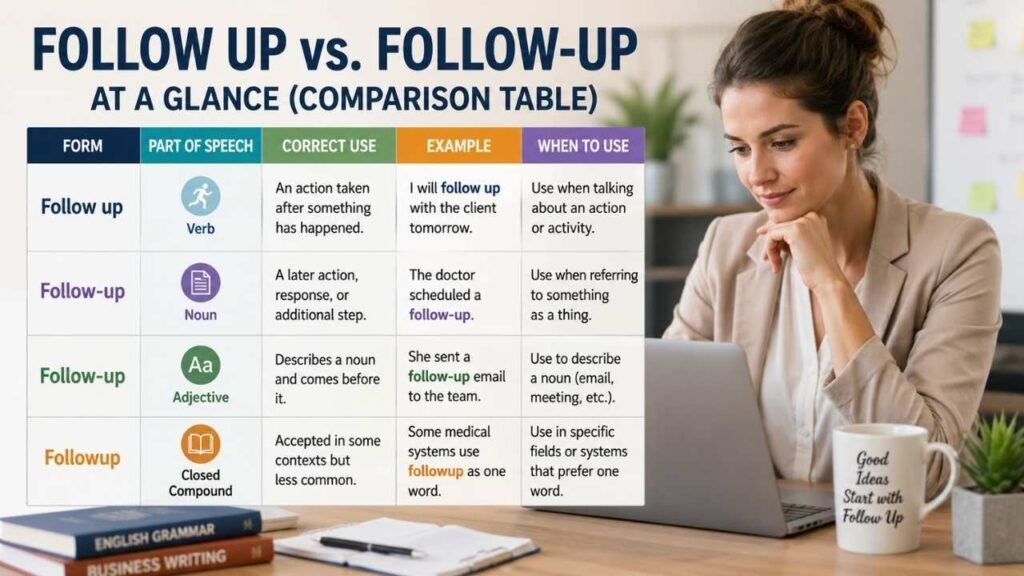
Many writers get confused because follow up, follow-up, and followup look similar but serve different purposes. The easiest way to choose the correct form is to identify how the word functions in your sentence. If it describes an action, use follow up.
If it names a thing or describes another noun, use follow-up. Although followup appears as a closed compound in some dictionaries and specialized industries, it is less common in everyday writing. The table below offers a quick comparison to help you avoid mistakes in business writing, email writing, academic work, and daily communication.
| Form | Part of Speech | Correct Use | Example |
| Follow up | Verb | An action taken later | I will follow up with the client tomorrow. |
| Follow-up | Noun | A later action or response | The doctor scheduled a follow-up. |
| Follow-up | Adjective | Describes a noun | She sent a follow-up email. |
| Followup | Closed compound | Accepted in some contexts but less common | Some medical systems use followup as one word. |
What Does “Follow Up” Mean?
The phrase follow up means to continue something, check on progress, or take another action after an earlier event. People commonly use it in professional communication, healthcare, education, customer service, and everyday conversations.
For example, a manager may follow up on a project, a teacher may follow up with students after an exam, or a doctor may contact a patient after treatment. While the basic meaning stays the same, the spelling changes depending on whether the phrase acts as a verb, noun, or adjective.
Understanding this simple grammar rule helps you write more accurately and confidently. If you enjoy learning how English figures of speech differ, you may also like our guide on Metaphor vs Hyperbole.
When to Use “Follow Up” (Verb)
Use follow up as a verb whenever you are talking about taking action after something has already happened. Since it functions as a verb phrase, the two words remain separate and are not hyphenated. You might follow up after a meeting, follow up with a customer, or follow up on an email.
This is the correct form in most English grammar and business writing. A helpful question to ask yourself is, “Can someone perform this action?” If the answer is yes, follow up is the right choice.
Similar grammar patterns appear in other language topics, such as Metaphor vs Analogy, where understanding each term’s function helps you choose the correct one.
Examples:
- I will follow up with the client next week.
- Please follow up on your job application.
- The nurse will follow up after your appointment.
- Our team plans to follow up with every customer.
When to Use “Follow-Up” (Noun)
Use follow-up with a hyphen when it acts as a noun, meaning a later action, meeting, phone call, email, or appointment. Instead of describing an action, it names the thing itself. This form is especially common in healthcare, business communication, and customer support.
For example, a doctor may schedule a follow-up after treatment, or a company may send a follow-up to answer a customer’s questions. Remember that if you can place words like a, an, or the before it, you are probably using the noun form.
This simple rule makes it easier to choose the correct spelling and avoid common writing mistakes.
Examples:
- The doctor arranged a follow-up for next month.
- We received a follow-up after the interview.
- Her follow-up answered every question clearly.
- The customer appreciated the quick follow-up.
When to Use “Follow-Up” (Adjective)
Use follow-up as an adjective when it describes another noun. In this role, the hyphen connects the two words because they work together as a single modifier before a noun. You will often see this form in phrases like follow-up email, follow-up meeting, follow-up appointment, or follow-up report.
The hyphen improves clarity and follows the standard rule for many compound adjectives in English grammar.
If follow-up appears directly before a noun and explains what kind of noun it is, the hyphenated form is almost always the correct choice. Using it correctly makes your writing look more polished and professional.
Examples:
- She sent a follow-up email after the interview.
- We scheduled a follow-up meeting for Friday.
- The patient received follow-up care after surgery.
- The manager prepared a follow-up report for the team.
Is “Followup” One Word Correct?
Many writers ask, “Is followup correct?” The answer is yes, but only in some situations. Followup as one word appears in a few dictionaries and is sometimes used in medical records, software systems, and technical writing.
However, it is less common than follow up and follow-up. Most style guides and professional writers still prefer the two-word or hyphenated forms because they are clearer and more widely accepted.
If you are writing an article, email, report, or school assignment, it is usually best to use follow up as a verb and follow-up as a noun or adjective. Doing so keeps your writing accurate and easy for readers to understand.
Grammar Rules Behind Compound Words
To understand follow up and follow-up, it helps to know how compound words work. English has open compounds (two separate words), hyphenated compounds, and closed compounds (one word).
Follow up is an open compound because it functions as a verb phrase. Follow-up is a hyphenated compound when it acts as a noun or adjective. In some industries, followup is treated as a closed compound, but this spelling is not the standard choice in most writing.
Learning these simple grammar rules also makes it easier to use similar word pairs correctly. Once you understand the pattern, choosing the right spelling becomes much more natural.
Follow Up vs. Follow-Up vs. Followup (Side-by-Side Comparison)
Although these three forms look alike, each has a different job in a sentence. The table below gives a quick comparison that helps answer questions like “Follow up vs follow-up grammar” and “When to use follow-up.”
Keeping this chart in mind can prevent common grammar mistakes and improve your professional communication.
| Form | Function | Example |
| Follow up | Verb | We will follow up tomorrow. |
| Follow-up | Noun | The follow-up was successful. |
| Follow-up | Adjective | She sent a follow-up email. |
| Followup | Closed compound | Seen in some technical or medical systems. |
Whenever you are unsure, first identify whether the word is an action, a thing, or a description.
Common Mistakes People Make
One of the biggest mistakes is using follow-up as a verb. For example, writing “I will follow-up tomorrow” is incorrect because the verb should remain two separate words: “I will follow up tomorrow.”
Another common error is writing follow up email without a hyphen. Since the phrase describes the noun email, the correct form is follow-up email.
Some writers also use followup everywhere because they have seen it online, but that spelling is not the preferred choice in most English grammar or business writing. Checking whether the word is a verb, noun, or adjective is the easiest way to avoid these mistakes.
Real-Life Examples in Different Contexts
Understanding the rules becomes easier when you see them in everyday situations. In business writing, you might write, “I’ll follow up with you next week.” In healthcare, a doctor may schedule a follow-up appointment after treatment.
Teachers often plan a follow-up lesson to review important topics, while customer service teams send a follow-up email after solving a problem. These examples show that the spelling changes according to the word’s role in the sentence, not its meaning.
Whether you are writing an email, report, or school assignment, using the correct form makes your message clearer and more professional for every reader.
AP Style, Chicago Style & Dictionary Guidance
Major writing authorities generally agree on how these forms should be used. AP Style recommends using follow up as a verb and follow-up as a noun or adjective.
The Chicago Manual of Style follows the same general pattern, although consistency within a document is always important. Merriam-Webster also recognizes follow-up as a noun and adjective while listing follow up as the related verb.
Some dictionaries include followup as a closed compound, but it is not the preferred spelling for most professional documents. If you follow these trusted guidelines, your writing will remain clear, consistent, and easy for readers to understand.
Easy Trick to Remember the Difference
A simple memory trick can help you choose the correct spelling every time. Ask yourself whether the phrase shows an action or names something. If someone can follow up, use two separate words because it is a verb.
If you can say a follow-up, the follow-up, or a follow-up email, use the hyphenated form because it is a noun or adjective. Think of the hyphen as a connector that joins the words when they work together as one idea. This quick test only takes a few seconds and helps you avoid one of the most common grammar mistakes in English writing.
FAQs
Is follow up hyphenated?
No. Follow up is usually written as two words when it is used as a verb.
Is follow-up one word?
No. The standard form is hyphenated when it functions as a noun or adjective.
Is followup correct?
Yes, but it is less common and mostly appears in certain dictionaries, technical writing, or medical systems.
Can follow-up be a verb?
No. When used as a verb, the correct spelling is follow up.
Which form should I use in emails?
Write follow up for actions and follow-up email when describing the email itself.
Is there a difference between American and British English?
Both varieties generally follow the same grammar pattern for these forms.
How can I remember the correct spelling?
Think action = follow up and thing or description = follow-up.
Conclusion
Choosing between follow up, follow-up, and followup becomes simple once you understand their grammar. Use follow up as a verb whenever you mean to take action later. Use follow-up as a noun or adjective when referring to a later event or describing another noun, such as a follow-up meeting or follow-up appointment.
Although followup appears in some specialized contexts, it is less common in everyday writing. By following these easy grammar rules, you can write with greater confidence and avoid common mistakes.
Whenever you are unsure, identify the word’s role in the sentence first. That one step will help you choose the correct form every time.