
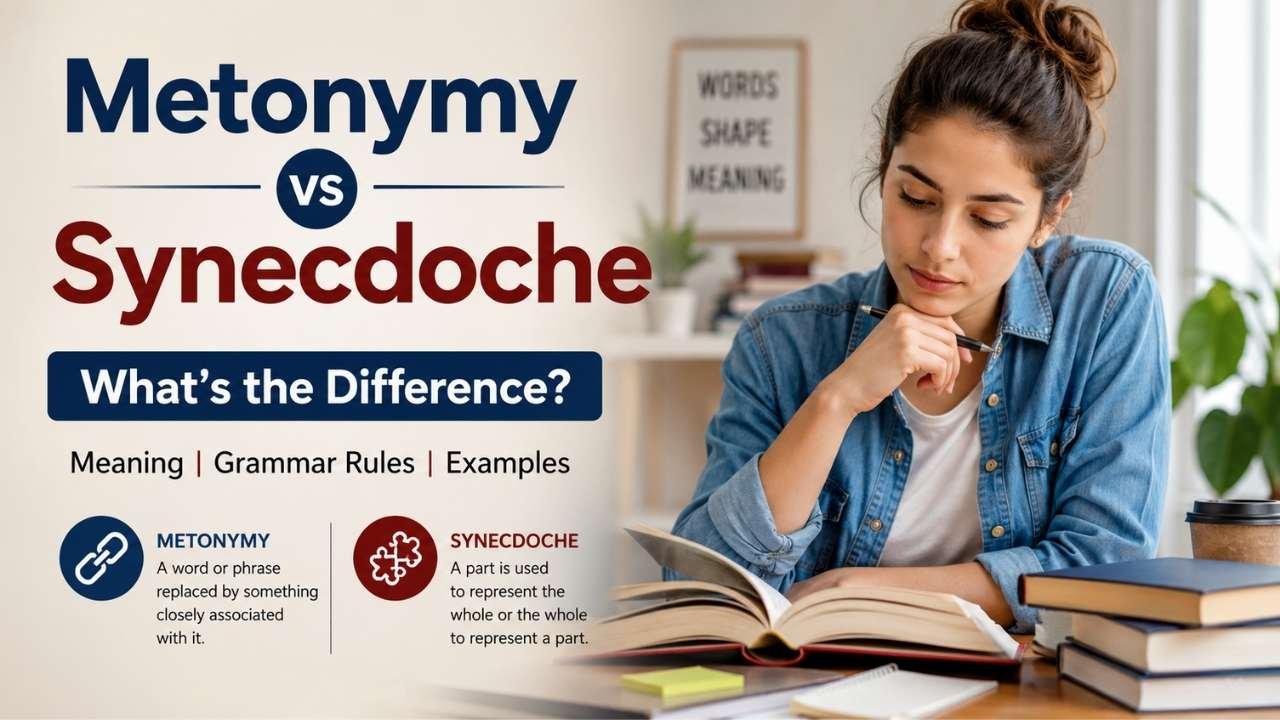
Have you ever wondered why people say “The White House announced” instead of naming the president, or “all hands on deck” instead of saying all sailors? These expressions use two closely related literary devices known as metonymy vs synecdoche.
Because they both replace one word with another, many writers, students, and English learners struggle to understand the difference between metonymy and synecdoche. The good news is that the distinction is easier than it seems.
In this guide, you’ll learn what metonymy is, what synecdoche is, how each works in figurative language, and when to use them correctly. We’ll explain the concepts in simple language, compare them side by side, and provide plenty of metonymy vs synecdoche examples from everyday English and literature so you can recognize and use both with confidence.
Quick Answer
Metonymy and synecdoche are both figures of speech, but they work differently. Metonymy replaces something with a closely related word or concept, while synecdoche replaces something using a part for the whole or the whole for a part. Understanding this difference between metonymy and synecdoche helps you identify these literary devices and use them correctly in writing and everyday English.
What Is Metonymy?

Metonymy is a figure of speech in which one word is replaced with another that is closely connected to it. The replacement is based on association, not similarity or a part-whole relationship.
For example, when someone says, “The White House announced a new policy,” they mean the people who work in the White House, not the building itself. Likewise, “Hollywood” often refers to the American film industry.
These are common metonymy examples used in everyday English. Writers use metonymy to make language shorter, more engaging, and more expressive. If you’re also learning about other forms of figurative language, our guide on Metaphor vs Idiom explains how those devices differ from metonymy and are used in different ways.
What Is Synecdoche?
Synecdoche is another literary device, but it works differently from metonymy. It uses a part to represent the whole or the whole to represent a part. For example, saying “all hands on deck” means all sailors should come to work, not just their hands.
Likewise, “wheels” can refer to a car instead of only its tires. These familiar synecdoche examples show how a smaller or larger part can stand for something else. Writers use synecdoche to create vivid and memorable expressions that readers easily understand.
Since this device often appears in both writing and speech, learning to recognize it makes it easier to understand figurative language and improve your communication skills.
Metonymy vs Synecdoche: Key Differences at a Glance
Although metonymy and synecdoche both replace one word with another, they are not the same. The main difference between metonymy and synecdoche is the relationship between the two words.
Metonymy relies on a close association, such as “the Crown” for a monarch or “Wall Street” for the financial industry. Synecdoche, however, depends on a part-whole relationship, like “hands” for workers or “wheels” for a vehicle.
In simple terms, if the replacement is connected by association, it is metonymy. If it represents a part or the whole, it is synecdoche. Understanding this distinction helps you identify both literary devices with greater confidence.
| Feature | Metonymy | Synecdoche |
| Relationship | Based on association | Based on part and whole |
| Replacement | Related concept | Part for whole or whole for part |
| Example | “The White House” = U.S. administration | “All hands” = sailors |
| Purpose | Shortens or strengthens expression | Highlights a specific part or whole |
How to Tell Metonymy and Synecdoche Apart
The easiest way to identify metonymy and synecdoche is to ask one simple question: Is the replacement a part of the thing being described? If the answer is yes, it is usually synecdoche. If the answer is no, but the replacement is closely connected, it is metonymy.
For instance, “the pen is mightier than the sword” uses metonymy because the pen represents writing and the sword represents military force. On the other hand, “nice wheels” is synecdoche because wheels are part of a car. Understanding this simple rule makes it much easier to recognize metonymy vs synecdoche in both everyday conversations and literature.
Examples of Metonymy in Everyday Language
You probably hear metonymy every day without realizing it. News reports often say “Downing Street issued a statement,” referring to the British government instead of the street itself. Sports fans may hear “The bench played well,” meaning the substitute players. In business, “Silicon Valley” commonly represents the technology industry.
These metonymy examples are easy to understand because the replacement words have a strong connection to what they represent. Learning these patterns helps you recognize this figure of speech more quickly.
If you’re improving your English writing, it’s also helpful to understand correct language rules. Our guide on Grammar or Grammer explains one of the most common spelling mistakes and how to avoid it.
Examples of Synecdoche in Everyday Language
Like metonymy, synecdoche appears regularly in daily conversations. Someone might say, “We need more hands in the kitchen,” meaning more people are needed to help. A person could also say, “She bought a new set of wheels,” referring to a new car.
Farmers may talk about “fifty head of cattle,” where head represents each animal. These classic synecdoche examples are easy to recognize once you understand the part-for-whole relationship.
Writers and speakers use synecdoche to make their language more vivid, concise, and memorable. The more examples you study, the easier it becomes to tell synecdoche apart from metonymy and other figures of speech.
Metonymy vs Synecdoche in Literature
Authors have used metonymy and synecdoche for centuries to make their writing more expressive and memorable. In literature, metonymy often replaces a person, place, or idea with something closely connected to it.
For example, “the Crown” may represent the monarchy, while “the stage” can refer to the theater industry. Synecdoche, however, uses a part to represent the whole or the whole to represent a part.
A poet might use “hands” to describe workers or “sails” to refer to ships. These literary devices help create vivid images, add meaning, and make sentences more engaging. Understanding these examples also makes reading novels, poems, and speeches much easier.
Metonymy vs Metaphor vs Synecdoche
Many learners confuse metonymy, metaphor, and synecdoche because they all belong to figurative language, but they work in different ways. A metaphor compares two unrelated things by saying one is the other, creating a fresh image or idea.
Metonymy replaces something with a closely related word, while synecdoche uses a part for the whole or the whole for a part. For example, calling someone “a shining star” is a metaphor.
Saying “The White House announced” is metonymy, and “all hands on deck” is synecdoche. Knowing these differences helps you identify each figure of speech correctly and use them more effectively in both writing and speech.
Common Mistakes and Misconceptions
A common mistake is believing that metonymy and synecdoche are exactly the same. Although they are closely related, they are not interchangeable. Another misunderstanding is thinking every shortened expression is a synecdoche.
In reality, you should first check the relationship between the replacement word and its meaning. If the connection is based on association, it is metonymy. If it depends on a part-whole relationship, it is synecdoche.
Some people also confuse both devices with metaphors, even though metaphors are based on comparison rather than substitution. Learning these simple rules will help you avoid mistakes in school assignments, exams, creative writing, and everyday communication.
How to Use Metonymy and Synecdoche in Your Own Writing
Using metonymy and synecdoche can make your writing more natural, interesting, and memorable. Metonymy works well when you want to replace a person, place, or organization with a closely related term.
Synecdoche is useful when a part or whole creates a stronger image for the reader. However, use these figures of speech only when they make your meaning clearer. Overusing them can confuse readers, especially if the connection is not obvious.
Before using either device, ask yourself whether your audience will understand the substitution without extra explanation. When used carefully, both literary devices add style, variety, and impact to essays, stories, speeches, and everyday writing.
Memory Tricks to Never Confuse Them Again
Remembering the difference between metonymy and synecdoche becomes much easier with a few simple tricks. Think of synecdoche as the “part-and-whole” device. If one part stands for the entire object, or the whole represents one part, you are looking at synecdoche.
For metonymy, remember the word “association.” The replacement is not a physical part but something closely connected.
A quick test is to ask, “Is this actually part of the thing?” If yes, it is likely synecdoche. If no, but it has a strong connection, it is metonymy. Practicing this simple method with everyday examples will help you recognize both devices quickly and confidently.
FAQs
Is synecdoche a type of metonymy?
Many language experts consider synecdoche a special type of metonymy because both replace one term with another. However, in most grammar and literature lessons, they are taught as separate literary devices to make their differences easier to understand.
Which is more common in everyday English?
Both appear often, but metonymy is more common in news, politics, business, and media. Synecdoche is frequently found in literature, speeches, and familiar expressions.
Can a phrase be both metonymy and synecdoche?
In some cases, experts disagree about classification. A few expressions can overlap depending on how they are interpreted, but most examples clearly fit one category.
How can I identify them quickly?
Check the relationship. Association points to metonymy, while a part-whole relationship points to synecdoche.
Why do students confuse these literary devices?
They both replace one word with another, so they seem similar at first. Understanding the type of relationship between the words makes the distinction much clearer.
Are metonymy and synecdoche still used today?
Yes. Both devices are common in modern English, especially in journalism, advertising, speeches, books, movies, and everyday conversations.
Do these figures of speech improve writing?
Yes. When used naturally, they make writing more vivid, engaging, and memorable while helping avoid unnecessary repetition.
Conclusion
Understanding metonymy vs synecdoche is easier once you know the key difference. Metonymy replaces something with a closely related word based on association, while synecdoche uses a part for the whole or the whole for a part.
Although both are important figures of speech, each serves a different purpose in figurative language. By learning their definitions, studying real-life examples, and practicing the simple identification tips in this guide, you can recognize each device with confidence.
Whether you’re a student, writer, or English learner, mastering these literary devices will strengthen your reading, improve your writing, and help you communicate ideas more effectively.