
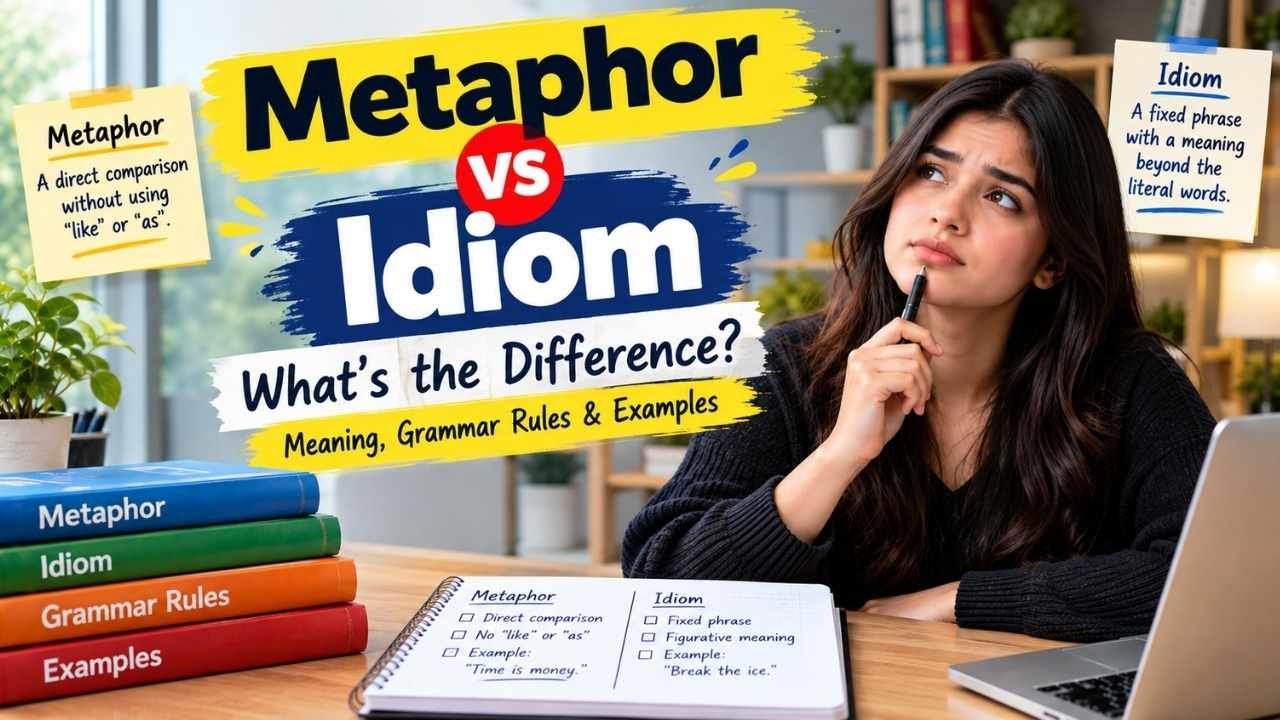
Have you ever wondered whether a phrase is a metaphor vs idiom? Many people use these figures of speech every day, but they often confuse one with the other. Although both belong to figurative language, they work in different ways and serve different purposes.
Understanding the difference between a metaphor and an idiom can improve your writing, speaking, and reading skills. Whether you’re a student, an ESL learner, a teacher, or a writer, knowing how to identify and use each correctly will help you communicate more clearly.
In this guide, you’ll learn the metaphor definition, idiom definition, key differences, similarities, and plenty of metaphor vs idiom examples. We’ll also explain how to identify a metaphor, recognize an idiom, avoid common mistakes, and choose the right expression with confidence.
Quick Answer
The difference between a metaphor and an idiom is that a metaphor directly compares two unlike things to create a vivid image, while an idiom is a fixed expression whose meaning cannot be understood from its individual words. Although both are forms of figurative language, not every metaphor is an idiom, and not every idiom is a metaphor.
What Is a Metaphor?

A metaphor is a figure of speech that directly compares two different things without using the words “like” or “as.” Instead of saying something is similar, it states that one thing is another to create a stronger image or idea. For example, “Time is a thief” means time quietly takes moments from our lives. This comparison is not meant to be taken literally.
A metaphor helps readers imagine feelings, ideas, or situations more clearly, making it a common tool in creative writing, speeches, and literature. If you’re learning about figurative language, understanding the metaphor definition is an important first step.
For another comparison of literary devices, see our guide on Analogy vs Allegory, which explains how those terms differ.
What Is an Idiom?
An idiom is a fixed expression whose meaning cannot be understood by looking at the individual words. Instead, you must know its accepted meaning in everyday English. For example, “break the ice” means to make people feel comfortable, not to literally break frozen water. Likewise, “spill the beans” means to reveal a secret.
These phrases are part of figurative language and are widely used in conversations, books, and media. Learning the idiom definition helps you understand native English speakers more easily and improves your own communication.
If you’re also interested in common language mistakes, our article on Grammar or Grammer explains which spelling is correct and why.
Metaphor vs Idiom: Key Differences at a Glance
Although both belong to figurative language, there are clear differences in the metaphor vs idiom comparison. A metaphor creates a direct comparison between two unlike things to express an idea or emotion.
An idiom, however, is a set phrase with a meaning that cannot be guessed from the words themselves. For example, “Life is a journey” is a metaphor because it compares life to a journey. In contrast, “hit the sack” is an idiom because it simply means to go to bed.
Understanding the difference between a metaphor and an idiom helps students, writers, and ESL learners identify each expression correctly and use them naturally in speaking and writing.
| Feature | Metaphor | Idiom |
| Meaning | Direct comparison | Fixed expression with a non-literal meaning |
| Structure | Flexible | Usually fixed |
| Purpose | Create imagery | Express common ideas naturally |
| Literal Meaning | No | No |
| Example | The classroom was a zoo. | Piece of cake |
Similarities Between Metaphors and Idioms
Even though they are different, metaphors and idioms share several similarities. Both are forms of figurative language, meaning their messages go beyond the literal meaning of the words. They make conversations and writing more engaging, colorful, and memorable.
Writers often use both to create stronger emotions, explain difficult ideas, or make stories more interesting. You can find them in novels, poems, movies, speeches, and even everyday conversations.
Both also depend on context, so readers or listeners must understand the situation to interpret the intended meaning. Learning these similarities makes it easier to recognize whether a phrase is a metaphor or an idiom and helps improve your overall English language and writing skills.
Can an Idiom Also Be a Metaphor?
Yes, an idiom can sometimes include a metaphor, but the two terms are not the same. Some idioms began as creative metaphors many years ago and eventually became fixed expressions that people use without thinking about the original comparison.
For example, “carry the world on your shoulders” is both metaphorical and idiomatic because it describes feeling overwhelmed rather than physically carrying the world. However, many metaphors are original comparisons created by a writer and are not established idioms.
Likewise, many idioms contain no direct comparison at all. This is why understanding can an idiom be a metaphor is important when studying figurative expressions and improving your writing or language skills.
How to Tell Whether a Phrase Is a Metaphor or an Idiom
The easiest way to decide whether a phrase is a metaphor or an idiom is to ask yourself two simple questions. First, does the phrase directly compare two different things? If the answer is yes, it is probably a metaphor.
Second, is it a fixed expression with a special meaning that people commonly use? If so, it is likely an idiom. For example, “Her smile is sunshine” is a metaphor because it compares a smile to sunshine.
“Under the weather” is an idiom because it means someone feels sick, not that they are beneath the weather. Practicing with metaphor vs idiom examples is one of the best ways to identify each correctly.
Common Examples of Metaphors and Idioms in Sentences
Looking at metaphor vs idiom examples is one of the easiest ways to understand how each works. A metaphor creates a direct comparison to make an idea more vivid, while an idiom expresses a meaning that is different from the words themselves.
For example, “His mind is a computer” is a metaphor because it compares a person’s intelligence to a computer. “Costs an arm and a leg” is an idiom because it means something is very expensive, not that it literally requires a body part.
Other examples include “She has a heart of gold” (metaphor) and “Once in a blue moon” (idiom). Reading these examples helps students, writers, and ESL learners recognize figurative language more easily.
Common Mistakes People Make
Many learners confuse metaphors and idioms because both use figurative language instead of literal meanings. One common mistake is thinking that every unusual phrase is an idiom. In reality, a metaphor is often a fresh comparison created for a specific purpose, while an idiom is a well-known expression with a fixed meaning.
Another mistake is reading idioms literally. For example, “Kick the bucket” does not mean kicking an actual bucket. People also confuse metaphors with similes because both compare things, but similes use “like” or “as.”
Avoiding these mistakes becomes much easier when you understand the difference between a metaphor and an idiom and practice identifying both in everyday English.
Metaphor vs Idiom vs Simile
People often compare metaphors, idioms, and similes because they are all forms of figurative language, but each has a different purpose. A metaphor makes a direct comparison without using “like” or “as.”
A simile compares two things using those words, such as “She runs like the wind.” An idiom is a fixed phrase whose meaning cannot be understood literally, such as “Hit the books,” which means to study hard.
While metaphors and similes create comparisons, idioms are expressions learned through common usage. Understanding these differences helps improve reading, writing, and speaking skills while making it easier to recognize each literary device in books and everyday conversations.
When Should You Use a Metaphor or an Idiom?
Knowing when to use a metaphor or an idiom can make your communication more effective. Use a metaphor when you want to paint a picture, explain an idea creatively, or make your writing more engaging.
Metaphors are common in stories, speeches, poems, and descriptive writing. Choose an idiom when you want to sound natural in everyday conversations or informal writing. Since idioms are familiar expressions, they help your speech feel more fluent and conversational.
However, be careful when writing for an international audience because some readers may not understand local idioms. Choosing the right expression for the right situation makes your message clearer, stronger, and easier for others to understand.
Tips for Remembering the Difference
You do not need to memorize long grammar rules to remember the metaphor vs idiom difference. Instead, use a few simple tricks. First, ask whether the phrase creates a direct comparison. If it does, it is likely a metaphor.
Next, ask whether it is a common expression with a special meaning that people already know. If the answer is yes, it is probably an idiom.
You can also remember that metaphors are often creative and flexible, while idioms usually stay the same over time. Reading books, listening to conversations, and practicing with metaphor and idiom examples will help you recognize both naturally and use them with greater confidence.
Practice Quiz: Is It a Metaphor or an Idiom?
Test your knowledge by deciding whether each phrase is a metaphor or an idiom.
1. “The classroom was a zoo.” 2. “Break the ice.” 3. “Her voice is music to my ears.” 4. “Let the cat out of the bag.” 5. “The world is a stage.”
Answers: 1. Metaphor because it compares the classroom to a zoo. 2. Idiom because it means to start a conversation. 3. Metaphor because it compares a voice to music. 4. Idiom because it means to reveal a secret. 5. Metaphor because it compares the world to a stage.
Practicing examples like these improves your understanding of figurative expressions.
FAQs
What is the difference between a metaphor and an idiom?
A metaphor is a direct comparison between two unlike things, while an idiom is a fixed expression with a meaning that is different from its literal words.
Can an idiom also be a metaphor?
Yes. Some idioms contain metaphorical ideas, but not every idiom is a metaphor, and not every metaphor becomes an idiom.
Is every metaphor figurative language?
Yes. Every metaphor is a type of figurative language because it expresses a non-literal meaning.
Are idioms used in everyday English?
Yes. Native English speakers use idioms regularly in conversations, books, movies, and media.
What is an easy example of a metaphor?
“Time is money” is a common metaphor because it compares time to money without using “like” or “as.”
What is an easy example of an idiom?
“Piece of cake” is an idiom that means something is very easy.
How can I identify a metaphor or an idiom?
Check whether the phrase is a direct comparison or a well-known fixed expression with a figurative meaning.
Conclusion
Understanding the difference between a metaphor and an idiom helps you use English more confidently in both speaking and writing. A metaphor creates a direct comparison to explain an idea in a creative way, while an idiom is a fixed phrase with a meaning that goes beyond the literal words.
Although they share similarities as figurative language, they serve different purposes and should not be used interchangeably. By learning their definitions, studying metaphor vs idiom examples, and practicing with real sentences, you will quickly recognize each one.
Whether you are a student, teacher, writer, or ESL learner, mastering these expressions will improve your communication and make your writing more natural, engaging, and effective.