
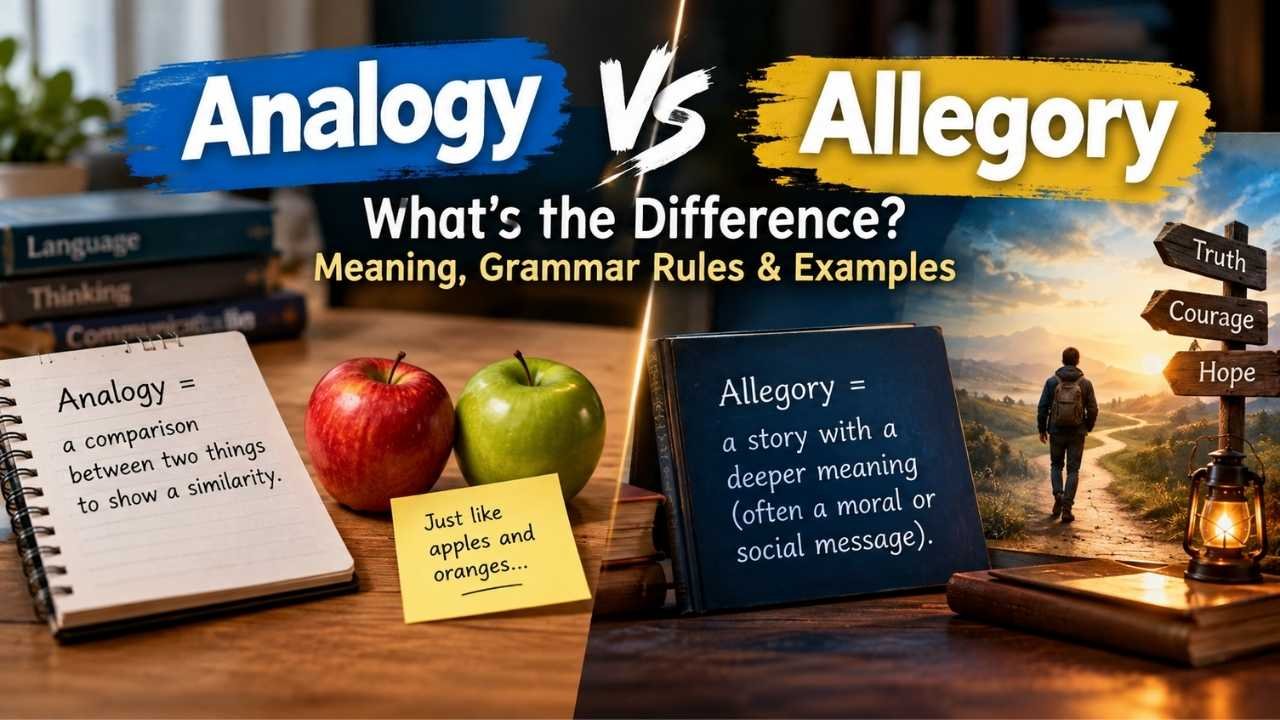
Have you ever wondered whether analogy vs allegory mean the same thing? Although these terms are often used in discussions about figurative language and literature, they have very different purposes. An analogy is a comparison that helps explain an idea by showing how two things are similar.
An allegory, on the other hand, is a complete story in which characters, events, or settings represent a deeper meaning or message. Understanding the difference between analogy and allegory can improve your writing, strengthen your literary analysis, and help you avoid common mistakes.
In this guide, you’ll learn what an analogy is, what an allegory is, how they compare, when to use each one, and explore plenty of easy examples. By the end, you’ll be able to recognize both with confidence and use them correctly in everyday writing and literature.
Quick Answer
Analogy and allegory are both literary devices, but they serve different purposes. An analogy compares two things to explain an idea or make it easier to understand. An allegory is a complete story in which characters, events, and settings symbolize a deeper meaning or moral lesson. Simply put, an analogy explains, while an allegory tells a symbolic story.
What Is an Analogy?
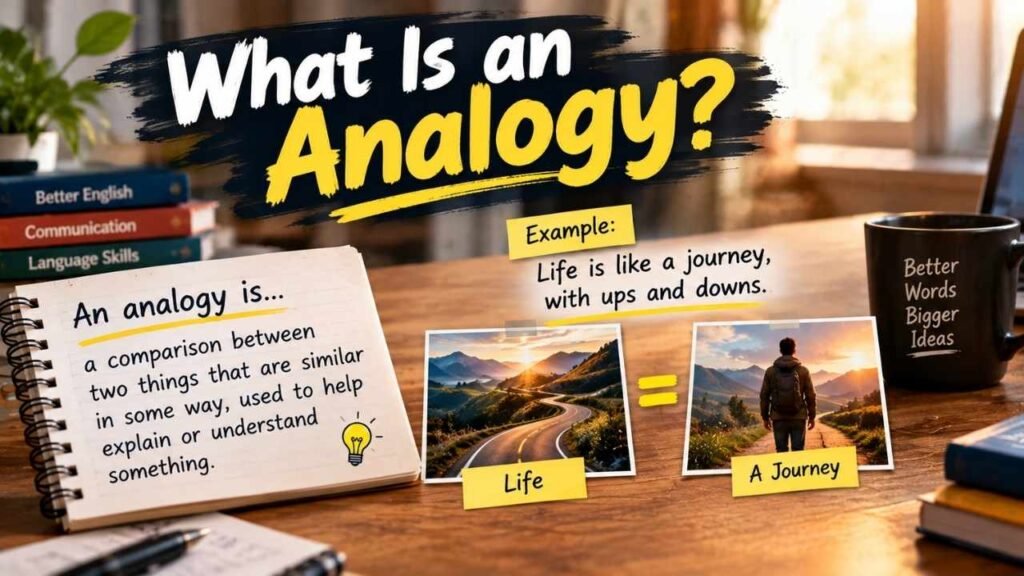
An analogy is a comparison between two different things that helps explain an idea or makes it easier to understand. Instead of saying two things are exactly alike, an analogy shows how they are similar in a meaningful way.
Writers, teachers, and speakers often use analogies to simplify complex topics. For example, saying “The human brain is like a computer” is an analogy because it compares two different things to explain how the brain processes information.
You’ll find analogies in books, classrooms, speeches, and everyday conversations. Understanding what an analogy is can improve your communication and writing skills. If you enjoy learning about commonly confused words, you may also like our guide on Pallette or Palette, which explains another pair of often-mistaken terms.
What Is an Allegory?
An allegory is a story in which characters, events, and settings represent a deeper meaning beyond the surface plot. Unlike an analogy, which explains a single idea through comparison, an allegory tells a complete narrative with a hidden message.
These messages often teach a moral lesson, express political ideas, or explore social issues. A famous example is George Orwell’s Animal Farm, where the animals symbolize real historical figures and events.
Readers enjoy the story on one level while discovering its symbolic meaning on another. Knowing what an allegory is helps you better understand literature and recognize how writers use symbolism to communicate powerful ideas through storytelling.
Analogy vs Allegory: Key Differences
Although analogy and allegory both help explain ideas, they work in very different ways. An analogy is a direct comparison that makes a concept easier to understand by relating it to something familiar.
An allegory, however, is a complete story with characters and events that symbolize a deeper meaning. Think of an analogy as a teaching tool, while an allegory is a symbolic narrative. For example, comparing teamwork to a well-oiled machine is an analogy, but Animal Farm is an allegory because the entire story represents historical events.
The table below highlights the difference between analogy and allegory to help you recognize each one more easily.
| Feature | Analogy | Allegory |
| Meaning | Compares two things to explain an idea | A story with a hidden symbolic meaning |
| Purpose | Makes concepts easier to understand | Conveys a deeper message or moral |
| Length | Usually a sentence or short explanation | A complete story, poem, or narrative |
| Symbolism | Limited or none | Strong use of symbolism throughout |
| Common Use | Teaching, writing, speeches | Literature, fiction, and storytelling |
| Example | “Life is like a marathon.” | Animal Farm by George Orwell |
When Should You Use an Analogy?
Use an analogy whenever you want to explain a difficult idea in a simple and relatable way. Teachers often use analogies to help students understand science, history, or mathematics. Business professionals use them during presentations to explain strategies, while writers include them to make articles more engaging.
Everyday conversations also become clearer when familiar comparisons are used. For instance, saying “Learning a language is like building a house—one brick at a time” helps people understand the process more easily.
Because analogies improve clarity, they are valuable in blogs, essays, speeches, and reports. If you’re interested in spelling differences, our guide on Flavor vs Flavour explores another common language question with clear examples.
When Should You Use an Allegory?
Choose an allegory when you want to share a deeper message through storytelling rather than direct explanation. Allegories are common in novels, short stories, poems, children’s books, and religious texts because they encourage readers to think beyond the surface meaning.
Authors often use symbolic characters and events to discuss topics such as freedom, justice, power, or human behavior without stating the message directly. This approach makes stories more meaningful and memorable.
If your goal is to entertain while also teaching a lesson or expressing an important idea, an allegory is an excellent choice. Understanding when to use an allegory can strengthen your creative writing and help you appreciate the hidden meanings found in many classic works of literature.
Analogy vs Allegory vs Metaphor
People often confuse analogy, allegory, and metaphor because they all involve comparing ideas. However, each one has a different purpose. A metaphor directly says one thing is another to create a vivid image, such as “Time is a thief.”
An analogy explains an idea by comparing two different things to make the concept easier to understand. An allegory goes much further by telling a complete story in which characters, events, and places represent a deeper meaning.
While a metaphor is usually a single figure of speech and an analogy is an explanation, an allegory is a full symbolic narrative. Knowing these differences helps you choose the right literary device in writing and better understand works of literature.
Common Mistakes People Make
Many people mix up analogy and allegory because both involve comparing ideas. One common mistake is thinking every comparison is an allegory. In reality, a simple comparison is usually an analogy, not a symbolic story.
Another mistake is assuming that every story with a lesson is an allegory. A story becomes an allegory only when its characters, events, and settings consistently represent a deeper meaning.
Some writers also confuse metaphors with analogies because both compare things, but a metaphor creates an image while an analogy explains an idea. Remembering these differences will help you use each literary device correctly and avoid confusion in school assignments, creative writing, and everyday communication.
How to Quickly Tell Whether Something Is an Analogy or an Allegory
A simple way to identify analogy vs allegory is to ask yourself a few questions. Is the writer comparing two things to explain an idea? If the answer is yes, it is probably an analogy.
Is the writer telling a complete story in which people, animals, or events stand for larger ideas or moral lessons? Then it is most likely an allegory. You can also look at the length. Analogies are usually short, while allegories develop throughout an entire story.
Another clue is symbolism. If hidden meanings appear repeatedly from beginning to end, you are reading an allegory. These quick checks make it much easier to recognize the correct literary device.
Famous Examples of Analogies and Allegories
Examples are one of the best ways to understand the difference between analogy and allegory. A well-known analogy is, “A good teacher is like a guide who helps travelers reach their destination.”
This comparison explains an idea without telling a story. Famous allegories, however, include works such as Animal Farm by George Orwell, The Pilgrim’s Progress by John Bunyan, and Plato’s Allegory of the Cave.
Each tells a complete story that represents deeper themes about society, faith, knowledge, or human nature. These classic works show how allegories communicate important messages through symbolism, while analogies simply make ideas easier to understand through clear and familiar comparisons.
Tips for Writers and Students
Understanding analogy and allegory can make your writing stronger and your reading skills sharper. Before choosing one, think about your purpose. If you want to explain a difficult idea clearly, use an analogy. If you want your story to carry a hidden message or moral lesson, choose an allegory.
Always make sure your comparisons are easy to understand and relevant to your audience. When reading literature, look for repeated symbols and deeper meanings instead of focusing only on the surface story.
Practicing with examples from books and everyday life will help you recognize these literary devices more quickly. Over time, using analogies and understanding allegories will become a natural part of your writing and analysis.
FAQs
What is the main difference between an analogy and an allegory?
An analogy explains an idea by comparing two different things, while an allegory is a complete story with characters and events that symbolize a deeper meaning or moral lesson.
Is an allegory the same as a metaphor?
No. A metaphor is a figure of speech that compares two things directly, while an allegory is an extended symbolic story. They are related but serve different purposes.
Can an analogy be part of an allegory?
Yes. An author may include an analogy within an allegory to explain a specific idea, but the two literary devices remain different in structure and purpose.
What is a famous example of an allegory?
Animal Farm by George Orwell is one of the most famous allegories. Its characters and events symbolize real historical people and political events.
Why do writers use analogies?
Writers use analogies to explain difficult ideas through familiar comparisons. They make information easier to understand and more memorable for readers.
Are analogies only used in literature?
No. Analogies are common in education, business, science, speeches, and everyday conversations because they simplify complex ideas.
How can I quickly identify an allegory?
Look for a complete story where the characters, settings, and events consistently represent deeper meanings or moral lessons. Strong symbolism throughout the narrative is a key sign of an allegory.
Conclusion
Although analogy and allegory may sound similar, they serve very different purposes in writing and communication. An analogy compares two things to explain an idea clearly, making difficult concepts easier to understand.
An allegory, on the other hand, tells a complete symbolic story that communicates a deeper message or moral lesson. Once you understand these differences, it becomes much easier to recognize each literary device in books, speeches, and everyday language.
Whether you are a student, writer, or language learner, knowing the difference between analogy and allegory will improve your reading, strengthen your writing, and help you express ideas with greater confidence and accuracy.