
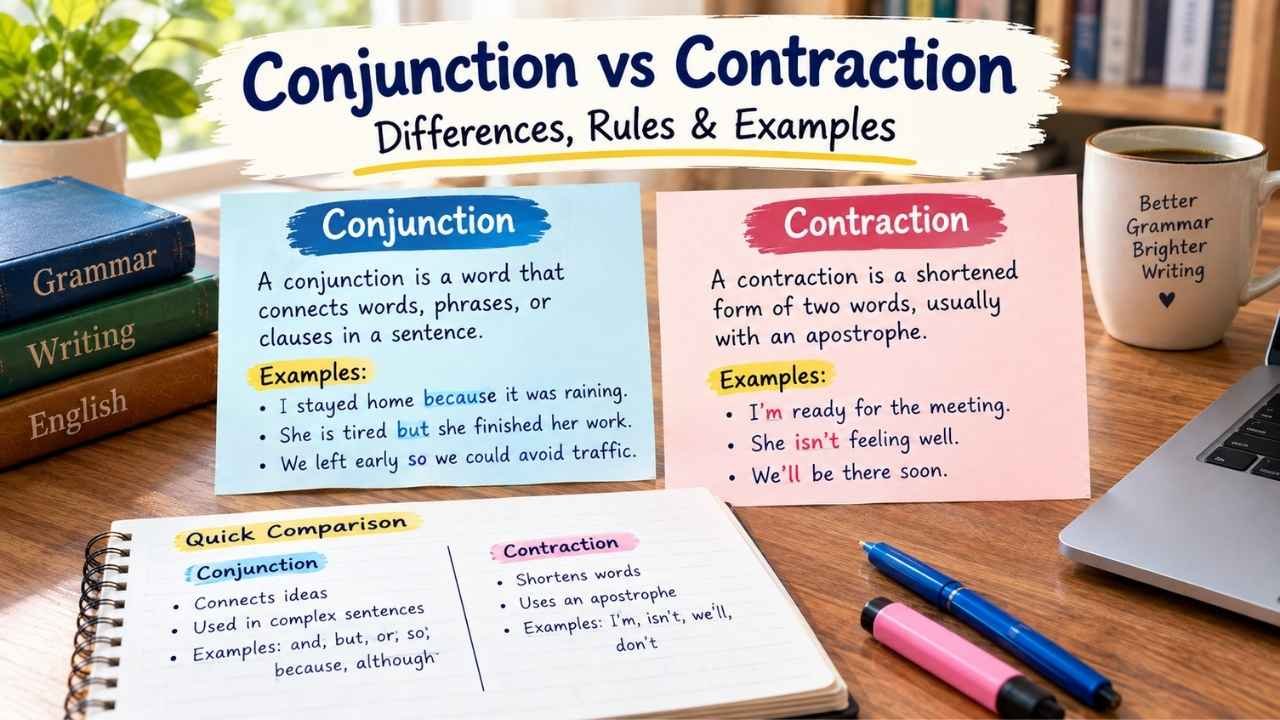
Many English learners often confuse conjunction vs contraction because these two grammar terms look and sound similar. However, they have completely different roles in English grammar. A conjunction is a connecting word that joins words, phrases, or clauses, while a contraction is a shortened form of two words combined with an apostrophe.
Understanding the difference between conjunction and contraction can help you write clearer sentences and avoid common grammar mistakes. In this guide, we will explain conjunction vs contraction with simple definitions, examples, and usage rules.
Whether you are a student, writer, or someone improving English skills, learning how these grammar terms work will make your writing more accurate and confident.
Quick Answer
A conjunction is a word that connects words, phrases, or clauses in a sentence, such as and, but, or, and because. A contraction is a shortened form of two words that uses an apostrophe, such as don’t, can’t, and they’re. In simple terms, conjunctions connect ideas, while contractions shorten words.
What Is a Conjunction? Definition and Meaning
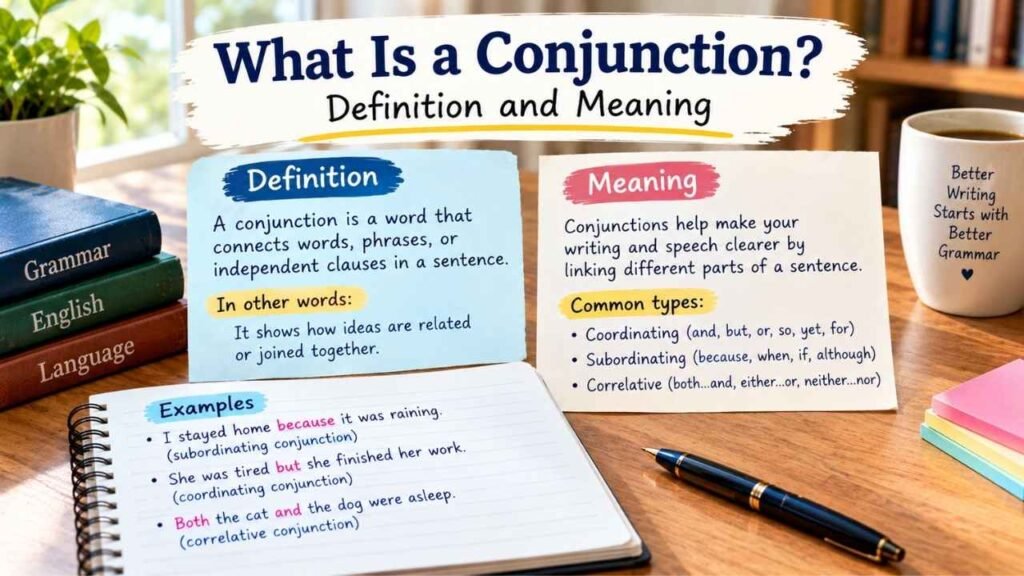
A conjunction is a word that connects different parts of a sentence. It can join two words, phrases, or clauses to make ideas flow smoothly. In English grammar, conjunctions help writers show relationships between thoughts, such as addition, contrast, reason, or choice.
Common conjunction examples include and, but, or, because, although, and so. For example, in the sentence “I wanted to go outside, but it started raining,” the word but connects two ideas.
Understanding what is a conjunction is important because these connecting words help create clear and meaningful sentences. Without conjunctions, writing can feel short, disconnected, and difficult to follow.
Types of Conjunctions With Examples
There are three main types of conjunctions used in English grammar: coordinating, subordinating, and correlative conjunctions. Coordinating conjunctions connect words or equal ideas, such as and, but, or, so, yet, for, and nor.
For example, “She likes tea and coffee.” Subordinating conjunctions connect a main clause with a dependent clause. Common examples include because, although, while, since, and unless.
For example, “I stayed home because I was tired.” Correlative conjunctions work in pairs, such as either/or, neither/nor, and both/and. Learning these categories makes it easier to identify conjunctions and understand how they improve sentence structure.
What Is a Contraction? Definition and Meaning
A contraction is a shortened form of two words combined into one. In English grammar, contractions are created by removing some letters and adding an apostrophe to show the missing letters.
Common contraction words include don’t (do not), can’t (cannot), isn’t (is not), and they’re (they are). Understanding what is a contraction helps writers use these shortened forms correctly. Contractions are common in everyday conversations, emails, and informal writing because they make language sound more natural.
However, they are usually avoided in very formal writing, such as academic papers or official reports. Knowing when to use contractions can improve both speaking and writing skills.
Types of Contractions With Common Examples
English has several common types of contractions that appear in daily communication. One common group is negative contractions, which combine a helping verb with “not,” such as don’t, doesn’t, didn’t, isn’t, and wasn’t.
Another group includes pronoun contractions, where a pronoun joins with a verb, such as I’m (I am), you’re (you are), and we’ve (we have). Modal contractions are also common, including won’t (will not), couldn’t (could not), and shouldn’t (should not).
These shortened forms make sentences quicker and more natural. However, writers should remember that contractions are different from conjunctions because they do not connect ideas; they simply combine words.
Conjunction vs Contraction: Key Differences at a Glance
The main difference between a conjunction and contraction is their purpose in a sentence. A conjunction connects words, phrases, or clauses, while a contraction combines two words into a shorter form.
Conjunctions are usually complete words, while contractions often include an apostrophe. For example, and connects ideas in a sentence, but don’t replaces the words “do not.” This simple comparison helps learners understand the difference between these two grammar terms.
| Feature | Conjunction | Contraction |
| Purpose | Connects ideas | Shortens words |
| Grammar role | Connecting word | Combined word form |
| Apostrophe | Not used | Usually used |
| Examples | and, but, because | don’t, can’t, they’re |
Conjunction vs Contraction Examples in Sentences
Looking at conjunction vs contraction examples makes the difference easier to understand. A conjunction connects parts of a sentence. For example, “I wanted to play outside, but it was raining.” Here, but connects two different ideas.
A contraction shortens two words. For example, “I didn’t play outside because it was raining.” The word didn’t means “did not” and uses an apostrophe. Many learners confuse these grammar terms because they have similar names, but their functions are completely different.
Remember this simple rule: conjunctions connect, while contractions combine. This quick trick can help students identify each one correctly when reading or writing sentences.
How Grammar Terms Can Be Confusing
Some grammar terms can look similar but have different meanings, just like many commonly confused words in English. For example, understanding differences between words like [Reel vs Real] can help improve vocabulary accuracy and prevent mistakes in writing.
In the same way, learning the difference between conjunction vs contraction requires looking at the function of each term rather than just their spelling. Grammar learners often become confused when words sound alike or have similar structures.
Another useful comparison is [Assonance vs Rhyme], where similar sounds may appear but serve different purposes in writing. By focusing on meaning, purpose, and examples, learners can understand grammar concepts more easily and use them with confidence.
How to Identify a Conjunction vs a Contraction Quickly
Knowing how to identify conjunctions and contractions can make grammar learning much easier. The simplest way is to look at the job the word performs in a sentence. If a word connects two ideas, words, or sentence parts, it is usually a conjunction.
For example, in “I wanted to go, but I was busy,” the word but joins two thoughts. If a word combines two words into a shorter form and includes an apostrophe, it is usually a contraction. For example, they’re means “they are.”
A quick memory trick is: conjunctions connect, contractions compress. This simple rule helps students recognize the difference between these two grammar terms while reading and writing.
Common Mistakes When Using Conjunctions and Contractions
Many learners make mistakes because conjunctions and contractions can be confusing at first. One common mistake is thinking that contractions are conjunctions because their names sound similar.
Another mistake is using apostrophes incorrectly in contractions. For example, it’s means “it is,” while its shows possession. Similarly, they’re means “they are,” while their shows ownership.
Conjunction mistakes usually happen when writers use the wrong connecting word, such as choosing and when a contrast word like but is needed. Learning the basic rules of English grammar and practicing examples can help avoid these errors. Understanding the purpose of each word is the easiest way to use them correctly.
Are Conjunctions and Contractions Related?
Although the words conjunction and contraction look similar, they are not related grammar concepts. A conjunction focuses on connection, while a contraction focuses on shortening words.
Both are important parts of English grammar, but they perform completely different jobs. Conjunctions help create smoother sentences by connecting ideas, such as “I stayed home because I was tired.” Contractions make communication faster and more natural, such as “I don’t want to go.”
The confusion usually comes from their similar names rather than their meanings. Remembering their main purpose can prevent mistakes: conjunctions join sentence parts, while contractions join words together in a shorter form.
When Should You Use Contractions in Writing?
Contractions are commonly used in informal writing and everyday conversations because they make sentences sound more natural and friendly.
For example, people usually say “I can’t come today” instead of “I cannot come today” in casual conversations. However, contractions may not always be suitable for formal writing. Academic essays, business reports, and official documents often use full forms because they sound more professional.
Understanding when to use contractions helps writers choose the right style for different situations. Contractions are not incorrect, but writers should consider their audience and purpose. Using them properly can make writing clearer, more natural, and better suited for the situation.
Conjunction vs Contraction: Similarities and Differences
The main similarity between conjunctions and contractions is that both are important grammar features used in English sentences. However, their functions are completely different. A conjunction is a part of speech that connects words, phrases, or clauses.
A contraction is a shortened form created by combining two words, usually with an apostrophe. For example, because is a conjunction because it connects ideas, while wasn’t is a contraction because it replaces “was not.”
Understanding these differences makes grammar easier for students and writers. Instead of focusing only on how the words look, focus on what they do in a sentence. This approach helps identify each term correctly.
Conjunction vs Contraction: Common Confusing Cases
Some words create confusion because they sound similar to other words or have different meanings depending on their form. For example, it’s and its are often confused. It’s is a contraction of “it is,” while its shows ownership.
Another common example is you’re and your. You’re means “you are,” while your shows possession. These examples are not conjunctions, but they show why understanding contractions is important.
Many grammar mistakes happen when writers focus on pronunciation instead of meaning. Learning common contraction words and their full forms can improve accuracy. Careful practice with examples helps writers avoid confusion and create stronger sentences.
Easy Tricks to Remember Conjunctions and Contractions
Remembering the difference between conjunction vs contraction does not have to be difficult. A simple trick is to focus on the first letters of each word. A conjunction helps connect ideas, while a contraction makes words compact by shortening them.
You can also check for an apostrophe. If a word contains an apostrophe and represents two combined words, it is likely a contraction. For example, don’t equals “do not.” If a word joins two parts of a sentence, it is likely a conjunction.
For example, and joins two ideas. These easy reminders can help students quickly understand grammar rules and use both forms correctly in everyday writing.
FAQs
What is the difference between a conjunction and a contraction?
A conjunction connects words, phrases, or clauses, while a contraction combines two words into a shorter form.
Is a contraction a type of conjunction?
No. A contraction is not a conjunction. They are two different grammar concepts.
Do all contractions use apostrophes?
Most common contractions use apostrophes to show missing letters, such as don’t and can’t.
What are some examples of conjunctions?
Common conjunction examples include and, but, or, because, although, and so.
What are some common contraction words?
Examples include I’m, you’re, isn’t, won’t, don’t, and they’ve.
Can contractions be used in formal writing?
Contractions can be used in some professional writing, but many formal documents prefer full word forms.
How can I remember the difference?
Remember: conjunctions connect ideas, while contractions combine words.
Conclusion
Understanding conjunction vs contraction becomes easier when you focus on their purpose. A conjunction connects words, phrases, or clauses to create smoother sentences. A contraction shortens two words into one form, usually with an apostrophe.
Although these grammar terms have similar names, they play completely different roles in English writing. Learning their definitions, examples, and usage rules can help students avoid common mistakes and improve their communication skills.
Whether you are writing an essay, improving your grammar, or learning English, knowing the difference between conjunctions and contractions will make your sentences clearer and more accurate. Remember the simple rule: conjunctions connect, contractions shorten.