

Choosing between forward vs forwards can be confusing, especially if you’ve seen both words used in books, websites, or everyday conversations. You may wonder, “Is forwards grammatically correct?” or “Should I use forward or forwards?” The answer depends on the type of English you’re using and the context of your sentence.
While these words have nearly the same meaning, their usage differs slightly in American English and British English. Understanding the difference between forward and forwards will help you write more naturally and avoid common grammar mistakes.
In this guide, you’ll learn forward vs forwards through simple explanations, practical examples, and easy grammar tips. By the end, you’ll know when to use forward instead of forwards and feel confident choosing the correct word in any situation.
Quick Answer
Forward and forwards are both correct, but their usage depends on the variety of English you use. Forward is the preferred form in American English, while forwards is more common in British English, especially as an adverb. Both words usually mean toward the front or ahead, and the difference is mainly a matter of regional preference rather than meaning.
Forward vs Forwards at a Glance
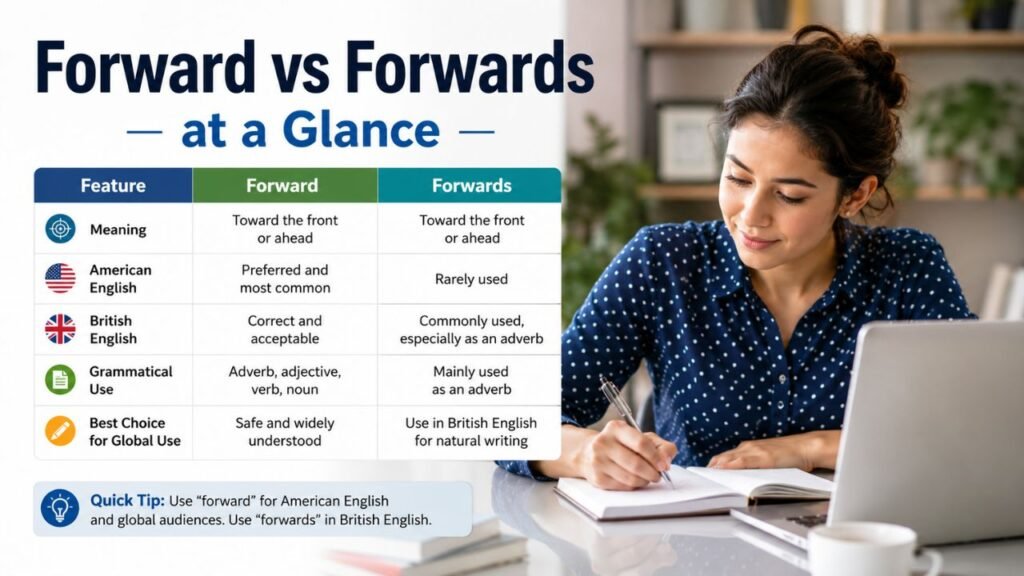
Many learners ask, “Forward or forwards—which one is correct?” The good news is that both words are correct. The difference is mostly based on regional English rather than grammar. In American English, forward is the preferred form in almost every situation.
In British English, forwards is commonly used as an adverb, although forward is also acceptable. Both words usually mean toward the front or ahead. If you’re writing for an international audience, forward is often the safest choice because it is widely understood.
Learning the difference between forward and forwards will help you write naturally and avoid confusion. Like Afterward vs Afterwards, this is another example of regional spelling preferences.
| Feature | Forward | Forwards |
| Meaning | Toward the front or ahead | Toward the front or ahead |
| American English | Preferred | Rare |
| British English | Correct | Common |
| Formal Writing | Widely preferred | Less common |
| Grammatical Status | Correct | Correct |
What Does “Forward” Mean?
Forward is a versatile word in English. It can work as an adverb, adjective, verb, or noun, depending on the sentence. Most often, it means moving toward the front or making progress. In American English, it is the standard choice in both spoken and written communication.
For example, you might say, “Please move forward,” or “She looked forward to the weekend.” Because it has several grammar roles, forward appears in many everyday expressions. If you’re wondering when to use forward instead of forwards, choose forward for American audiences or whenever you want a style accepted almost everywhere.
Understanding this usage builds stronger grammar skills, just as learning the Plural of Journey helps improve everyday writing.
What Does “Forwards” Mean?
Forwards has almost the same meaning as forward. It is mainly used as an adverb to describe movement toward the front or ahead. This form is especially common in British English, where native speakers often say things like, “Take two steps forwards,” or “The team moved forwards together.”
If you ask, “Is forwards grammatically correct?” the answer is yes. It is a standard and accepted word, particularly in British usage. However, it is much less common in American English, where forward is usually preferred. The choice between forward vs forwards depends more on your audience than on grammar because both words express the same basic idea.
Is “Forwards” Grammatically Correct?
Yes, forwards is grammatically correct. Many people mistakenly think it is incorrect because forward appears more often in American books, websites, and style guides. In reality, forwards has been part of English for centuries and remains widely used in the United Kingdom and other regions that follow British English.
The key is understanding your readers. If you are writing for an American audience, forward will usually sound more natural. If your readers are mainly British, forwards is perfectly acceptable.
So, when someone asks, “Should I use forward or forwards?” the best answer is to choose the form that matches your audience while keeping your writing consistent throughout the article or document.
The Main Difference Between Forward and Forwards
The difference between forward and forwards is not about meaning but about regional preference. Both words describe movement toward the front or ahead. The biggest difference is where they are commonly used.
Forward is the standard form in American English, while forwards appears more often in British English, especially when used as an adverb. For example, an American writer is likely to write, “Move forward,” while a British writer may write, “Move forwards.”
Neither sentence is wrong because both follow accepted grammar rules. If you want your writing to suit readers worldwide, forward is generally the safer option because it is recognized and preferred in most international contexts.
Forward vs Forwards in American English
In American English, forward is the preferred form in almost every situation. Whether it is used as an adverb, adjective, verb, or noun, American dictionaries and style guides usually recommend forward.
For example, you would write, “Please move forward,” or “We are looking forward to the event.” Although Americans understand forwards, they rarely use it in everyday writing or speech.
If you are creating content for readers in the United States, choosing forward will make your writing sound more natural and professional. So, if you are wondering when to use forward instead of forwards, the answer is simple: use forward for American audiences and most formal writing.
Forward vs Forwards in British English
In British English, both forward and forwards are correct, but forwards is more common when it functions as an adverb. You may hear sentences like, “She stepped forwards to greet the guests,” or “The car rolled forwards slowly.”
However, forward is also widely accepted and often appears in newspapers, books, and formal documents. This means British writers have more flexibility than American writers. If your audience is mainly in the UK, either word will usually be understood without confusion.
The important thing is to stay consistent throughout your writing. Understanding this regional difference makes it easier to choose between forward vs forwards with confidence.
When to Use “Forward”
Use forward whenever you are writing for an American English audience or when you want a form that works well across different English-speaking regions. It is also the better choice in formal reports, academic writing, business communication, and professional websites. Here are a few examples:
- Please move forward with the project.
- She leaned forward to hear better.
- I look forward to your reply.
- The company is moving forward with its plans.
If you ask, “Should I use forward or forwards?”, forward is usually the safest option because it is accepted worldwide. It is simple, natural, and fits almost every type of writing, making it the preferred choice for many writers.
When to Use “Forwards”
Use forwards mainly when writing for a British English audience or when following British writing conventions. It is commonly used as an adverb to describe movement toward the front. While it is less common in American English, it remains a perfectly correct choice in the UK and many other English-speaking regions. Here are some examples:
- Take two steps forwards.
- The players moved forwards together.
- He leaned forwards to read the sign.
- The children ran forwards across the field.
If your readers expect British English, forwards will sound familiar and natural. The key is to use it consistently instead of switching between forward and forwards without a reason.
Common Mistakes Writers Make
Many writers make small mistakes when choosing between forward and forwards. One common error is believing that forwards is incorrect. In reality, it is a standard word in British English.
Another mistake is mixing both forms in the same article without considering the audience. If you start with American English, keep using forward throughout the content. If you choose British English, using forwards where appropriate is perfectly fine.
Some people also think the two words have different meanings, but they generally mean the same thing. Understanding the difference between forward and forwards helps you avoid these mistakes and keeps your writing clear, natural, and consistent.
Easy Memory Trick to Choose the Right Word
A simple memory trick can help you remember forward vs forwards. Think about where your readers are. If your audience is in the United States, choose forward because it is the standard American form.
If your audience is mainly in the United Kingdom, forwards is also a natural option, especially when showing movement. Another easy tip is to remember that forward works well almost everywhere, making it the safer choice for international writing.
Whenever you’re unsure, ask yourself who will read your content. This quick habit will help you decide when to use forward instead of forwards and keep your writing consistent from beginning to end.
Forward vs Forwards: Real Sentence Examples
Seeing both words in context makes the difference much easier to understand. Here are some simple examples:
- Please move forward so everyone can see.
- I look forward to meeting you next week.
- The project is moving forward as planned.
- She stepped forwards to answer the question.
- The children ran forwards after the ball.
- Everyone moved forwards when the doors opened.
These examples show that forward is more common in American English, while forwards appears more often in British English. Both words describe movement or progress, so the correct choice depends mainly on your audience rather than a difference in meaning.
FAQs
Is forwards grammatically correct?
Yes. Forwards is grammatically correct and is widely used in British English, especially as an adverb.
Should I use forward or forwards?
Choose forward for American English or international audiences. Choose forwards if you are writing in British English.
What is the difference between forward and forwards?
The main difference is regional usage. Both words have the same meaning, but forward is preferred in American English, while forwards is more common in British English.
Can I use forward in British English?
Yes. Forward is completely acceptable in British English, although forwards is often heard in everyday speech.
Which form is better for formal writing?
Forward is generally the better choice because it is widely accepted across different English-speaking regions and is commonly recommended in formal writing.
Conclusion
The debate over forward vs forwards is not about right or wrong but about regional preference. Both forms are correct and mean toward the front or ahead. Forward is the standard choice in American English and is also widely used in formal and international writing.
Forwards, on the other hand, is more common in British English, particularly as an adverb. If you are unsure which is correct, forward or forwards, think about your audience and stay consistent throughout your writing.
By understanding these simple grammar rules and practicing with real examples, you can confidently choose the right word in every situation.