
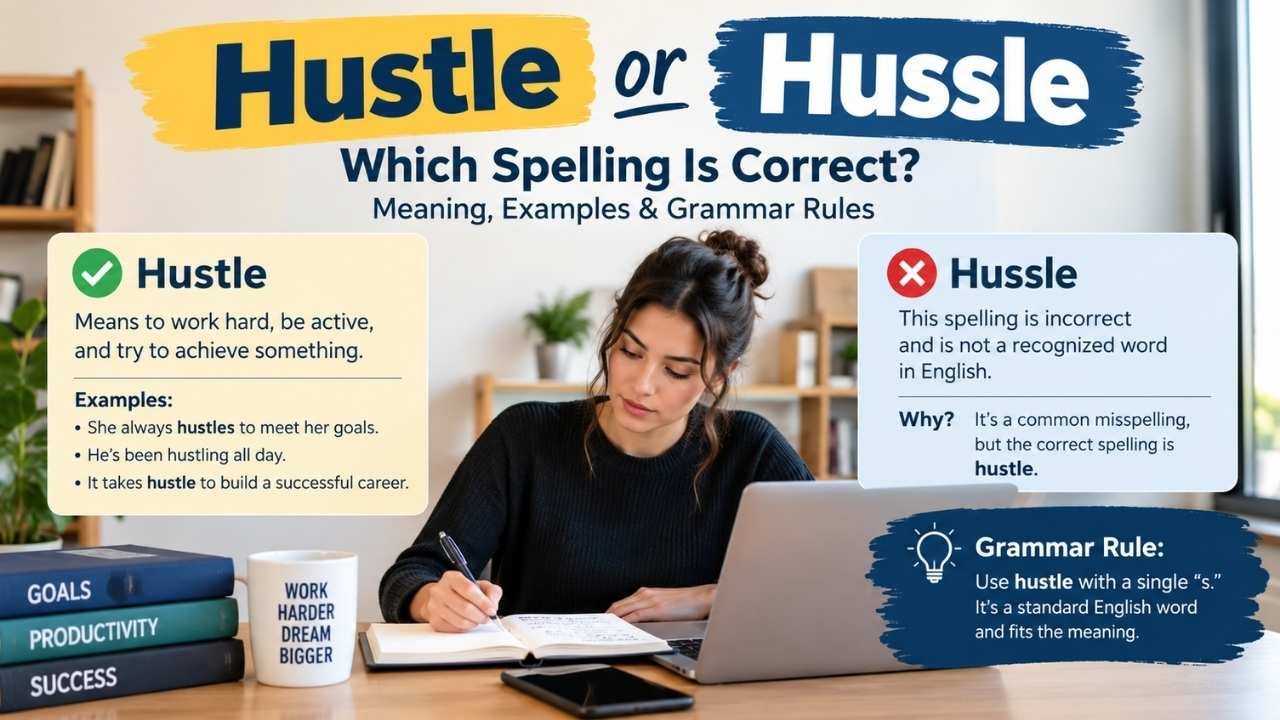
Choosing between Hustle and Hussle can be confusing, especially because both spellings appear online. You may see Hustle in dictionaries, books, and professional writing, while Hussle is often linked to names, brands, or simple spelling mistakes.
So, which one should you use? In standard English, Hustle is the correct spelling when you mean to work hard, move quickly, or make a determined effort. Understanding this difference helps you write with confidence and avoid common grammar mistakes.
In this guide, you’ll learn the correct spelling, the meaning of Hustle, when Hussle may still be appropriate, and how to use the word correctly with clear examples. By the end, you’ll know exactly which spelling fits every situation and avoid this common English mistake in both writing and everyday communication.
Quick Answer
Hustle is the correct spelling in standard English. It means to work hard, move quickly, or make a strong effort to achieve something. Hussle is generally considered a misspelling, except when it is used as a proper name, such as Nipsey Hussle. For everyday writing, school, business, and professional communication, always use Hustle.
What Does “Hustle” Mean?

The word hustle is a common English word that can be used as both a verb and a noun. As a verb, it means to work hard, move quickly, or push yourself to achieve a goal. For example, someone may hustle to finish a project before a deadline or hustle to catch a bus.
As a noun, it describes hard work, determination, or energetic effort. You may also hear phrases like “side hustle,” which refers to a part-time job or business that earns extra income.
In modern English, hustle often has a positive meaning because it reflects dedication and persistence. However, in some situations, it can also mean pushing someone forcefully or pressuring people to buy something.
Is “Hussle” Ever Correct?
In most situations, Hussle is not the correct spelling in standard English. If you are talking about working hard, moving quickly, or making an effort, you should always write hustle. However, Hussle is correct when it is used as a proper name.
The most well-known example is Nipsey Hussle, the American rapper and entrepreneur who intentionally used this spelling as his stage name. You may also come across Hussle in business names, social media usernames, or brand names.
These are exceptions because names follow personal or branding choices rather than grammar rules. For everyday writing, school assignments, emails, and professional documents, hustle remains the only accepted spelling.
Hustle vs. Hussle: Side-by-Side Comparison
| Feature | Hustle | Hussle |
| Correct English Spelling | ✅ Yes | ❌ No (except as a proper name) |
| Meaning | Work hard, move quickly, or make a strong effort | Usually a personal or brand name |
| Dictionary Recognition | Included in major dictionaries | Not listed as a standard English word |
| Common Usage | Everyday writing, business, school, and conversation | Names such as Nipsey Hussle |
| Professional Writing | Recommended | Not recommended unless referring to a name |
| Pronunciation | Sounds like “HUHS-ul” | Pronounced the same as Hustle |
The main difference is simple: hustle is the correct English word, while Hussle is mainly seen as a surname or stage name. If your goal is accurate grammar, choose hustle unless you are referring to a specific person or brand.
Why Do People Confuse Hustle and Hussle?
Many people mix up hustle and Hussle because they sound exactly the same when spoken. Since English contains many words with double letters, some writers mistakenly think Hussle follows the same spelling pattern.
Another reason is the popularity of Nipsey Hussle, whose stage name has introduced the spelling to millions of people around the world. Seeing it on social media, music platforms, or news websites can make it seem like both spellings are correct.
Fast typing, autocorrect mistakes, and simple spelling errors also add to the confusion. The easiest way to remember the rule is that hustle is the standard English spelling, while Hussle is generally reserved for proper names.
How to Use “Hustle” Correctly in Sentences
Learning through examples is one of the easiest ways to remember the correct spelling. Use hustle whenever you mean working hard, acting quickly, or showing determination. Here are a few examples:
- She had to hustle to finish the report before the meeting.
- His daily hustle helped him build a successful business.
- We hustled through the airport to catch our flight.
- Many students hustle to balance classes and part-time jobs.
- Starting a side hustle can help you earn extra income.
These examples show that hustle fits naturally in both formal and informal writing. If you’re improving your English skills, you may also enjoy learning the difference between Set or Sit, another pair of commonly confused words. Likewise, understanding the Plural of Oasis can help you avoid another frequent grammar mistake and strengthen your overall writing.
Common Mistakes to Avoid
Many writers make small mistakes when using hustle, but they are easy to avoid once you know the rule. The most common error is writing Hussle when you actually mean hustle.
Remember that Hussle is mainly a proper name, not the standard English spelling. Another mistake is using hustle in formal writing without considering its context. In business or academic writing, it usually means working hard or making a determined effort, while in informal speech it can also mean moving quickly.
Some people also capitalize Hustle in the middle of a sentence without a reason. Before submitting your work, always proofread and check the spelling in a trusted dictionary to ensure accuracy.
Easy Trick to Remember the Correct Spelling
A simple memory trick can help you remember the correct spelling every time. Think of the word “hard work.” The word hustle has one “s,” just like the word “success” begins with a single s sound.
Whenever you write about working hard, moving quickly, or making an effort, choose hustle. If you see Hussle, ask yourself whether you are talking about Nipsey Hussle or another person’s name.
If the answer is no, then hustle is almost certainly the correct choice. This quick reminder is useful for students, professionals, and anyone learning English. With regular practice, the correct spelling will soon become a natural habit.
Synonyms and Related Words
If you want to avoid repeating hustle in your writing, several similar words can express the same idea. Depending on the sentence, you can use work hard, strive, push, rush, move quickly, grind, effort, drive, or determination.
Each word has a slightly different meaning, so choose one that matches your context. For example, grind often refers to consistent hard work, while rush focuses on speed. If you are writing about business, side hustle is another common expression for a part-time job or extra source of income.
Using a variety of related words makes your writing more natural while keeping your message clear and easy to understand.
Origin and History of the Word “Hustle”
The word hustle has been part of the English language for many years. It is believed to have developed from older words that described shaking, pushing, or moving quickly. Over time, its meaning expanded beyond physical movement.
People began using hustle to describe someone who works with energy, determination, and ambition. Today, the word is widely used in business, sports, education, and everyday conversations.
In modern English, hustle often carries a positive message about hard work and persistence, although it can still have negative meanings in certain situations, such as pushing through a crowd or pressuring someone. Its long history explains why it remains a popular and versatile English word.
Is “Hustle Culture” Related to the Word “Hustle”?
Yes, hustle culture comes directly from the word hustle, but it has a broader meaning. Hustle culture is the idea that people should always work harder, stay busy, and keep chasing success.
While many people see it as a source of motivation, others believe it can lead to stress, burnout, and an unhealthy work-life balance. The original meaning of hustle simply refers to working hard or moving with energy.
However, hustle culture describes a modern lifestyle and mindset rather than the dictionary definition of the word. Understanding this difference helps you use the term correctly, especially when reading business articles, career advice, or discussions about productivity.
FAQs
Is Hussle a real English word?
No. Hussle is not a standard English word. It is mainly used as a proper name, such as Nipsey Hussle.
Is hustle a noun or a verb?
It can be both. As a verb, it means to work hard or move quickly. As a noun, it refers to hard work or energetic effort.
Is hustle a formal word?
Yes, it can be used in both formal and informal writing, depending on the context.
What is a side hustle?
A side hustle is a part-time job or business that helps someone earn extra money.
Why do people spell it Hussle?
Many people are influenced by famous names or simply make a spelling mistake because both words sound alike.
Conclusion
The answer is simple: Hustle is the correct spelling in standard English. Whether you are talking about working hard, moving quickly, showing determination, or starting a side hustle, you should always use hustle.
The spelling Hussle is appropriate only when referring to a proper name, such as Nipsey Hussle, or a brand that intentionally uses that spelling. Knowing this small but important difference will help you write with greater confidence and avoid a common English mistake.
Whenever you are unsure, remember that dictionaries recognize hustle as the standard word. Following this rule will keep your writing accurate, professional, and easy for readers to understand.