
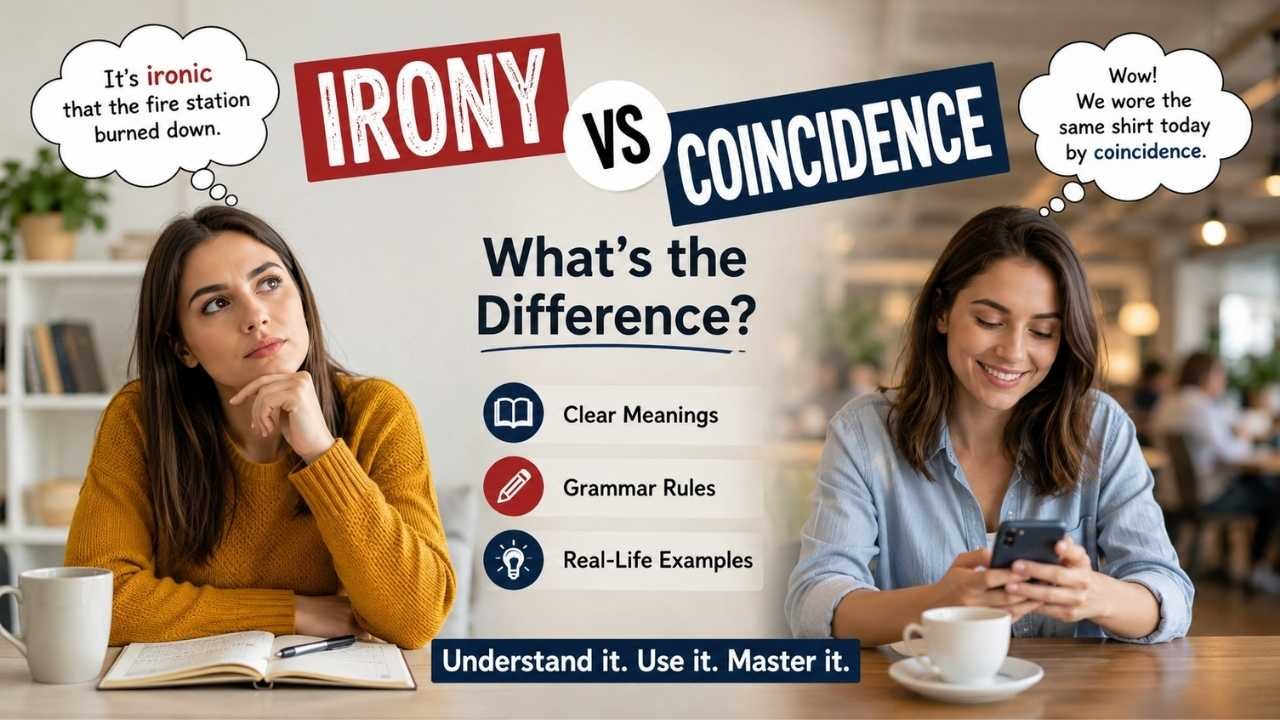
Have you ever heard someone describe an unusual event as Irony vs Coincidence when it was actually just a coincidence? You’re not alone. Many people confuse these two words because both involve unexpected situations. However, they have very different meanings.
Irony happens when the outcome is the opposite of what you expect, while a coincidence is simply two or more events that happen by chance without a meaningful connection. Understanding the difference can improve your grammar, make your writing clearer, and help you communicate more accurately in everyday conversations.
In this guide, you’ll learn the meaning of irony and coincidence, explore the key differences, discover the types of irony, and see plenty of real-life examples. By the end, you’ll know exactly when to use irony and when to use coincidence with confidence.
Quick Answer
Irony and coincidence are not the same. Irony occurs when the result is the opposite of what you would normally expect, creating a surprising contrast. A coincidence happens when two or more events occur by chance without a planned connection. Knowing the difference between irony and coincidence helps you use both terms correctly in writing and everyday conversation.
What Does “Irony” Mean?

Irony is a situation where the actual result is very different from what people expect. In simple words, something ironic happens when reality turns out to be the opposite of what seems likely.
This makes irony a popular literary device as well as a common part of everyday conversation. People often say something is ironic when it is merely surprising, but that is not always correct.
Understanding the meaning of irony helps you avoid this common mistake. There are different forms of irony, including situational irony, verbal irony, and dramatic irony, each with its own purpose. If you enjoy learning about commonly confused words, you may also like our guide on Ill vs Sick, which explains another pair of terms that people often mix up.
What Does “Coincidence” Mean?
A coincidence happens when two or more events occur by chance without one causing the other. These events may seem connected, but there is no hidden reason behind them. For example, you might think about an old friend and then receive a message from that person on the same day.
That is a coincidence because it happened by chance. Unlike irony, a coincidence does not involve an opposite or unexpected outcome based on expectations. It simply describes an accidental connection between events.
Learning the meaning of coincidence makes it much easier to understand the difference between irony and coincidence and use both words correctly in everyday writing and conversation.
Irony vs Coincidence: Key Differences Explained
The biggest difference between irony and coincidence is how the event happens. Irony depends on a contrast between expectation and reality, while a coincidence is based on chance. Imagine a firefighter whose own house catches fire.
That is situational irony because the result is the opposite of what you expect. Now imagine meeting your neighbor while traveling in another country. That is a coincidence because it happened by chance.
Although both situations may seem surprising, only one is ironic. Remember, not every unexpected event is irony. Understanding this distinction will improve your grammar and help you communicate more accurately. Like the phrase By Hook or by Crook, using these expressions correctly depends on knowing their true meaning and context.
Comparison Table: Irony vs Coincidence
| Feature | Irony | Coincidence |
| Meaning | An outcome that is opposite to what is expected. | Two or more events happen by chance. |
| Main Cause | Contrast between expectation and reality. | Random chance or accidental timing. |
| Connection Between Events | Yes, the outcome creates an ironic contrast. | No meaningful connection exists. |
| Purpose | Often used for humor, surprise, or storytelling. | Describes unexpected events without deeper meaning. |
| Common Examples | A traffic officer gets a speeding ticket. | Two friends wear the same outfit without planning. |
| Common Mistake | People use it for any surprising event. | People confuse it with irony. |
This simple comparison shows that irony involves an unexpected contrast, while a coincidence is simply an accidental event.
Types of Irony You Should Know
There are three main types of irony, and knowing them makes it easier to recognize ironic situations. Situational irony happens when the outcome is the opposite of what people expect, such as a lifeguard needing to be rescued.
Verbal irony occurs when someone says one thing but means another, often for humor or emphasis. For example, saying, “What lovely weather!” during a heavy storm is verbal irony. Dramatic irony is common in books, movies, and plays. It happens when the audience knows something that the characters do not.
These forms of irony are different from a coincidence because they rely on contrast rather than chance. Learning these types will help you identify ironic examples more confidently.
Can Something Be Both Ironic and Coincidental?
Yes, although it is rare, an event can be both ironic and coincidental. A coincidence may create the situation, while irony comes from the unexpected result. For example, imagine a doctor randomly meeting a patient while on vacation in another country.
The meeting itself is a coincidence because it happens by chance. If the doctor had traveled there to escape work but ended up giving medical help anyway, the outcome also becomes ironic because it is the opposite of what was expected.
In most situations, however, events are either irony or coincidence, not both. Asking whether the surprise comes from chance or from expectation versus reality is the easiest way to decide which word fits best.
Common Mistakes People Make
Many people use irony and coincidence as if they mean the same thing, but they do not. One of the most common mistakes is calling any surprising event ironic. For example, meeting a friend on vacation after not seeing them for years is a coincidence, not irony.
Another mistake is confusing bad luck with irony. If it rains on your picnic, that is unfortunate, but it is not automatically ironic. Irony requires a clear contrast between expectation and reality, while a coincidence happens by chance.
Before using either word, ask yourself one simple question: Did this happen because of an unexpected contradiction or simply by chance? This habit will help you use both terms correctly in speech and writing.
Real-Life Examples of Irony vs Coincidence
Looking at everyday situations is one of the easiest ways to understand the difference between irony and coincidence. Imagine a dentist who never brushes their own teeth. That is irony because the result goes against what people expect from a dental professional.
Now imagine you and your coworker buying the same shirt on the same day without telling each other. That is a coincidence because it happened by chance. Another example of irony is a weather reporter getting caught in a storm while talking about clear skies.
On the other hand, running into an old classmate at an airport is simply a coincidence. These real-life examples make it much easier to recognize the correct meaning of each word.
Irony vs Coincidence in Literature and Movies
Writers and filmmakers often use irony to make stories more interesting and memorable. In literature, dramatic irony allows readers to know something important that the characters do not, creating suspense.
Situational irony surprises readers by delivering an ending that is the opposite of what they expected. A coincidence, however, usually helps move the story forward by bringing characters or events together through chance. While coincidences can start or shape a plot, they do not create the same contrast that irony does.
Understanding how these ideas work in books and movies also helps you recognize them in real life. It becomes easier to identify whether an event is truly ironic or simply coincidental.
How to Tell If Something Is Irony or Coincidence (Decision Checklist)
If you are unsure whether an event is irony or a coincidence, use this simple checklist. First, ask yourself if the outcome is the opposite of what was expected. If the answer is yes, it is probably irony.
Next, ask whether the events happened by chance without any meaningful connection. If they did, it is likely a coincidence. Also think about whether there is a strong contrast between expectation and reality.
If there is no contrast and only unexpected timing, the correct word is coincidence. Following these questions can help you avoid common mistakes and choose the right term in conversations, school assignments, and professional writing.
Easy Tricks to Remember the Difference
You do not need to memorize long grammar rules to remember irony vs coincidence. A simple trick is to link irony with opposites and coincidence with chance. If something turns out completely opposite to what people expect, think of irony.
If two unrelated events happen at the same time without planning, think of a coincidence. Another easy memory tip is this: Irony surprises because of contrast, while coincidence surprises because of timing.
Repeating this sentence whenever you are unsure can help you remember the difference. With a little practice, identifying ironic situations and coincidental events will become natural and much easier in everyday communication.
FAQs
Is irony the same as coincidence?
No. Irony is based on a contrast between expectation and reality, while a coincidence happens by chance without a meaningful connection.
Can a coincidence also be ironic?
Yes, but it is uncommon. A chance event can also produce an unexpected outcome that creates irony.
What is situational irony?
Situational irony happens when the final result is the opposite of what people normally expect.
Is sarcasm the same as irony?
No. Sarcasm is a way of speaking, while verbal irony is saying one thing but meaning another. Not all verbal irony is sarcastic.
Why do people confuse irony and coincidence?
Both involve unexpected events, which makes them seem similar. The key difference is that irony depends on contrast, while coincidence depends on chance.
Can irony happen in real life?
Yes. Everyday situations, news stories, and personal experiences can all include genuine examples of irony.
Which is more common in daily life?
Coincidences are generally more common because random events happen frequently, while true irony requires a specific contrast between expectation and reality.
Conclusion
Understanding irony vs coincidence is easier once you know what makes each one unique. Irony happens when reality is the opposite of what people expect, while a coincidence is simply an unexpected event that occurs by chance.
Although both can be surprising, they are not interchangeable. Learning this difference will improve your grammar, strengthen your writing, and help you communicate with greater confidence.
Whenever you are unsure, remember this simple rule: If the surprise comes from a clear contrast, it is irony. If it comes from random timing or chance, it is a coincidence. With these definitions, examples, and tips, you can use both words accurately in everyday conversations, academic work, and professional writing.