

Have you ever wondered whether a letter and an alphabet mean the same thing? Many people use these words interchangeably, but they actually have different meanings. A letter is a single symbol used to represent sounds in a language, while an alphabet is the complete collection of those letters arranged in a specific order.
Understanding the difference between a letter and an alphabet can improve your grammar, writing, and communication skills. Whether you are a student, teacher, parent, or simply curious about language, knowing these basic terms will help you avoid common mistakes.
In this guide, you’ll learn what a letter is, what an alphabet is, their key differences, practical examples, and answers to frequently asked questions. By the end, you’ll clearly understand when to use each term with confidence.
Quick Answer
A letter is a single written symbol that represents a sound in a language, while an alphabet is the complete set of letters arranged in a fixed order. In the English alphabet, there are 26 letters, from A to Z. Simply put, a letter is one part, and an alphabet is the entire collection of those letters.
Letter vs. Alphabet at a Glance (Comparison Table)
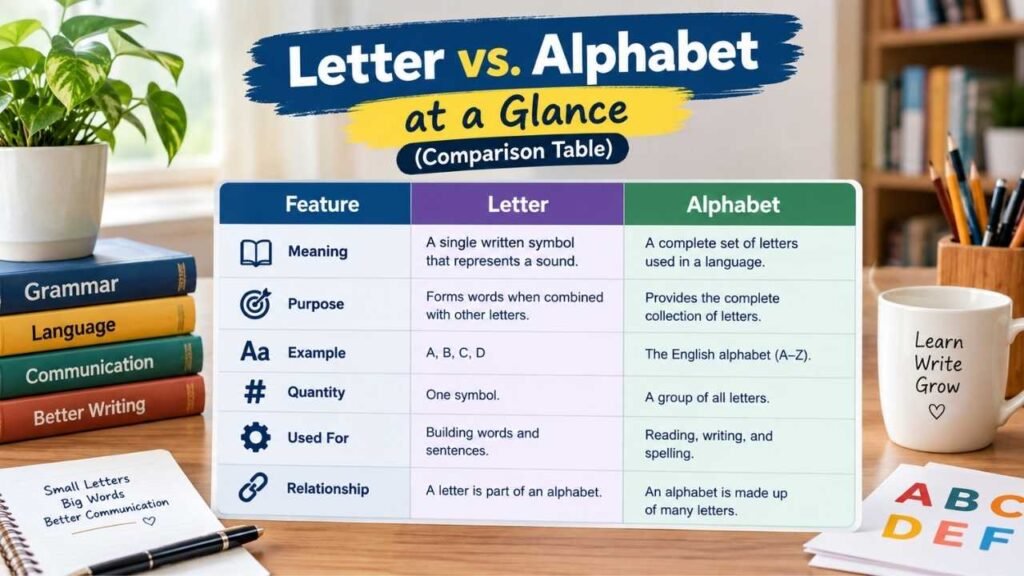
| Feature | Letter | Alphabet |
| Meaning | A single written symbol that represents a sound | A complete set of letters used in a language |
| Purpose | Forms words when combined with other letters | Provides the complete collection of letters |
| Example | A, B, C, D | The English alphabet (A–Z) |
| Quantity | One symbol | A group of all letters |
| Used For | Building words and sentences | Reading, writing, and spelling |
| Relationship | A letter is part of an alphabet | An alphabet is made up of many letters |
The difference between a letter and an alphabet is simple. A letter is one individual symbol, while an alphabet is the entire collection of letters arranged in a fixed order. For example, A is a letter, but A to Z together make the English alphabet.
Learning this distinction helps improve grammar, spelling, reading, and everyday communication. This basic knowledge also makes it easier to understand how written languages are organized.
What Is a Letter?
A letter is a single written symbol that represents one or more sounds in a language. Every word you read or write is made by combining different letters.
For example, the word book contains the letters B, O, O, and K. In the English alphabet, there are 26 letters, and each has an uppercase and lowercase form, such as A/a or B/b. Letters help us create words, sentences, and complete ideas.
They are the smallest building blocks of written language. If you enjoy learning grammar, you may also like our guide on the Past Tense of Fall Down, which explains another common English question in a simple and practical way.
What Is an Alphabet?
An alphabet is the complete set of letters used to write a language. Unlike a single letter, an alphabet includes every letter arranged in a standard order. The English alphabet contains 26 letters, beginning with A and ending with Z.
Different languages may have different alphabets or a different number of letters, but they all serve the same purpose—helping people read, write, and communicate. Understanding the alphabet meaning makes it easier to learn spelling, pronunciation, and vocabulary.
If you enjoy grammar topics, you might also find our article on the Plural of Phalanx helpful, as it explains another commonly misunderstood English word with clear examples.
Why People Confuse Letter and Alphabet
Many people think a letter and an alphabet are the same because the words are closely connected. In everyday conversation, someone might say, “Write the alphabet A,” even though A is actually a single letter, not the entire alphabet.
This habit creates confusion, especially for children and English learners. The easiest way to remember the difference between a letter and an alphabet is that a letter is one symbol, while an alphabet is the complete group of letters.
For example, M is a letter, but A to Z together form the English alphabet. Once you understand this relationship, using both terms correctly becomes much easier in speaking and writing.
Key Differences Between a Letter and an Alphabet
Although the terms are related, a letter and an alphabet have different meanings. A letter is a single symbol used to represent sounds and build words. An alphabet is the complete collection of those letters arranged in a fixed sequence.
For example, C is one letter, while the English alphabet includes all 26 letters from A to Z. Another difference is that letters combine to create words, but an alphabet provides the system that makes writing possible.
Understanding the letter vs. alphabet comparison improves reading, spelling, grammar, and communication. Knowing when to use each word correctly also helps avoid common mistakes in school, work, and everyday conversations.
How Letters Work Together to Form an Alphabet
A letter is useful on its own, but it becomes much more powerful when it is part of an alphabet. An alphabet is a complete system that organizes all the letters of a language in a fixed order. These letters work together to create words, sentences, and complete ideas.
For example, the letters C, A, and T can be combined to form the word cat. Without letters, an alphabet would not exist, and without an alphabet, reading and writing would be much harder to learn.
is relationship explains why a letter is one part of a larger system. Understanding how letters and alphabets work together makes spelling, reading, and communication easier for learners of every age.
Examples from the English Alphabet
The English alphabet contains 26 letters, starting with A and ending with Z. Each letter has a specific shape, name, and sound, although some letters can represent more than one sound depending on the word.
For example, A appears in apple, while B appears in book. When these letters are combined, they create thousands of words used in everyday communication. Every sentence you read is built from these same 26 letters.
The alphabet also includes uppercase and lowercase forms, such as A/a and B/b, which are used in different writing situations. Learning the English alphabet is one of the first steps toward becoming a confident reader and writer.
Examples from Other Writing Systems (Greek, Cyrillic, Arabic, etc.)
Not every language uses the same alphabet, but many languages have their own writing systems. For example, the Greek alphabet includes letters such as Alpha (Α) and Beta (Β). The Cyrillic alphabet, used in languages like Russian and Bulgarian, contains different letter shapes from English.
The Arabic alphabet is written from right to left and has its own unique letters. Even though these alphabets look different, they all serve the same purpose: helping people read, write, and communicate.
Every alphabet is made up of individual letters, just as the English alphabet is. Learning about different writing systems also helps us appreciate the variety and richness of languages around the world.
Common Mistakes When Using “Letter” and “Alphabet”
One common mistake is calling a single letter an alphabet. For example, saying “A is an alphabet” is incorrect because A is only one letter. The correct statement is “A is a letter in the English alphabet.”
Another mistake is using both words as if they have the same meaning. Remember that a letter is an individual symbol, while an alphabet is the complete set of letters. Some learners also believe every language has the same alphabet, but many languages use different writing systems.
By understanding the correct letter meaning and alphabet meaning, you can avoid these errors and communicate more clearly in both speaking and writing.
Letter vs. Alphabet in Early Education and Phonics
Children usually learn letters before they begin reading full words. They first recognize the shape and name of each letter, then learn the sound it makes through phonics. After becoming familiar with individual letters, they learn the complete alphabet in its correct order.
This process helps children build words, improve pronunciation, and develop strong reading skills. Teachers often use songs, flashcards, games, and picture books to make learning fun and memorable.
Understanding the difference between a letter and an alphabet at an early age creates a strong foundation for spelling, writing, and language development. It also helps children gain confidence as they begin reading and communicating independently.
FAQs
Is a letter the same as an alphabet?
No. A letter is one written symbol, while an alphabet is the complete collection of letters used in a language.
How many letters are in the English alphabet?
The English alphabet has 26 letters, from A to Z.
Can an alphabet have different numbers of letters?
Yes. Different languages have different alphabets, and the number of letters can vary.
Why do people confuse letters and alphabets?
Because the terms are closely related and are often used incorrectly in everyday conversation.
What comes first, a letter or an alphabet?
An alphabet is made up of many letters, so individual letters are the building blocks of an alphabet.
Conclusion
Understanding the difference between a letter and an alphabet is an important step in learning any language. A letter is a single written symbol that represents a sound, while an alphabet is the complete set of letters arranged in a specific order.
Although the two terms are closely connected, they should not be used interchangeably. Knowing this difference improves grammar, spelling, reading, and writing skills.
Whether you are a student, teacher, parent, or language learner, this knowledge will help you communicate more accurately and confidently. The next time someone asks whether a letter and an alphabet are the same, you’ll know the correct answer and be able to explain it with clear, simple examples.