
Have you ever wondered what the plural of iris is? Many people are unsure whether the correct form is irises or irides, and it’s easy to see why. Both words appear in dictionaries, but they are not used in the same way.
If you’ve searched for what is the plural of iris, iris plural, or is the plural of iris irises or irides, you’re in the right place. This guide explains the correct plural of iris in clear, simple language.
You’ll learn when to use irises, when irides is appropriate, and why the word has two accepted plural forms. We’ll also cover grammar rules, real-life examples, common mistakes, and expert writing tips so you can use the plural form of iris confidently in everyday English.
Quick Answer
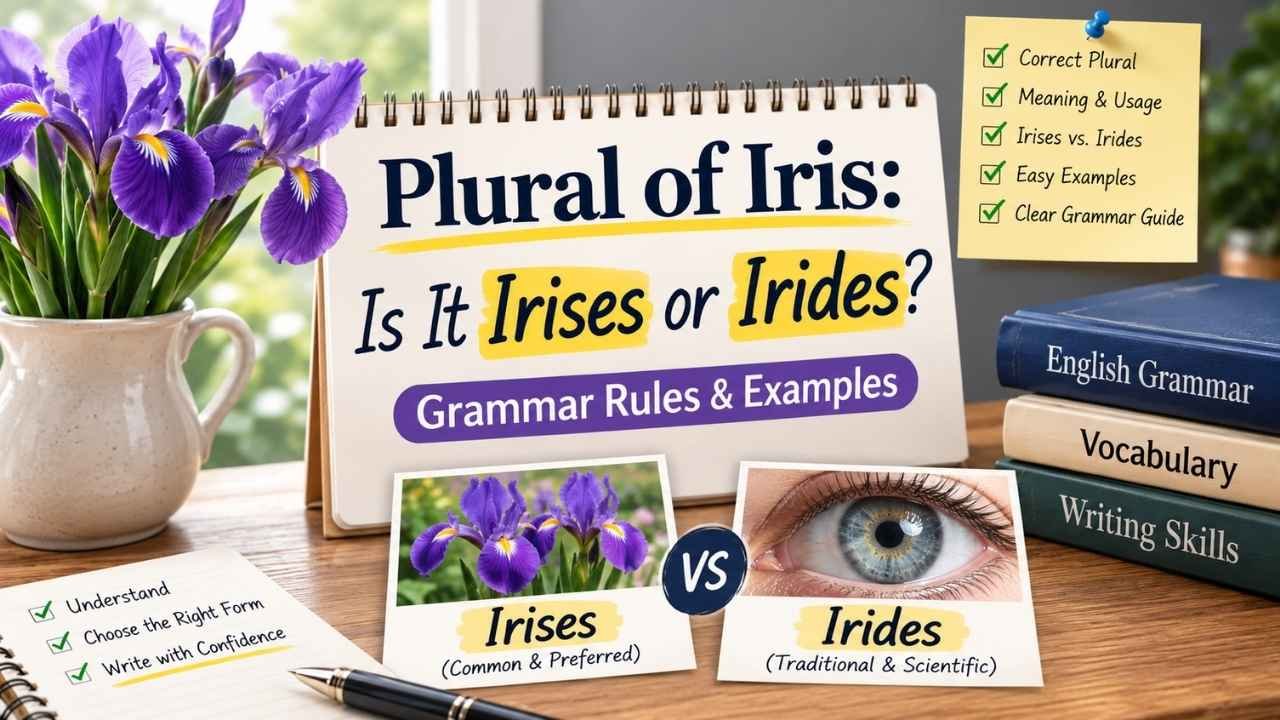
The plural of iris can be irises or irides, and both are correct. However, irises is the preferred form in modern English and is commonly used for both the iris flower and the colored part of the eye. Irides is a traditional plural that appears mainly in scientific, medical, or historical contexts.
What Does “Iris” Mean?
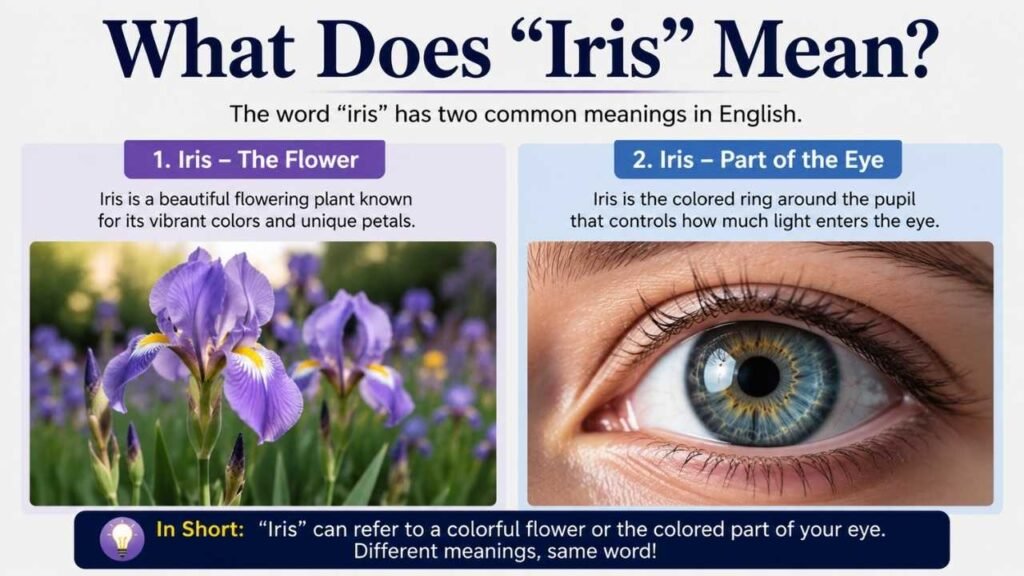
Before learning the plural of iris, it helps to understand what the word means. An iris has two common meanings in English. First, it is a beautiful flowering plant that comes in many colors and is popular in gardens around the world.
Second, the iris is the colored ring of the eye that controls how much light enters through the pupil. Although these meanings are different, they share the same spelling and the same plural form of iris.
Whether you are talking about flowers or eyes, you may need to choose between irises and irides. Knowing the meaning of the word makes it much easier to understand what is the plural of iris and when each form is appropriate.
Is the Plural of Iris “Irises” or “Irides”?
Many people ask, “Is the plural of iris irises or irides?” The answer is that both are correct, but they are not equally common. In modern English, irises is the standard and preferred plural.
It is widely used in books, schools, newspapers, and everyday conversations for both the flower and the colored part of the eye. Irides is also an accepted plural, but it is much less common.
You may see it in older texts or in scientific, medical, or anatomical writing. If you want the correct plural of iris for general communication, irises is the safest choice because it sounds natural and matches current English usage.
Irises vs. Irides: What’s the Difference?
Although irises and irides are both accepted, understanding the difference helps you choose the right word. Irises is the plural used by most English speakers today. It fits naturally in everyday writing, business communication, school assignments, and casual conversations.
Irides, however, comes from the word’s Greek origin and is considered a more traditional plural. It is mostly found in medical, scientific, or historical texts where classical language is preferred. The difference is mainly about usage, not meaning.
Both words refer to more than one iris, whether you are discussing flowers or eyes. For most situations, irises is the recommended choice because it is familiar to readers and follows modern English usage.
| Plural Form | Best Used In |
| Irises | Everyday English, schools, blogs, business writing, general communication |
| Irides | Scientific papers, medical writing, anatomy, historical or classical contexts |
Why Does Iris Have Two Accepted Plural Forms?
The reason iris has two accepted plural forms goes back to its history. The word comes from Greek, where many nouns formed their plurals differently from modern English. As the word became part of English, people started using the regular English plural irises.
At the same time, the older classical plural irides continued to appear in academic and scientific writing. Over time, irises became much more popular because it follows the standard English rule of adding -es to nouns ending in -s.
This is why both forms still exist today. Learning about the word’s history also makes it easier to understand other grammar topics, such as Acclimate vs Acclimatize, where usage can vary depending on region and style.
Which Plural Should You Use in Modern English?
If you are writing for a general audience, choose irises almost every time. It is the plural recommended in modern English because readers recognize it immediately and it works well in both formal and informal writing.
Use irides only when writing for a scientific, medical, or historical audience where the traditional form is expected. Choosing the right plural also depends on your readers. Clear and familiar language always improves communication.
The same idea applies when choosing between similar words, such as Re-sign or Resign, where one small spelling difference completely changes the meaning. For everyday grammar, emails, blog posts, and school work, irises is the correct plural of iris and the best option for most writers.
Example Sentences Using “Irises” and “Irides”
Seeing the words in real sentences is one of the easiest ways to remember the plural of iris. In everyday English, irises is the form you will see most often because it sounds natural and is easy for readers to understand.
For example, The garden was filled with colorful irises in full bloom. Another example is, The doctor carefully examined both irises during the eye test. The traditional plural, irides, is mostly used in scientific or medical writing.
For instance, Researchers compared the irides of patients to study eye color variations. These examples show that both forms are correct, but irises is the preferred choice for general writing, while irides fits specialized contexts.
Common Mistakes People Make with the Plural of Iris
Many writers become confused because they see both irises and irides in dictionaries. One common mistake is believing that only one form is correct. In reality, both are accepted, but they are used in different situations.
Another mistake is using irides in everyday writing, where irises sounds much more natural. Some people also assume the plural changes depending on whether they mean the flower or the colored part of the eye.
In modern English, irises works well for both meanings. It is also important to avoid creating incorrect forms like irises or iris’ when referring to more than one. Knowing the correct plural of iris helps your writing stay clear, accurate, and professional.
Similar English Words with Two Accepted Plurals
The plural of iris is not the only English word with two accepted plural forms. Many words borrowed from Greek or Latin have both a traditional and a modern English plural. For example, cactus can become cactuses or cacti, while syllabus has the plurals syllabuses and syllabi.
You may also see appendixes and appendices, indexes and indices, or formulas and formulae. In most everyday situations, the regular English plural is easier for readers to understand, while the classical form is often used in academic or technical writing.
Learning these patterns makes English grammar less confusing and helps you choose the right plural with confidence.
Quick Comparison Table: Singular vs. Plural Forms
The table below gives you a quick overview of the singular and plural forms of iris. It also shows when each plural is commonly used. This simple comparison can help you decide which form fits your writing. In most cases, irises is the best choice because it follows modern English usage and is familiar to most readers.
Irides remains correct but appears mainly in specialized fields such as medicine, biology, and historical texts. If your goal is clear communication, choosing the form your audience expects is always the smartest approach.
| Singular | Plural | Common Usage |
| Iris | Irises | Everyday English, education, blogs, business writing |
| Iris | Irides | Scientific, medical, anatomical, and historical writing |
Pronunciation Guide for Iris, Irises, and Irides
Correct pronunciation makes it easier to use new words with confidence. Iris is commonly pronounced as EYE-riss. The modern plural irises is pronounced EYE-riss-iz, adding a soft -iz sound at the end.
The traditional plural irides is usually pronounced IR-ih-deez or EYE-rih-deez, depending on the speaker and regional preference. Since irises is far more common in everyday English, most learners only need to remember that pronunciation for daily conversations and writing.
If you read scientific or medical material, you may also hear irides, but it is much less common outside those fields. Listening to dictionary audio recordings is another helpful way to improve your pronunciation.
FAQs
Is the plural of iris “irises” or “irides”?
Both forms are correct. However, irises is the standard plural in modern English, while irides is mostly used in scientific, medical, or historical writing.
Which plural should I use in everyday writing?
Use irises because it is the form most readers recognize and expect.
Can I use “irides” when talking about flowers?
Yes. Although it is uncommon, irides can refer to more than one flower or more than one colored part of the eye.
Why does iris have two plural forms?
The word comes from Greek. English kept the traditional plural irides while also adopting the regular English plural irises.
Do dictionaries accept both plurals?
Yes. Major dictionaries recognize both irises and irides, though irises is the preferred choice for general English.
Conclusion
The plural of iris can be either irises or irides, and both are accepted in English. The key difference is how they are used. Irises is the preferred form in modern English and works well for everyday conversations, school assignments, business writing, and most online content.
Irides is a traditional plural that mainly appears in scientific, medical, or historical contexts. If you are unsure which form to choose, irises is usually the safest and clearest option.
By understanding the history of the word, its grammar, and its real-life usage, you can confidently use the correct plural of iris in any situation and communicate more naturally with your readers.