
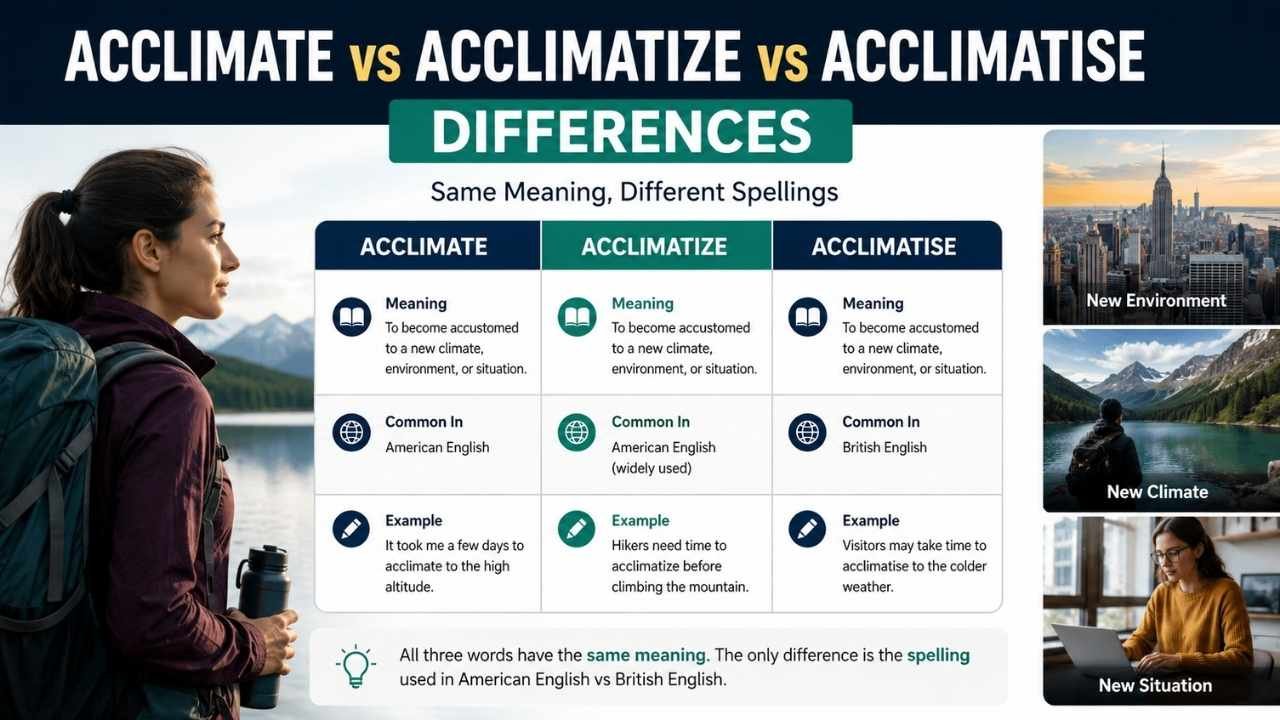
When you come across Acclimate vs Acclimatize vs Acclimatise, it’s easy to wonder whether they have different meanings or if one spelling is more correct than the others. The good news is that all three words describe the process of becoming accustomed to a new climate, environment, or situation.
The main difference lies in regional spelling and usage, not in meaning. Acclimate is the shorter form commonly used in American English, while acclimatize is also widely accepted in the United States. Acclimatise is the preferred spelling in British English and other regions that follow British spelling conventions.
In this guide, you’ll learn the meaning of each word, understand the differences between them, explore American vs. British English usage, see practical examples, avoid common mistakes, and discover which spelling is the best choice for your writing.
Quick Answer
Acclimate vs Acclimatize vs Acclimatise all mean to become accustomed to a new climate, environment, or situation. They have the same meaning, but the preferred spelling depends on the region. Acclimate and acclimatize are commonly used in American English, while acclimatise is the standard spelling in British English. Choose the form that matches your audience and remain consistent throughout your writing.
Comparison Table: Acclimate vs Acclimatize vs Acclimatise
| Word | Meaning | Common Region | Part of Speech | Example |
| Acclimate | To become used to a new climate, environment, or situation | Mainly American English | Verb | It took me a week to acclimate to the hot weather. |
| Acclimatize | To become adapted to a new climate or surroundings | Mostly American English, but accepted elsewhere | Verb | Hikers should acclimatize before climbing a high mountain. |
| Acclimatise | Same meaning as acclimatize | British English | Verb | Visitors need time to acclimatise to the colder weather. |
All three words have the same meaning. The only real difference is regional spelling. If you write for an American English audience, acclimate or acclimatize are both appropriate. If your readers use British English, acclimatise is usually the preferred choice. Pick one spelling and stay consistent throughout your writing.
What Does “Acclimate” Mean?

Acclimate means to become accustomed to a new climate, environment, or condition over time. It is the shorter form of acclimatize and is especially common in American English. You may see it used when people talk about adjusting to hot weather, cold temperatures, high altitudes, or even a new workplace.
Although it is shorter, its meaning is exactly the same. Writers often choose acclimate because it is simple and natural in everyday communication.
If you’re learning about other grammar choices, you may also enjoy our guide on Long Term or Long-Term, which explains another common usage question. In most situations, acclimate is a clear and widely accepted word.
Examples:
- It took the new employees a few weeks to acclimate to their workplace.
- We needed two days to acclimate to the mountain air.
- Plants often acclimate to changing weather over time.
What Does “Acclimatize” Mean?
Acclimatize also means to adjust to a different climate, environment, or situation. It is a longer spelling that is commonly used in American English, especially in scientific, medical, and travel-related writing.
Whether someone is adapting to high altitude, extreme temperatures, or a new country, acclimatize describes that gradual process of becoming comfortable. There is no difference in meaning between acclimate and acclimatize.
The choice usually depends on personal preference or writing style. Many dictionaries recognize both spellings as correct, so you can confidently use either one as long as you remain consistent throughout your document.
Examples:
- Climbers should acclimatize before reaching the summit.
- It took several days to acclimatize to the tropical climate.
- New employees quickly acclimatized to the company’s routine.
What Does “Acclimatise” Mean?
Acclimatise has the same meaning as acclimate and acclimatize, but it follows the British English spelling convention. The -ise ending is common in the UK, Australia, and many other countries that prefer British spelling.
If you are writing for a British audience, acclimatise is usually the better choice. The word is often used when talking about adjusting to new weather, different surroundings, or unfamiliar conditions. The meaning never changes—only the spelling does.
Similar spelling differences appear in many English words, just as verb forms can cause confusion, which is why guides like our Past Tense of Panic article can also be helpful.
Examples:
- Visitors need time to acclimatise to the colder weather.
- The team slowly acclimatised to the new training conditions.
- It may take a few weeks to acclimatise after moving abroad.
Are Acclimate, Acclimatize, and Acclimatise Interchangeable?
Yes, Acclimate vs Acclimatize vs Acclimatise are interchangeable because they all describe the process of becoming accustomed to a new climate, environment, or situation. They share the same definition, so using one instead of another does not change the meaning of your sentence.
The main thing to consider is your audience. For American English, acclimate and acclimatize are both common choices. For British English, acclimatise is generally preferred. Once you choose a spelling, keep it consistent throughout your article, report, or document.
This creates a polished and professional piece of writing while avoiding unnecessary confusion for your readers.
American English vs British English
The biggest difference between these three words is regional spelling, not meaning. In American English, both acclimate and acclimatize are accepted, although acclimate is often preferred because it is shorter and commonly used in everyday writing.
In British English, the standard spelling is acclimatise, following the traditional -ise pattern. Australian and New Zealand English also commonly use acclimatise, though -ize spellings may appear in some publications depending on the style guide.
No matter which version you choose, the meaning remains the same. The best approach is to match the spelling to your audience and use that form consistently from beginning to end.
Why Does English Have Three Versions of the Same Word?
English has many words with more than one accepted spelling, and acclimate, acclimatize, and acclimatise are good examples. The word acclimatize developed from acclimatise, while acclimate later became a shorter version that many writers found easier to use.
Over time, different countries adopted different spelling preferences. American English commonly uses acclimate and acclimatize, while British English usually prefers acclimatise. Even though the spellings are different, they all carry the same meaning.
This shows how English has changed over the years while keeping the original idea of the word. Understanding this history makes it easier to choose the spelling that best matches your readers and writing style.
Acclimate vs Acclimatize: Which One Is More Common?
Both acclimate and acclimatize are correct, but acclimate is generally more common in everyday American English because it is shorter and easier to read.
You will often find it in blogs, news articles, and casual writing. On the other hand, acclimatize appears more often in scientific, medical, travel, and outdoor writing, especially when discussing altitude, climate, or environmental changes. In British English, writers usually choose acclimatise instead.
None of these spellings is more accurate than the others. The best choice depends on your audience and the type of content you are creating. Whatever spelling you select, keep it consistent throughout your document for a professional and polished result.
Common Mistakes and Misconceptions
One common mistake is thinking that acclimate, acclimatize, and acclimatise have different meanings. In reality, they all mean to become accustomed to a new climate, environment, or situation.
Another misunderstanding is believing that acclimate is incorrect because it is shorter. Modern dictionaries accept it as a standard word, especially in American English. Some writers also mix -ize and -ise spellings within the same article, which can make the writing look inconsistent.
To avoid confusion, choose the spelling that matches your audience and use it throughout your content. Finally, remember that these words are different from adapt, which has a broader meaning and is not limited to climate or surroundings.
Real-Life Examples in Different Contexts
These words can be used in many everyday situations, not just when talking about the weather. Travelers often need time to acclimate or acclimatize after arriving in a place with a different climate.
Mountain climbers should acclimatize before reaching high altitudes to help their bodies adjust safely. Students moving to another country may acclimatise to a new culture, school, and daily routine. Employees can also acclimate to a new workplace and work schedule. Even plants and animals gradually acclimatize to changes in their environment.
These examples show that the words are useful in travel, education, sports, science, and everyday life, making them practical choices for many types of writing.
How to Choose the Right Word in Your Writing
The right choice depends mainly on who will read your content. If your audience uses American English, acclimate is usually the simplest and most natural option, while acclimatize is also completely correct.
If you are writing for readers in the United Kingdom, Australia, or other regions that follow British spelling, acclimatise is generally the preferred form. For schools, businesses, or publications, follow the style guide they recommend.
Most importantly, stay consistent. Switching between different spellings in the same document can distract readers. By matching the spelling to your audience, your writing will appear clearer, more professional, and easier to understand.
FAQs
Is acclimate the same as acclimatize?
Yes. Both words have the same meaning and describe becoming used to a new climate, environment, or situation.
Is acclimatise correct?
Yes. Acclimatise is the standard British English spelling of the word.
Which spelling should I use?
Choose acclimate or acclimatize for American English, and acclimatise for British English. Match the spelling to your audience.
Can I use the three words interchangeably?
Yes. They are interchangeable because they share the same meaning. The only difference is regional spelling.
Conclusion
Acclimate, acclimatize, and acclimatise all mean to become accustomed to a new climate, environment, or situation. There is no difference in meaning between them.
The only distinction is the preferred spelling in different regions. Acclimate and acclimatize are common in American English, while acclimatise is the standard choice in British English. If you are unsure which one to use, think about your audience first. Then, stick with the same spelling throughout your writing.
Following this simple rule will make your content look more natural, consistent, and professional while helping readers understand your message without confusion.