
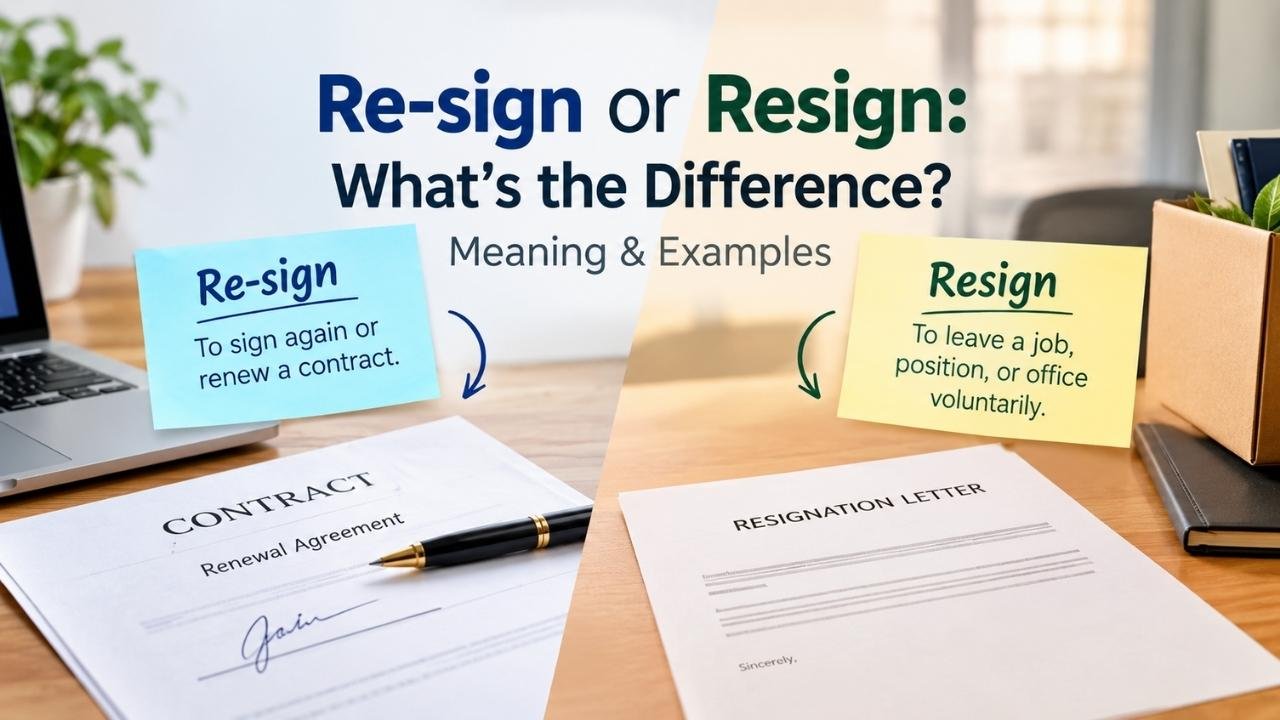
Choosing between re-sign and resign can be confusing because the two words look almost identical, yet they have completely opposite meanings. A single hyphen changes everything.
Resign means to quit a job, position, or responsibility, while re-sign means to sign something again, such as renewing a contract or agreeing to continue with a team. This small punctuation mark is especially important in business, employment, legal documents, and sports. Using the wrong word can easily change the meaning of your sentence and cause unnecessary confusion.
In this guide, you’ll learn the difference between re-sign and resign, their meanings, pronunciation, grammar rules, and correct usage with clear examples. By the end, you’ll know exactly when to use re-sign or resign and how to avoid one of the most common mistakes in English writing.
Quick Answer
Re-sign and resign are two similar-looking words with very different meanings. Resign means to leave a job, position, or office voluntarily, while re-sign means to sign again, often to renew a contract or agreement. The hyphen in re-sign is essential because it completely changes the meaning. Understanding this difference helps you use both words correctly in writing and everyday communication.
Re-sign vs Resign at a Glance
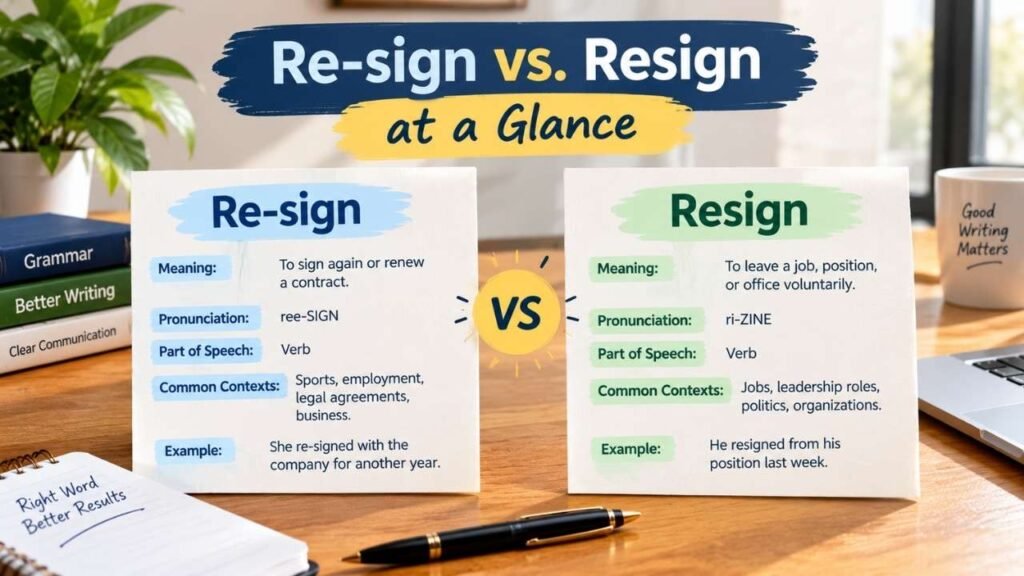
Although re-sign and resign differ by only one hyphen, they have completely opposite meanings. Resign means to leave a job, office, or position voluntarily, while re-sign means to sign again, usually to renew a contract or agreement.
The table below gives a quick comparison to help you understand the difference at a glance.
| Feature | Re-sign | Resign |
| Meaning | To sign again or renew a contract | To leave a job, office, or position voluntarily |
| Pronunciation | ree-SIGN | ri-ZINE |
| Part of Speech | Verb | Verb |
| Common Contexts | Sports, employment, legal agreements, business | Jobs, leadership roles, politics, organizations |
| Example | She re-signed with the company for another year. | He resigned from his position last week. |
What Does “Resign” Mean?
Resign is a verb that means to leave a job, position, office, or responsibility by your own choice. People usually resign when they decide to move to another job, retire, or step down for personal or professional reasons. It is one of the most common words used in workplace communication, official letters, and news reports.
For example, if an employee tells their manager that they no longer want to continue working, they resign from the company. Likewise, a government official may resign from office after completing their duties or facing public pressure.
In every case, resign refers to voluntarily leaving, not signing a new agreement. Learning this meaning will help you avoid confusing it with re-sign, which has the exact opposite idea.
Examples:
- She decided to resign from her teaching job.
- The manager resigned after working there for ten years.
- He plans to resign at the end of the month.
What Does “Re-sign” Mean?
Re-sign is also a verb, but it has a completely different meaning. It means to sign something again, often to renew a contract or continue an agreement. The hyphen is very important because it separates the prefix re-, meaning “again,” from the word sign. Without the hyphen, the word becomes resign, which means to quit.
You will often see re-sign in sports, where a player re-signs with the same team for another season. It is also common in business when an employee or company renews a contract.
Before using this word, make sure the context is about signing again, not leaving a position. If you enjoy learning grammar rules like this, you may also find our guide on Long Term or Long-Term helpful for understanding another commonly confused word pair.
Examples:
- The company asked her to re-sign the employment contract.
- The football club hopes to re-sign its star player.
- Please re-sign the document because the first copy was incomplete.
Why Does One Hyphen Change the Entire Meaning?
A single hyphen may seem small, but in re-sign, it changes the meaning completely. The prefix re- means again, so re-sign simply means to sign again. When the hyphen is removed, the word becomes resign, which has an entirely different meaning: to leave a job or position voluntarily. Because the spellings are so similar, many writers accidentally use the wrong word.
This is why proofreading is important, especially in emails, contracts, and professional documents. Spell-check tools may not always catch this mistake because both words are correctly spelled.
Paying attention to punctuation can prevent confusion and improve your writing. If you’re interested in avoiding similar grammar mistakes, our article on the Past Tense of Panic explains another topic that often confuses English learners.
How to Pronounce Re-sign and Resign
Besides having different meanings, re-sign and resign are also pronounced differently. Re-sign is pronounced “ree-SIGN” because the prefix re- means again, and the stress falls on sign. Resign is pronounced “ri-ZINE,” where the s sounds like a z.
Since the spellings are almost the same, many English learners pronounce them incorrectly. Listening to native speakers and saying the words aloud can help you remember the difference.
A simple way to avoid mistakes is to connect the pronunciation with the meaning. If you mean sign again, say ree-SIGN. If you mean quit a job or position, say ri-ZINE. Practicing both words in sentences will make them easier to remember.
Examples:
- The player will re-sign with the team next season.
- She decided to resign from her role after five years.
Re-sign vs. Resign: Side-by-Side Examples
Looking at re-sign and resign in real sentences is one of the easiest ways to understand their correct usage. The context tells you whether someone is renewing an agreement or leaving a position. If the sentence talks about a contract, document, or team, re-sign is usually the correct choice.
If it discusses quitting a job, office, or leadership role, resign is the right word. Reading and writing example sentences will help you recognize the difference quickly and avoid common grammar mistakes.
Examples with re-sign:
- The company hopes to re-sign its top engineer for another year.
- She agreed to re-sign the lease before it expired.
- The basketball player decided to re-sign with his current club.
Examples with resign:
- He chose to resign from his position to start a new business.
- The principal resigned after serving the school for many years.
- They were surprised when the CEO announced he would resign.
Common Mistakes People Make
Many people confuse re-sign and resign because the words look almost identical. The most common mistake is leaving out the hyphen when they mean sign again. This small error completely changes the meaning of the sentence.
Another mistake is using resign when talking about renewing a contract, especially in sports news and business writing. Some writers also pronounce both words the same way, which can create confusion in conversations. To avoid these errors, always think about the context before choosing the word.
Ask yourself whether the person is leaving a position or signing again. A quick proofread can help you catch mistakes before sending an email, publishing an article, or signing an important document.
Easy Trick to Remember the Difference
A simple memory trick can help you remember the difference between re-sign and resign. Look at the prefix re-, which means again. If you see the hyphen, think of doing something again, so re-sign means to sign again or renew a contract.
Without the hyphen, resign means to leave a job or position. Another easy tip is to imagine a sports player. If the player stays with the same team, they re-sign a new contract. If the player leaves the team or a coach quits, they resign from their role. Using this simple connection makes it much easier to choose the correct word every time you write.
Related Words You Shouldn’t Confuse
Re-sign and resign are not the only English words that cause confusion. Several other words have similar spellings but different meanings. For example, quit and resign both refer to leaving a job, but resign is usually more formal.
Likewise, renew is often used in place of re-sign when talking about contracts or memberships. You may also come across words like rehire, sign, signature, and resignation, which are closely related but have different uses. Understanding these word pairs will improve your grammar and make your writing more accurate.
Learning the meaning of related terms also helps you choose the right word confidently in professional, academic, and everyday communication.
FAQs
What is the difference between re-sign and resign?
The main difference is the hyphen. Re-sign means to sign again, usually to renew a contract or agreement. Resign means to leave a job, position, or office voluntarily.
Does resign always mean quitting a job?
Most of the time, yes. Resign usually means leaving a job, leadership role, or official position by choice. It can also refer to giving up a responsibility or office voluntarily.
What does re-sign mean in sports?
In sports, re-sign means a player signs a new contract with the same team instead of joining another team. For example, “The club decided to re-sign its captain for two more seasons.”
Why is the hyphen important in re-sign?
The hyphen separates the prefix re-, meaning again, from the word sign. Without the hyphen, the word becomes resign, which has a completely different meaning.
Are re-sign and resign pronounced differently?
Yes. Re-sign is pronounced “ree-SIGN,” while resign is pronounced “ri-ZINE.” Their different pronunciations help distinguish their meanings in spoken English.
Can I write resign when I mean to renew a contract?
No. If you mean to sign a contract again or renew an agreement, you should write re-sign. Using resign instead changes the meaning to leaving a job or position.
Is re-sign always written with a hyphen?
Yes. When you mean to sign again, the standard spelling is re-sign with a hyphen. Writing it as resign creates a different word with a different meaning.
What is an easy way to remember the difference?
Remember that re- means again. If you see the hyphen, think “sign again.” If there is no hyphen, resign means to quit or step down from a job or position.
Can resign and re-sign be used in business writing?
Yes. Resign is commonly used when someone leaves a company or leadership role, while re-sign is used when an employee or business renews a contract or signs a new agreement.
Which is more common: re-sign or resign?
Resign is generally more common because it is frequently used in workplace, government, and news contexts. Re-sign is less common but is widely used in sports, employment contracts, and business agreements when someone signs a new contract.
Conclusion
Although re-sign and resign look almost the same, they have completely different meanings. Resign means to leave a job, position, or office voluntarily, while re-sign means to sign again, often to renew a contract or agreement.
The small hyphen in re-sign makes a big difference, so using the correct spelling is important for clear communication. Remember to look at the context before choosing either word. If someone is quitting, use resign.
If someone is renewing or signing a document again, use re-sign. By understanding their meanings, pronunciation, and grammar rules, you can confidently use both words in business, sports, professional writing, and everyday English without making this common mistake.