
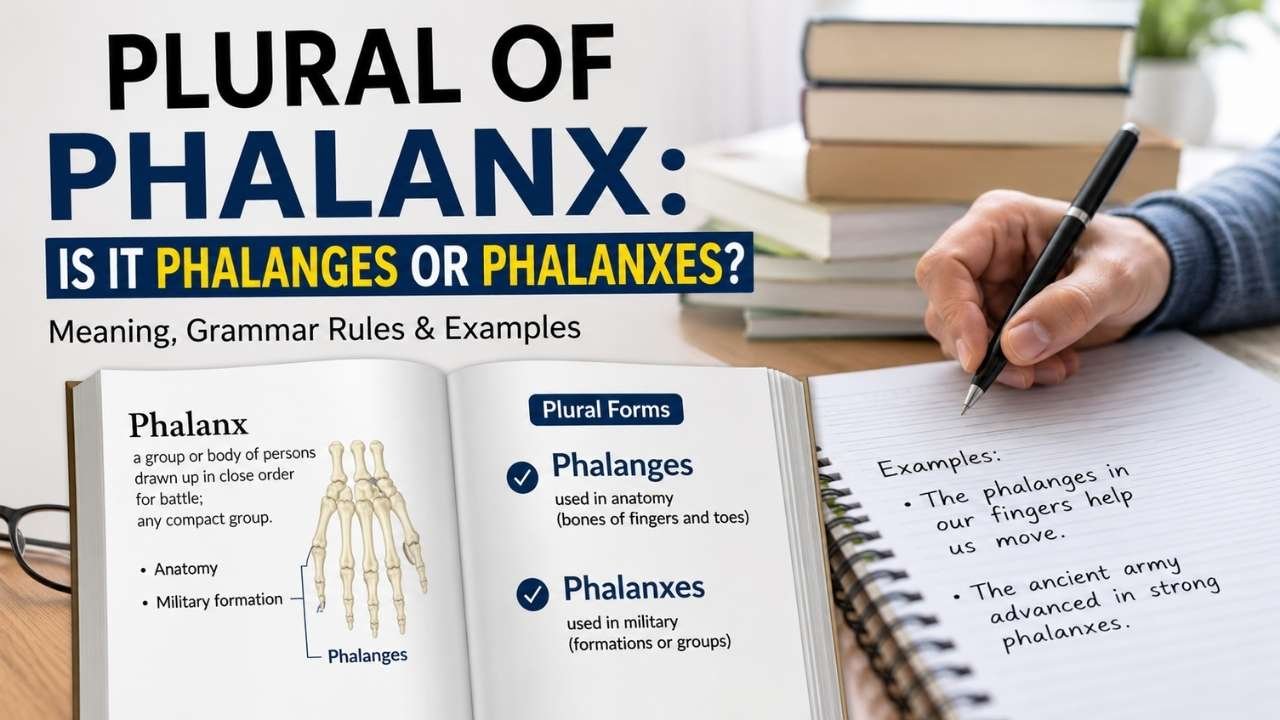
If you’ve ever wondered about the plural of phalanx, you’re not alone. Many English learners, students, and professionals ask whether the correct plural is phalanges or phalanxes. The good news is that both forms are correct, but they are used in different situations. In anatomy, phalanges usually refers to the bones in your fingers and toes.
In military history, phalanxes often describes groups of soldiers arranged in a defensive formation. Understanding the plural form of phalanx is easier once you know the meaning and context of the word.
In this guide, you’ll learn the phalanx meaning, simple grammar rules, pronunciation tips, and plenty of real-life examples. By the end, you’ll know what is the plural of phalanx, when to use each form, and how to avoid common mistakes with confidence.
Quick Answer
The plural of phalanx can be phalanges or phalanxes, and both are correct. Phalanges is the preferred plural in anatomy when referring to the bones in the fingers and toes. Phalanxes is more common when describing military formations or groups. The correct choice depends on the meaning and context in which you use the word.
What Does “Phalanx” Mean?
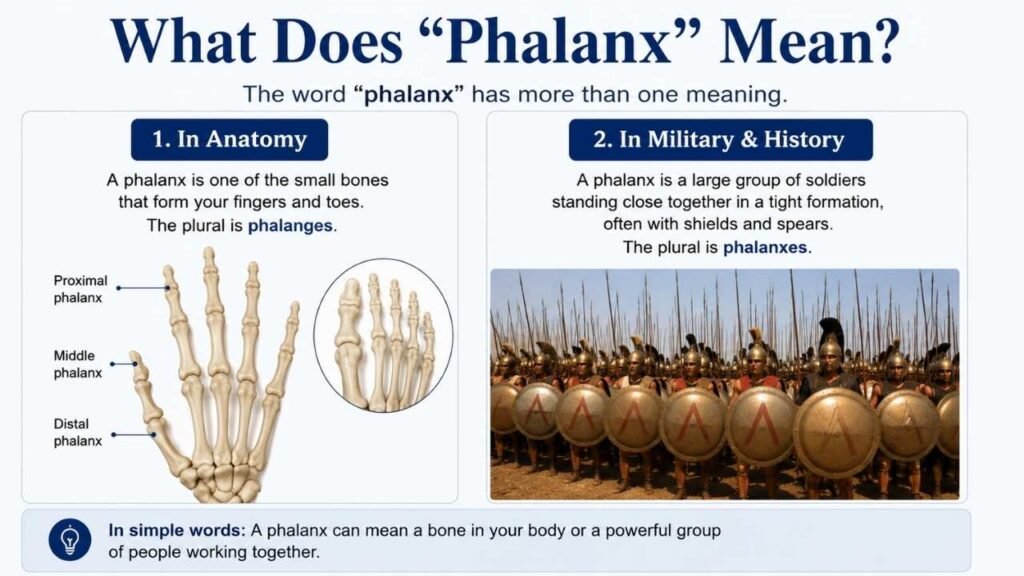
A phalanx is a singular noun with more than one meaning. In anatomy, it refers to one of the small bones found in your fingers and toes. Together, these bones are called phalanges, the most common plural used in medical and scientific writing.
In military history, a phalanx describes a close group of soldiers standing shoulder to shoulder with shields and long spears, a formation made famous by Ancient Greece. Today, the word can also describe any closely connected group of people working together.
Knowing the phalanx meaning helps you choose the correct plural form of phalanx. If you enjoy learning grammar, you may also like our guide on the Plural of Squid, another word with interesting plural usage.
Is the Plural of Phalanx “Phalanges” or “Phalanxes”?
The plural of phalanx can be phalanges or phalanxes, and both are correct. The right choice depends on the meaning of the word. Phalanges is the preferred plural in anatomy because it refers to the bones in the fingers and toes.
Phalanxes is commonly used when talking about military formations, historical armies, or groups arranged in a similar pattern. Most dictionaries accept both forms, but they are not always interchangeable.
If you are writing about medicine, use phalanges. If you are discussing history or strategy, phalanxes is often the better choice. Understanding this simple grammar rule helps you use the phalanx plural naturally and accurately in different contexts.
Phalanges vs. Phalanxes (Comparison Table)
Choosing between phalanges and phalanxes becomes much easier when you compare their common uses. Although both are accepted as the plural form of phalanx, each one fits a different context. The table below gives a quick overview to help you remember the difference.
| Feature | Phalanges | Phalanxes |
| Main use | Anatomy | Military history |
| Meaning | Finger and toe bones | Groups of soldiers |
| Common in | Medical writing | Historical writing |
| Dictionary status | Correct | Correct |
| Example | The doctor examined the phalanges. | The army formed several phalanxes. |
Using the correct plural makes your writing clearer and more professional.
Why Does Phalanx Have Two Correct Plural Forms?
Many people wonder why the plural of phalanx has two accepted forms. The answer comes from the word’s history. Phalanx comes from the Ancient Greek word phalanx, which entered English through Latin.
Over time, English kept the traditional Greek-style plural phalanges, especially in anatomy and medical language. At the same time, English also created the regular plural phalanxes, following common plural rules.
This is why both forms appear in modern dictionaries. Language naturally changes as people use words in different ways. Understanding the etymology of phalanx helps explain why English allows two correct plurals and why each has its own preferred context.
Grammar Rules Behind the Plural of Phalanx
The plural of phalanx is an example of how English includes both regular and irregular plural forms. Many words borrowed from Greek or Latin keep their original endings, while others develop standard English plurals over time.
Because of this, phalanges is considered an irregular plural noun, while phalanxes follows the usual English pattern of adding -es. Both forms are accepted by major dictionaries, so neither is wrong.
The best choice depends on your topic and audience. Learning these grammar patterns also makes other unusual words easier to understand. If you’re interested in verb forms as well, check out our guide on the Past Tense of Fall Down to strengthen your English grammar skills.
When Should You Use “Phalanges”?
Use phalanges when writing or speaking about anatomy, medicine, or the human skeletal system. In these fields, phalanges is the standard plural for the small bones in your fingers and toes.
Doctors, teachers, students, and medical books almost always use this form because it follows traditional scientific terminology. For example, you might say, “The X-ray showed no damage to the phalanges in the patient’s hand.” Using phalanges in medical or scientific writing makes your meaning clear and accurate.
Although phalanxes is also a correct plural, it is not commonly used when referring to bones. Choosing the right form helps your writing sound natural and professional while following accepted English grammar.
When Should You Use “Phalanxes”?
Use phalanxes when talking about military history, Ancient Greece, or groups arranged in a tight formation. This plural is commonly found in history books, articles about warfare, and discussions of ancient battle strategies.
For example, you could write, “The soldiers formed strong phalanxes before moving toward the battlefield.” The word can also describe any organized group of people standing or working closely together in a figurative sense.
While phalanges is the preferred choice in anatomy, phalanxes fits historical and military contexts much better. Understanding this difference helps you select the correct plural form of phalanx and avoid confusing readers who expect context-appropriate vocabulary.
Common Mistakes People Make
A common mistake is thinking that only one plural of phalanx is correct. In reality, phalanges and phalanxes are both accepted by major dictionaries. Another mistake is using phalanges when describing military formations or using phalanxes when referring to finger or toe bones.
These choices can make your writing sound inaccurate. Some people also spell the word incorrectly or forget that it has two accepted plural forms. The easiest way to avoid these errors is to remember the context.
Use phalanges for anatomy and phalanxes for military history. Keeping this simple rule in mind will help you write with greater confidence and accuracy.
Pronunciation of Phalanx, Phalanges, and Phalanxes
Correct pronunciation can make your English sound more natural. Phalanx is commonly pronounced as FUH-lanks (/ˈfeɪlæŋks/). The plural phalanges is usually pronounced fuh-LAN-jeez (/fəˈlændʒiːz/), while phalanxes is pronounced FUH-lank-siz (/ˈfeɪlæŋksɪz/).
Although the pronunciations are different, each form has a specific purpose. Phalanges is mainly heard in medical or anatomy discussions, while phalanxes appears more often in conversations about history and military formations.
Listening to dictionary audio recordings is a great way to practice these words. Learning both pronunciation and meaning will help you use the phalanx plural correctly in both speaking and writing.
Words Similar to Phalanx That Have Irregular Plurals
Phalanx is not the only English word with more than one accepted or unusual plural form. Many words borrowed from Greek and Latin follow similar grammar patterns. For example, appendix becomes appendices (or appendixes), index becomes indices (or indexes), and matrix becomes matrices (or matrixes).
You may also know words like criterion → criteria, analysis → analyses, and thesis → theses. These examples show that English often keeps traditional plural forms while also accepting regular English endings.
Learning these patterns makes it easier to understand irregular plural nouns and improve your grammar and vocabulary over time.
Example Sentences Using Every Form
Seeing each word in a sentence makes it easier to understand the correct usage. Here are a few examples:
- Phalanx (singular): The doctor examined one phalanx in the injured finger.
- Phalanges (anatomy): The athlete fractured two phalanges during the game.
- Phalanxes (military): The commander ordered the phalanxes to move forward together.
- Phalanxes (figurative): Supporters stood in phalanxes to protect the entrance.
These examples show that the plural form of phalanx depends on context. Using phalanges for bones and phalanxes for military or figurative groups helps your writing stay clear, accurate, and easy for readers to understand.
FAQs
What is the plural of phalanx?
The plural of phalanx is phalanges or phalanxes. Both are correct, but they are used in different contexts.
Is “phalanges” correct?
Yes. Phalanges is the preferred plural in anatomy when referring to the bones in the fingers and toes.
Is “phalanxes” correct?
Yes. Phalanxes is commonly used for military formations and sometimes for figurative groups.
Why does phalanx have two plural forms?
The word comes from Ancient Greek, and English accepts both the traditional Greek plural and the regular English plural.
Can I use phalanges and phalanxes interchangeably?
Not always. It is best to choose the form that matches the context of your writing.
How many phalanges are in the human body?
Most adults have 56 phalanges—14 in each hand and 14 in each foot.
Is phalanx an irregular noun?
Yes. It is considered an irregular plural noun because it has two accepted plural forms.
Conclusion
The plural of phalanx can be phalanges or phalanxes, and both are correct when used in the right context. Phalanges is the standard choice in anatomy for the bones in the fingers and toes, while phalanxes is more common in military history and similar discussions.
Knowing the difference helps you write more clearly and confidently. Remember that context is the key to choosing the correct form.
By understanding the word’s meaning, grammar rules, pronunciation, and history, you can avoid common mistakes and use the phalanx plural naturally in everyday writing, academic work, or professional communication.