
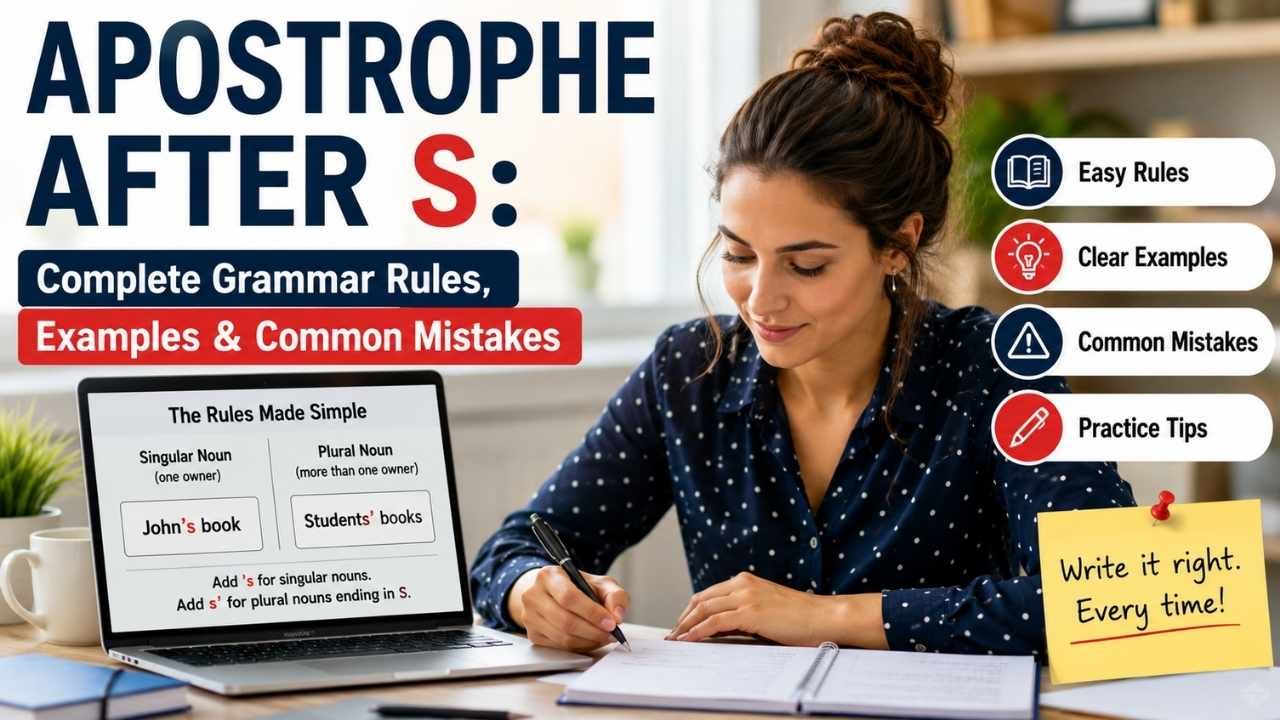
Have you ever wondered where the apostrophe should go after the letter “S”? Many people get confused by grammar rules like teacher’s vs. teachers’ or James’s vs. James’. The good news is that the apostrophe after S follows clear rules once you understand the difference between singular possessive and plural possessive nouns.
Whether you’re writing an email, school assignment, business document, or social media post, using the correct possessive apostrophe helps your writing look more professional and easier to understand.
In this guide, you’ll learn when to use an apostrophe after S, how to handle names ending in S, and the differences between major style guides. You’ll also find simple explanations, practical examples, comparison tables, and common mistakes to avoid, making these apostrophe rules easy to remember and apply in everyday writing.
Quick Answer
Use an apostrophe after S (s’) when a plural noun ending in S shows ownership, such as students’ books or teachers’ lounge. Use apostrophe + S (‘s) for most singular nouns, including many names ending in S, like James’s car. Some style guides allow James’, so always follow the style guide required for your writing.
What Does an Apostrophe After S Mean?
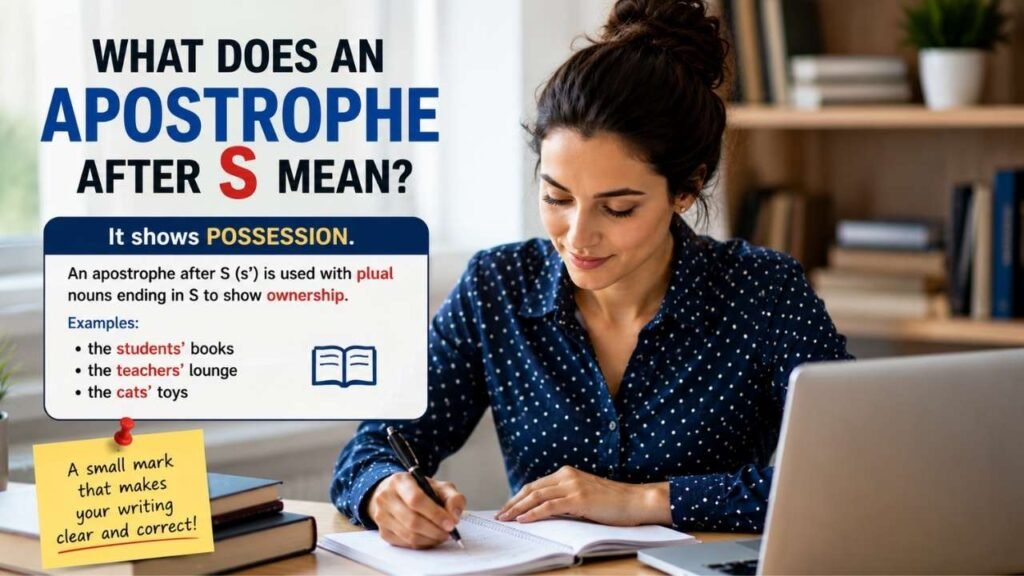
An apostrophe after S is a punctuation mark used to show possession when a plural noun ending in S owns something. For example, the students’ classroom means the classroom belongs to several students, while the teachers’ office belongs to several teachers. Many people think an apostrophe makes a word plural, but that is incorrect.
Apostrophes show ownership or form contractions, not regular plurals. Understanding this basic apostrophe rule helps you avoid common writing mistakes.
If you are learning English grammar, remember that the position of the apostrophe depends on whether the noun is singular or plural. Once you know this difference, using a possessive apostrophe becomes much easier in everyday writing.
The Basic Rules for Using an Apostrophe After S
The easiest way to remember the apostrophe after S rule is to first decide whether the noun is singular or plural. If a singular noun owns something, add ‘s, such as the girl’s backpack or the teacher’s desk.
If a plural noun already ends in S, place the apostrophe after the S, such as the players’ uniforms or the cats’ toys.
However, irregular plural nouns like children, men, and women do not end in S, so they still take ‘s, as in children’s books. These simple grammar rules make it easier to choose the correct possessive form and avoid confusing readers with incorrect punctuation.
Apostrophe Before S vs. Apostrophe After S
Many learners struggle to decide whether the apostrophe belongs before or after the letter S. The rule is simple once you understand ownership. Use apostrophe + S (‘s) with most singular nouns, such as the dog’s leash, the company’s policy, or the student’s notebook.
Use S + apostrophe (s’) with plural nouns ending in S, such as the girls’ team, the doctors’ meeting, or the employees’ lounge.
Comparing these forms side by side makes the difference much clearer. Always ask yourself, “Is one person or thing the owner, or are there several?” That quick question helps you choose the correct possessive apostrophe almost every time.
| Form | Correct Example | Why It Is Correct |
| ‘s | The student’s bag | One student owns the bag. |
| s’ | The students’ bags | Several students own the bags. |
| ‘s | The company’s office | One company owns the office. |
| s’ | The companies’ offices | Several companies own the offices. |
How to Use Apostrophes with Singular Nouns Ending in S
One of the biggest grammar questions is how to write singular nouns ending in S. In modern English, most style guides recommend adding ‘s to singular nouns, even when they already end with S. For example, write James’s bicycle, Chris’s laptop, or the boss’s office. This form clearly shows that one person owns something.
However, some publications, especially those following AP Style, may use James’ instead. Because style guides are different, always follow the one required for your school, workplace, or publisher.
The important thing is to stay consistent throughout your writing. Once you choose a style, use the same apostrophe rule everywhere in your document.
Related Reading: If you’re also improving your English basics, our guide on Letter or Alphabet explains an important difference that many learners often confuse.
Apostrophes with Plural Nouns Ending in S
When a plural noun already ends in S, simply place the apostrophe after the final S to show possession. For example, the teachers’ lounge, the players’ equipment, the neighbors’ gardens, and the students’ projects are all correct. You do not add another S because the noun is already plural.
This is one of the most common apostrophe rules in English grammar and appears in school writing, business documents, newspapers, and everyday conversations.
If you are unsure, first check whether the noun is already plural. If it ends in S and more than one person or thing owns something, the correct form is usually S + apostrophe (s’), making your writing clear and grammatically correct.
Apostrophes with Irregular Plural Nouns
Not every plural noun ends with the letter S. Words such as children, men, women, people, geese, and mice are called irregular plural nouns. Since these words do not already end in S, you form the possessive by adding ‘s.
For example, write children’s playground, men’s shoes, women’s clothing, people’s opinions, or geese’s feathers. These examples follow the same rule used for singular nouns because the plural word itself does not end with S. Remembering this exception helps you avoid one of the most common punctuation mistakes.
Learning grammar works the same way as understanding special plural forms, such as in our guide on the Plural of Phalanx, where irregular word patterns also require extra attention.
Apostrophes for Proper Names Ending in S
Using an apostrophe after S with proper names ending in S can be confusing because different style guides recommend different forms. In most cases, grammar experts suggest adding ‘s to a singular name, such as James’s book, Chris’s laptop, or Charles’s speech.
This makes it clear that one person owns something. However, some publications that follow AP Style prefer James’ or Chris’. Both forms can be correct depending on the style guide you use.
The most important rule is to stay consistent throughout your writing. If your school, workplace, or publisher follows one style, use that format everywhere to keep your writing professional and easy to understand.
Common Apostrophe Mistakes (and How to Avoid Them)
Many writers make small mistakes with apostrophe rules, but they are easy to fix once you know what to look for. One common error is using an apostrophe to make a word plural, such as writing apple’s instead of apples.
Another frequent mistake is confusing its with it’s. Remember that its shows possession, while it’s means it is or it has. Writers also mix up student’s and students’, forgetting that the apostrophe changes position depending on the number of owners.
Before finishing your work, read each sentence and ask who owns the object. This simple habit helps you catch mistakes and improve your grammar.
Real-Life Examples of Apostrophe After S
Understanding grammar becomes much easier when you see real-life examples. In a school, you might write the teachers’ meeting because several teachers are attending. At work, the managers’ office refers to an office shared by multiple managers.
In sports, the players’ uniforms belong to the whole team. For a singular owner, write the boss’s decision, James’s car, or the company’s policy. These examples show how the apostrophe after S changes depending on whether the owner is singular or plural.
You will see these forms in emails, reports, websites, newspapers, and books. Practicing with everyday examples helps you remember the correct possessive form without memorizing complicated grammar rules.
Practice Sentences with Answers
The best way to learn apostrophe after S is by practicing. Try these examples and check your answers.1. The teachers lounge → The teachers’ lounge. 2. The childs toys → The children’s toys. 3. James bicycle → James’s bicycle. 4. The dogs owner → The dog’s owner. 5. The players locker room → The players’ locker room.
Notice how the apostrophe moves depending on whether the noun is singular, plural, or an irregular plural noun. Reading and correcting sentences like these helps you remember the rules naturally. With regular practice, choosing the correct possessive apostrophe becomes quick and almost automatic whenever you write.
Quick Decision Chart: Should the Apostrophe Go Before or After S?
If you are unsure where to place the apostrophe, use this simple guide. First, ask whether the noun is singular or plural. If it is singular, add ‘s, as in the student’s notebook or the boss’s office. Second, if the noun is plural and already ends in S, place the apostrophe after the S, such as the students’ classroom or the doctors’ lounge.
Third, if the noun is an irregular plural like children or women, add ‘s, giving children’s books and women’s team. Following these three simple steps removes confusion and helps you use the correct apostrophe rule confidently in every piece of writing.
| Noun Type | Correct Form | Example |
| Singular noun | ‘s | The student’s bag |
| Plural noun ending in S | s’ | The students’ bags |
| Irregular plural noun | ‘s | The children’s toys |
| Singular name ending in S | Usually ‘s | James’s car |
FAQs
Is it James’ or James’s?
Both forms are accepted. James’s is preferred by many grammar and style guides, while James’ is common in AP Style. Follow the style guide required for your writing.
When do you use an apostrophe after S?
Use S + apostrophe (s’) when a plural noun ending in S shows ownership, such as teachers’ room.
When do you use apostrophe + S?
Use ‘s for most singular nouns and irregular plural nouns, such as the girl’s bike and children’s books.
Does an apostrophe make a word plural?
No. An apostrophe does not create a regular plural. It usually shows possession or forms a contraction.
What is the easiest way to remember the rule?
Identify the owner first. If there is one owner, use ‘s. If there are multiple owners and the plural already ends in S, use s’.
Conclusion
Learning the apostrophe after S rule is easier than it first appears. Once you understand the difference between singular possessive, plural possessive, and irregular plural nouns, you can place the apostrophe with confidence.
Remember to use ‘s for most singular nouns and irregular plurals, and s’ for plural nouns that already end in S. If you are writing names ending in S, check the style guide your school or workplace follows and stay consistent.
The more you read and practice, the more natural these apostrophe rules will become. Keep this guide as a quick reference whenever you need help, and you’ll avoid common grammar mistakes with confidence.