
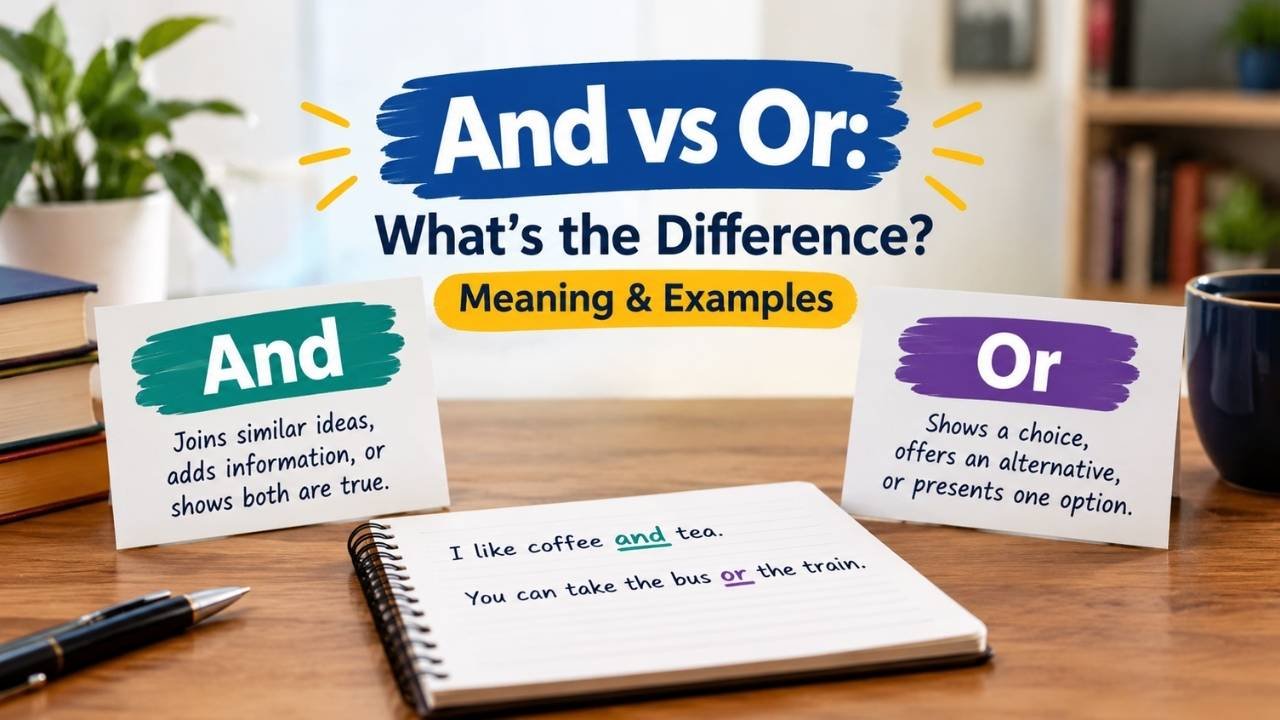
Have you ever stopped while writing and wondered whether you should use and vs or? These two small coordinating conjunctions appear in almost every English sentence, yet choosing the wrong one can completely change your meaning.
And is used to join ideas, words, or actions, while or presents a choice, an alternative, or a possibility. Understanding the difference between and and or helps you write more clearly, avoid confusion, and improve your English grammar.
Whether you’re writing an email, an essay, a business document, or simply chatting with friends, knowing when to use and and when to use or makes your sentences more accurate. In this guide, you’ll learn the grammar rules, practical examples, common mistakes, and simple tips that make using and vs or easy and natural.
Quick Answer
The difference between and and or is simple: and joins words, phrases, or ideas to show that they all happen or belong together, while or presents a choice, alternative, or possibility. Use and when every item applies, and use or when only one or more options may apply. Choosing the correct conjunction makes your writing clear and accurate.
What Does “And” Mean?
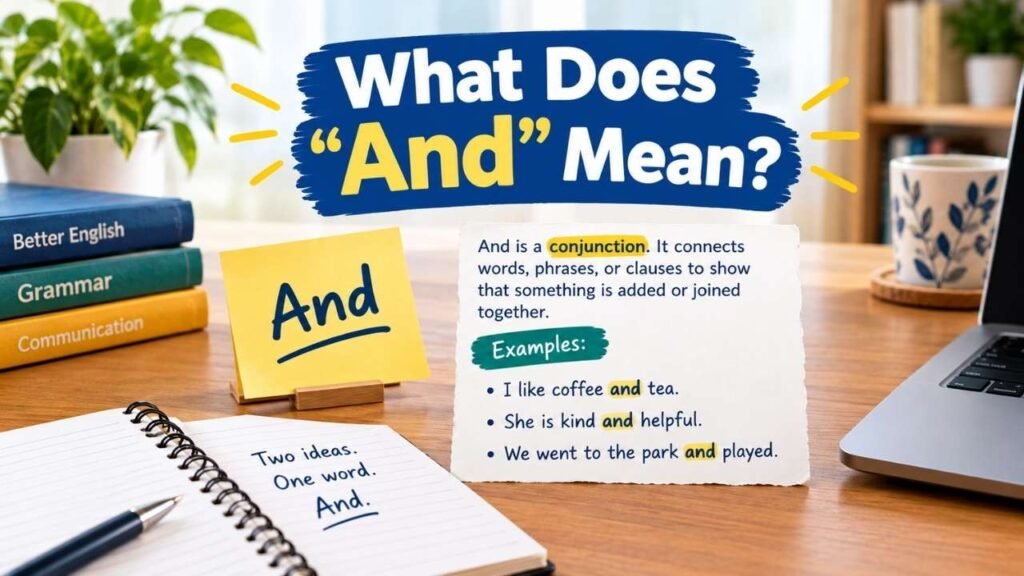
And is a coordinating conjunction that joins words, phrases, clauses, or ideas that belong together. It tells the reader that all connected parts are included. For example, in the sentence, “Sarah bought apples and oranges,” both fruits were purchased.
Likewise, “He studied and passed the exam” shows that both actions happened. Knowing when to use and helps you build clear and complete sentences. It is one of the most common words in English grammar because it connects related thoughts smoothly.
If you’re learning sentence structure, understanding the difference between a Letter or Alphabet can also strengthen your writing foundation before moving on to conjunctions like and.
What Does “Or” Mean?
Or is another coordinating conjunction, but it serves a different purpose. Instead of joining ideas together, it presents a choice, alternative, or possibility.
For example, “Would you like tea or coffee?” gives two options, while “You can call me or send an email” means either action is acceptable. Learning when to use or helps you avoid confusing your readers. In some situations, or can also suggest uncertainty, such as “The meeting will be on Tuesday or Wednesday.”
Clear punctuation also matters when using conjunctions. If you are unsure about possessive punctuation, our guide on Apostrophe After S explains the rules with simple examples that improve your overall grammar.
And vs Or: Key Differences Explained
The difference between and and or becomes clear when you compare their meanings. And shows that every connected word or idea belongs together, while or introduces one or more possible choices.
For example, “Bring your notebook and pen” means you need both items. In contrast, “Bring your notebook or tablet” means either one is acceptable. Although both are common conjunctions, choosing the wrong one can completely change a sentence’s meaning.
This is especially important in instructions, exams, contracts, and everyday conversations. Understanding and vs or helps you communicate clearly, reduce confusion, and make your writing more accurate in both formal and informal situations.
Grammar Rules for Using “And”
There are several simple grammar rules for using and correctly. Use and to join two or more nouns, such as “Books and notebooks.” It also connects verbs, as in “She cooked and cleaned.”
You can join adjectives like “kind and helpful” or combine complete sentences, for example, “It started raining, and we went inside.” When connecting two independent clauses, a comma is often used before and.
However, a comma is usually unnecessary when joining only words or short phrases. Following these rules makes your writing smoother and easier to understand. Whether you’re writing school assignments, emails, or stories, and helps connect related ideas naturally and effectively.
Grammar Rules for Using “Or”
Using or correctly is just as important as using and. Choose or when you want to show a choice, alternative, or possibility. For example, “Would you like pizza or pasta?” means the person can choose either option. Or also works in negative sentences, such as “He doesn’t drink tea or coffee.”
When or joins two singular subjects, the verb is usually singular. If it joins subjects with different numbers, the verb normally agrees with the subject closest to it. Understanding these grammar rules helps you avoid mistakes and write naturally.
Whether you’re writing emails, essays, or everyday messages, using or correctly makes your meaning clear and easy for readers to understand.
When Should You Use “And/Or”?
You may have seen and/or in contracts, forms, or business documents. It means one option, the other option, or both. For example, “Applicants may submit a passport and/or a driver’s license” means either document is accepted, and both can also be submitted.
Although and/or is grammatically correct, many style guides recommend avoiding it in regular writing because it can sound awkward or unclear. Instead, rewrite the sentence whenever possible to make the meaning obvious.
In legal or technical writing, and/or is more common because it removes doubt about what is allowed. In everyday English, choosing either and or or usually creates a smoother and more natural sentence.
Common Mistakes with And and Or
One of the most common mistakes is using and when a sentence requires or, or using or when both items are actually needed. For example, “Bring your ID or ticket” suggests that only one item is needed, while “Bring your ID and ticket” means both are required.
Another mistake is using and/or too often, making sentences difficult to read. Some writers also forget punctuation when joining complete sentences with and. To avoid confusion, always think about your intended meaning before choosing the conjunction.
Ask yourself whether you are adding information or giving a choice. This simple habit will improve your English grammar and make your writing much clearer.
Real-Life Examples of And vs Or
Understanding and vs or becomes much easier when you see real-life examples. A teacher might say, “Bring a notebook and a pen,” because both items are needed. A restaurant menu may ask, “Would you like soup or salad?” because you can choose either one.
In the workplace, a manager might write, “Email me or call me if you have questions,” giving two ways to make contact. At home, someone could say, “Wash the dishes and clean the kitchen,” meaning both tasks should be completed.
These examples show how a single conjunction changes the meaning of a sentence. Choosing the correct word helps your message stay clear and accurate.
Quick Comparison Table: And vs Or
The table below gives a simple overview of the difference between and and or.
| Feature | And | Or |
| Main purpose | Shows addition | Shows choice or alternative |
| Meaning | Both items are included | One or more options may apply |
| Common use | Joining related ideas | Offering options |
| Example | Tom and Jack arrived. | Tom or Jack will arrive. |
| Best for | Lists, actions, and connected ideas | Decisions, possibilities, and alternatives |
Remember this simple rule: use and when everything belongs together, and use or when the reader must choose between options.
Practice Sentences (Interactive Quiz)
Test your understanding of and vs or with these simple sentences. Fill in the blank with and or or before checking the answers.
- Bring your pencil ___ notebook to class.
- Would you like juice ___ water?
- Emma cooked dinner ___ washed the dishes.
- You can pay by cash ___ credit card.
- Wear a jacket ___ sweater if it gets cold.
Answers: 1. and 2. or 3. and 4. or 5. or
If you answered correctly, you already understand the basic grammar rules for these two conjunctions. Keep practicing with everyday sentences, and choosing the right word will soon become a natural habit.
FAQs
Is and different from or?
Yes. And joins ideas or items together, while or gives a choice or an alternative.
When should I use and?
Use and when every connected word, phrase, or action is included.
When should I use or?
Use or when only one option, one possibility, or an alternative is intended.
Is and/or grammatically correct?
Yes, but it is mainly used in legal, technical, or business writing. In everyday writing, using and or or alone is usually clearer.
Can using the wrong conjunction change a sentence’s meaning?
Absolutely. Replacing and with or, or the other way around, can completely change what a sentence means.
Conclusion
Learning the difference between and and or is one of the easiest ways to improve your English grammar and make your writing more precise. Although these conjunctions are small, they have a big effect on the meaning of a sentence.
And connects ideas that belong together, while or presents choices or alternatives. By understanding the grammar rules, studying examples, and avoiding common mistakes, you can write with greater confidence.
Whenever you’re unsure, ask yourself a simple question: Am I adding information, or am I offering a choice? The answer will help you choose the correct conjunction and communicate your ideas clearly in school, work, and everyday conversations.