
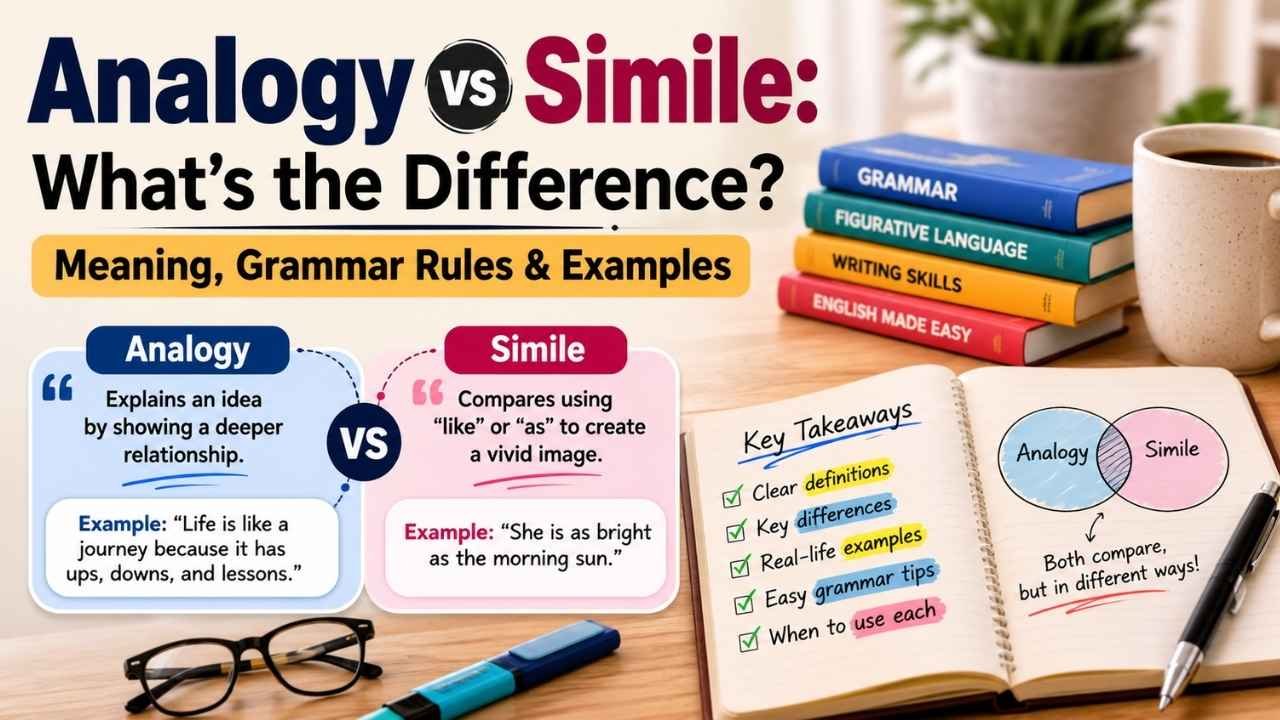
Have you ever wondered whether an analogy vs simile mean the same thing? Since both compare two things, many people mix them up. However, they are different literary devices, and knowing how they work can make your writing clearer and more engaging.
Understanding the difference between analogy and simile is useful whether you’re a student, teacher, writer, or someone learning English. A simile creates a direct comparison using words like “like” or “as,” while an analogy explains an idea by comparing it with something familiar to make it easier to understand.
In this guide, you’ll learn the meaning of analogy and simile, explore simple examples, discover their key differences and similarities, and find out when to use each in everyday writing and conversation.
Quick Answer
An analogy and a simile both compare two things, but they serve different purposes. A simile makes a direct comparison using “like” or “as,” while an analogy explains or clarifies an idea by showing a deeper relationship between two concepts. Understanding the difference between analogy and simile helps you choose the right figurative language for clearer, more effective writing.
What Is an Analogy?
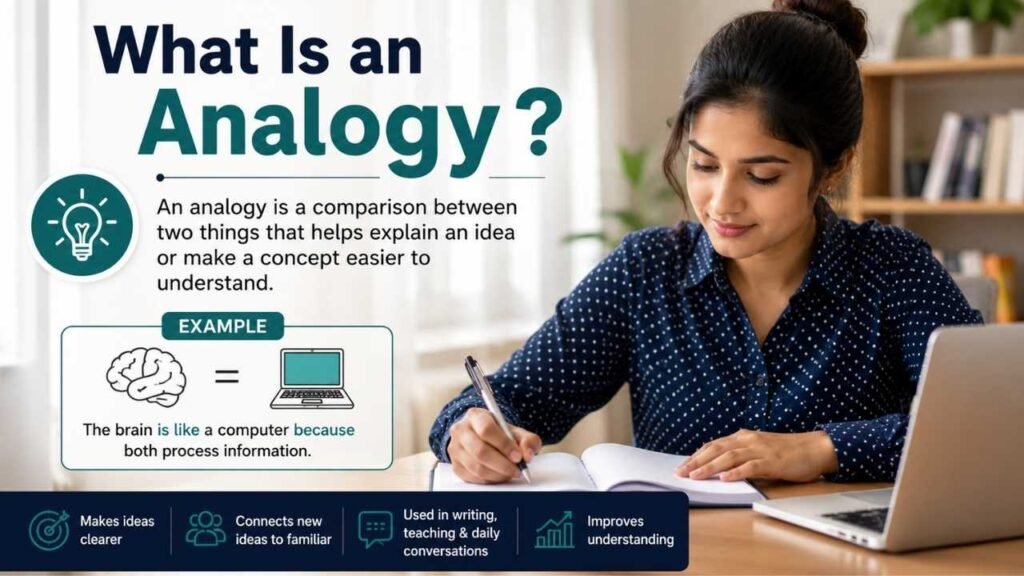
An analogy is a literary device that explains one idea by comparing it with another idea that is easier to understand. Unlike a simple comparison, an analogy focuses on the relationship between two things to make a concept clearer.
Writers, teachers, and speakers often use analogies to simplify difficult topics or make their points more memorable. For example, saying “The brain is like a computer because it processes information” helps readers understand how the brain works through a familiar object.
This is why analogies are common in education, business, and everyday conversations. If you enjoy learning about language and comparisons, you may also like our guide on Juxtaposition vs Paradox, which explains another pair of literary devices that are often confused.
What Is a Simile?
A simile is a type of figurative language that compares two different things using the words “like” or “as.” Its main purpose is to create a clear and vivid picture in the reader’s mind. For example, the sentence “She runs like the wind” compares a person’s speed with the wind to make the description more powerful.
Similes are common in stories, poems, speeches, and everyday conversations because they make writing more interesting and easier to imagine. While a simile makes a direct comparison, it usually does not explain the deeper relationship between the two ideas.
If you’re interested in grammar topics, you might also find our article on the Plural of Stimulus helpful for understanding another commonly misunderstood English rule.
Analogy vs Simile: Key Differences
Although both analogy and simile compare two things, they have different goals. A simile creates a quick comparison using “like” or “as” to make writing more descriptive.
An analogy, however, explains an idea in greater detail by comparing relationships between two situations or concepts. For example, saying “Her smile was like sunshine” is a simile because it paints a vivid image.
Saying “Learning to ride a bike is like learning a new language because both require practice and patience” is an analogy because it explains a larger idea. Understanding the difference between analogy and simile helps you choose the right comparison for essays, creative writing, presentations, and everyday communication.
| Feature | Analogy | Simile |
| Purpose | Explains an idea | Describes something |
| Length | Usually longer | Usually shorter |
| Uses “like” or “as” | Sometimes | Always |
| Main Goal | Improve understanding | Create vivid imagery |
Similarities Between Analogy and Simile
Even though they are different, analogies and similes share several important features. Both compare two unlike things to help readers understand or imagine something more clearly. They are both considered figurative language and are widely used in literature, education, speeches, and everyday writing.
Another similarity is that both make communication more engaging by connecting new ideas with familiar experiences. In many cases, they also encourage readers to think more deeply about a topic.
Because they both involve comparison, it’s easy to see why many people confuse them. Learning the similarities between analogy and simile alongside their differences will improve your writing skills and help you communicate ideas in a way that is clear, interesting, and memorable.
Can a Simile Be Part of an Analogy?
Yes, a simile can be part of an analogy, and this is where many learners become confused. A simile often serves as the starting point for a larger explanation. For example, the sentence “Life is like a journey” is a simile because it uses “like.”
If you continue by explaining how life has different paths, challenges, and destinations, the comparison becomes an analogy. In other words, the simile introduces the comparison, while the analogy develops it into a deeper explanation.
This shows that not every simile is an analogy, but an analogy may include one or more similes. Understanding this relationship makes it much easier to identify each literary device when reading or writing.
Analogy vs Simile vs Metaphor
Many people also compare analogy, simile, and metaphor because all three involve comparison. However, each works differently. A simile compares two things using “like” or “as.” A metaphor makes a direct comparison without using those words, such as “Time is a thief.”
An analogy goes a step further by explaining an idea through a detailed comparison between two situations. While similes and metaphors mainly make writing more descriptive, analogies focus on helping readers understand complex ideas.
Knowing the differences between these three figurative language techniques allows you to choose the best one for your purpose. Whether you’re writing an essay, story, or speech, using the right comparison makes your message stronger and easier to understand.
Everyday Examples of Analogies and Similes
You probably use analogies and similes every day without realizing it. A simile is often used to describe something quickly, such as “The baby slept like a log” or “He was as busy as a bee.” These comparisons create clear images in the reader’s mind. An analogy, however, explains an idea in more detail.
For example, “Building a successful business is like growing a tree. It takes time, care, and patience before you see results.” This comparison helps explain a larger concept rather than simply describing something.
Using analogy vs simile correctly in everyday conversations, school assignments, and professional writing makes your communication more effective, engaging, and easier for others to understand.
Analogy and Simile in Literature
Authors often use analogies and similes to make their stories more vivid and meaningful. A simile helps readers picture a scene by comparing one thing to another using “like” or “as.” For example, “Her voice was as soft as silk” creates a gentle image.
An analogy, on the other hand, develops a comparison over several sentences to explain a character, event, or idea in greater depth. Famous writers also use analogies to make abstract concepts easier to understand and more memorable.
Because these literary devices add clarity and emotion, they appear in novels, poems, speeches, and even modern articles. Learning to recognize them can improve both your reading skills and your own creative writing.
Common Mistakes People Make
One of the most common mistakes is thinking that analogy and simile mean exactly the same thing. Although both compare two things, they have different purposes. Another mistake is believing every comparison is an analogy.
In reality, a simple sentence using “like” or “as” is usually just a simile unless it develops a broader explanation. Some writers also confuse metaphors with similes because both compare ideas, but metaphors do not use “like” or “as.”
Finally, avoid forcing comparisons that do not make sense to your readers. Clear, natural examples always work better than complicated ones. Understanding these mistakes will help you use figurative language more confidently and accurately.
How to Choose Between an Analogy and a Simile
The choice between an analogy and a simile depends on your writing goal. If you want to create a quick and vivid description, a simile is usually the better option. It helps readers imagine people, objects, or situations with just a few words.
If your goal is to explain a difficult idea or teach a concept, an analogy is the stronger choice because it provides a deeper comparison. Think about your audience before deciding which one to use.
Students, teachers, business professionals, and creative writers all use these techniques in different ways. Choosing the right comparison makes your message clearer, keeps readers interested, and improves the overall quality of your writing.
Tips for Writing Better Analogies and Similes
Strong analogies and similes are simple, meaningful, and easy to understand. Start by comparing ideas your readers already know with the concept you want to explain. Avoid overused comparisons such as “busy as a bee” unless they fit your purpose.
Instead, create fresh and relevant examples that match your topic. Keep your comparisons clear and avoid adding unnecessary details that may confuse readers. Reading books, articles, and speeches can also help you discover effective ways to build comparisons.
After writing, read your sentence aloud to see if it sounds natural. If the comparison feels forced or unclear, revise it until it communicates your idea smoothly and effectively.
Practice Quiz: Can You Identify the Comparison?
Test your understanding of analogy vs simile by identifying the type of comparison in each sentence.
- Her smile was like sunshine. (Simile)
- Learning to swim is like learning to ride a bike because both require practice and confidence. (Analogy)
- His hands were as cold as ice. (Simile)
- A strong team is like a well-tuned orchestra, where everyone has an important role. (Analogy)
- The stars sparkled like diamonds in the sky. (Simile)
If you answered correctly, you now have a better understanding of the difference between analogy and simile. Regular practice will help you recognize these literary devices quickly in both reading and writing.
FAQs
Is an analogy the same as a simile?
No. A simile makes a direct comparison using “like” or “as,” while an analogy explains an idea through a more detailed comparison.
Can an analogy include a simile?
Yes. An analogy may begin with a simile and then expand the comparison to explain a concept more fully.
What is the easiest way to identify a simile?
Look for the words “like” or “as.” They are the most common signs of a simile.
Which is longer, an analogy or a simile?
An analogy is usually longer because it explains a relationship in detail, while a simile is generally brief.
Why are analogies and similes important?
They make writing clearer, more engaging, and easier for readers to understand by connecting new ideas with familiar ones.
Can a metaphor be an analogy?
Sometimes a metaphor can be part of an analogy, but they are not the same. An analogy develops a broader explanation.
Where are analogies and similes commonly used?
They are widely used in literature, education, speeches, business, advertising, and everyday conversations.
Conclusion
Understanding analogy vs simile is an important step toward becoming a better writer and communicator. While both compare two things, they do so in different ways. A simile creates a quick, vivid image by using “like” or “as,” whereas an analogy explains a larger idea through a detailed comparison.
Knowing when to use an analogy and when to use a simile helps you express ideas more clearly, whether you’re writing an essay, telling a story, giving a presentation, or having a conversation.
By practicing these figurative language techniques and using meaningful examples, you can make your writing more engaging, easier to understand, and more memorable for every reader.