
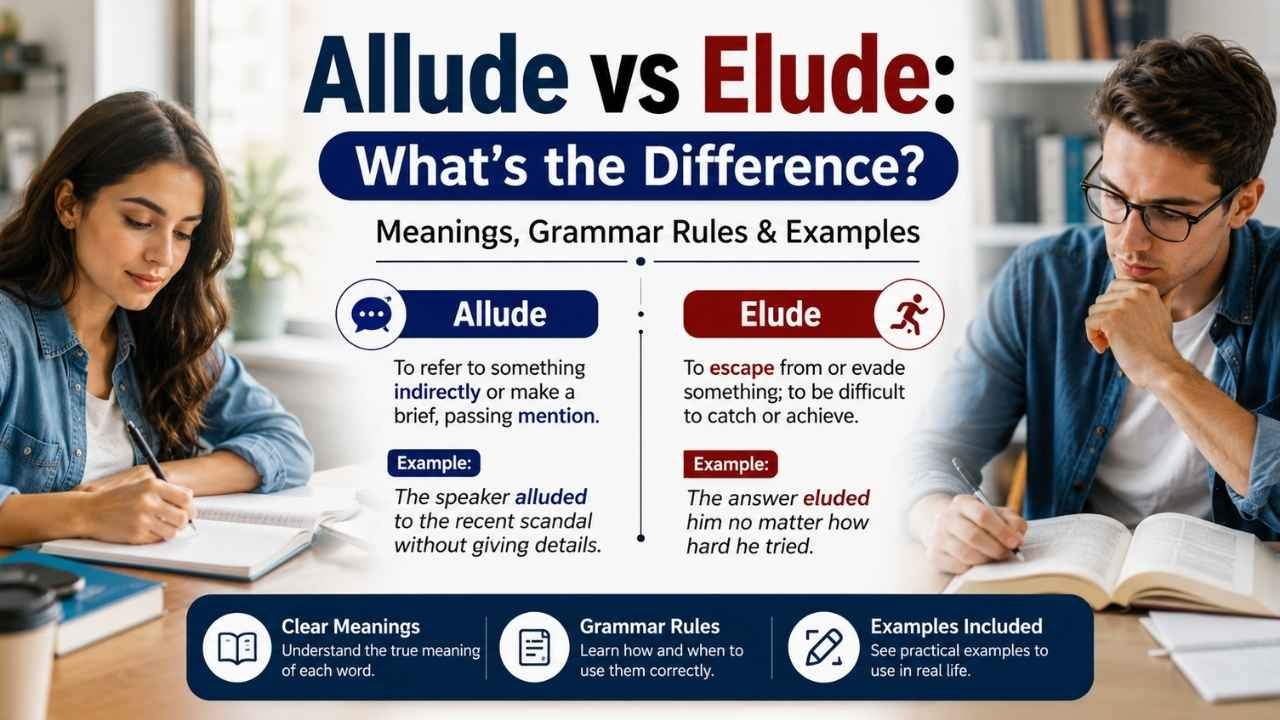
Have you ever paused while writing and wondered whether to use allude vs elude? You’re not alone. These two words look and sound similar, which is why they are among the most commonly confused words in English.
However, their meanings are completely different. Allude means to refer to something indirectly, while elude means to escape, avoid, or remain out of reach. Knowing the difference between allude and elude can make your writing clearer and more accurate, whether you’re working on an essay, email, or professional document.
In this guide, you’ll learn the allude meaning, elude meaning, pronunciation, grammar rules, and plenty of allude vs elude examples. You’ll also discover when to use allude, when to use elude, common mistakes to avoid, and simple memory tricks to help you remember the correct word every time.
Quick Answer
The difference between allude and elude is simple: allude means to refer to something indirectly or hint at it, while elude means to escape, avoid, or remain difficult to achieve or understand. If you’re unsure when to use allude or when to use elude, remember that allude is about making an indirect reference, whereas elude is about escaping or staying out of reach.
Allude vs Elude at a Glance (Comparison Table)
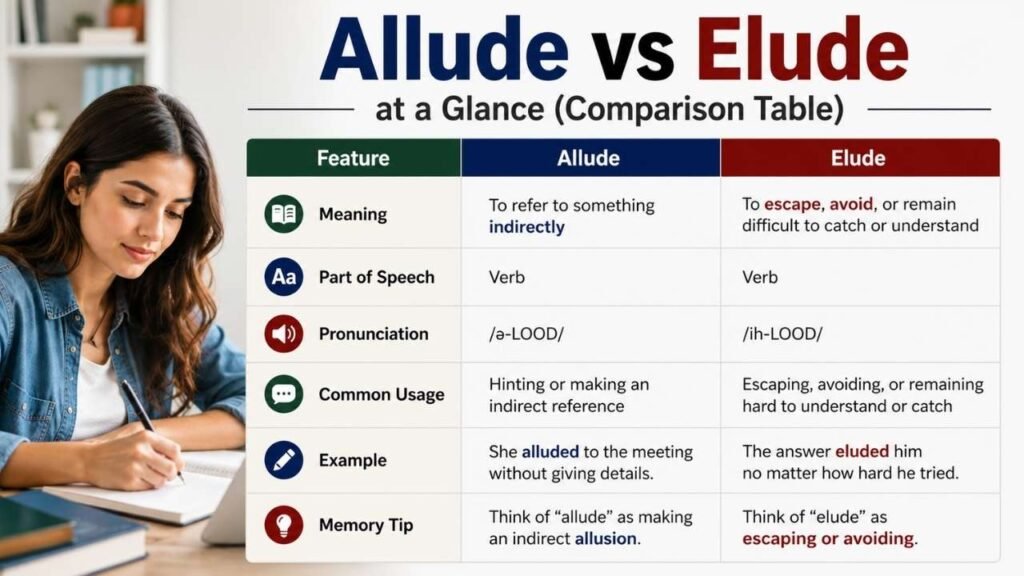
Although allude and elude look and sound alike, they have different meanings and uses. The table below gives a quick comparison to help you choose the correct word in any situation. If you often confuse these commonly confused words, reviewing this table before writing can improve your accuracy.
Understanding the allude vs elude meaning at a glance is especially useful for students, professionals, and English learners. Later in this guide, you’ll find detailed explanations, allude vs elude examples, and simple tips to help you remember the difference.
If you enjoy learning about English grammar, you may also like our guides on the Plural of Hibiscus and the Plural of Thorax, which explain other commonly misunderstood language rules.
| Feature | Allude | Elude |
| Meaning | To refer to something indirectly | To escape or avoid |
| Part of Speech | Verb | Verb |
| Pronunciation | /ə-LOOD/ | /ih-LOOD/ |
| Common Usage | Hinting or making an indirect reference | Escaping, avoiding, or remaining difficult to understand |
| Example | She alluded to the meeting. | The answer eluded him. |
| Memory Tip | Think of “allude” as making an indirect allusion | Think of “elude” as escaping |
What Does “Allude” Mean?
The allude meaning is to refer to something indirectly without saying it openly. When you allude to a person, event, or idea, you give a hint instead of explaining it directly. This verb is common in conversations, speeches, books, and professional writing because it allows the writer or speaker to make subtle references.
If you’re learning when to use allude, remember that it is always followed by the word “to.” For example, you can allude to a famous story or allude to a past experience. Many writers use this technique to make their message more interesting.
Understanding allude definition, pronunciation, and correct usage will help you communicate clearly and avoid confusing it with elude.
Examples:
- The speaker alluded to recent events without naming them.
- She alluded to her childhood during the interview.
- The author alluded to a famous historical figure.
- His joke alluded to a popular movie.
What Does “Elude” Mean?
The elude meaning is to escape, avoid, or remain difficult to catch, achieve, or understand. Unlike allude, which is about making an indirect reference, elude describes something that stays out of reach.
It can refer to a person escaping capture, an idea that is hard to understand, or success that remains difficult to achieve. If you’re wondering when to use elude, think about situations where something cannot be caught or fully understood.
The elude definition appears in both everyday English and formal writing, making it a useful word to know. Learning the correct allude vs elude usage will help you choose the right verb and avoid one of the most common grammar mistakes.
Examples:
- The suspect eluded the police for several days.
- The solution eluded the scientist for years.
- Sleep eluded me before the big exam.
- Her true intentions continued to elude everyone.
Allude vs Elude: Key Differences Explained
Although allude and elude share similar spelling and pronunciation, they describe completely different actions. The difference between allude and elude becomes clear when you focus on their purpose. Allude means to refer to something indirectly, while elude means to escape, avoid, or stay beyond someone’s understanding or reach.
Another helpful clue is sentence structure. Allude is commonly followed by “to,” as in allude to an idea. Elude is usually followed by a direct object, such as elude capture or elude understanding.
Learning these simple grammar patterns makes it much easier to remember allude vs elude and use each word correctly in everyday conversations, academic writing, and professional communication.
| Allude | Elude |
| Means to refer to something indirectly | Means to escape or avoid |
| Usually followed by to | Usually followed by a direct object |
| Used for hints or references | Used for escape or something difficult to grasp |
| Example: She alluded to the problem. | Example: The answer eluded him. |
When Should You Use “Allude”?
Use allude whenever you want to hint at something instead of mentioning it directly. It is common in essays, speeches, books, news articles, and everyday conversations. Writers often allude to famous people, historical events, movies, or books because readers can understand the reference without a full explanation.
If you’re asking when to use allude, remember that it helps make writing more engaging and thoughtful. The allude meaning always involves an indirect reference, not an escape or avoidance.
Whether you’re writing an email or giving a presentation, choosing allude correctly makes your message more natural and precise. Practicing allude vs elude examples will help you recognize the correct usage in different situations.
Examples:
- The teacher alluded to a well-known novel.
- His speech alluded to recent economic changes.
- She alluded to her future plans without sharing details.
- The article alluded to earlier research on the topic.
When Should You Use “Elude”?
Choose elude when something escapes, avoids, or remains difficult to understand or achieve. The word is often used for people avoiding capture, ideas that are hard to explain, or goals that remain out of reach. If you’re wondering when to use elude, think about anything that cannot be caught, found, solved, or fully understood.
The elude definition works in both literal and figurative situations, making it a versatile verb in English. Understanding this simple rule will improve your vocabulary and help you master the difference between allude and elude.
Reading and practicing allude vs elude examples regularly is one of the easiest ways to remember the correct choice.
Examples:
- The rare bird eluded photographers all day.
- The correct answer eluded the students.
- Success continued to elude the small business.
- The meaning of the poem eluded many readers.
Common Mistakes People Make with Allude and Elude
One of the biggest mistakes English learners make is using allude when they actually mean elude, or the other way around. Since both words have similar spelling and pronunciation, it is easy to mix them up. Remember that allude is about making an indirect reference, while elude is about escaping or remaining difficult to understand.
Another common mistake is forgetting that allude is normally followed by “to.” Reading the sentence carefully before choosing the word can prevent these errors.
As you continue learning allude vs elude grammar, you’ll become more confident using each verb correctly in conversations, exams, and professional writing.
Incorrect: He alluded the police for hours.
Correct: He eluded the police for hours.
Incorrect: She eluded to her childhood memories.
Correct: She alluded to her childhood memories.
Incorrect: The speaker eluded the famous author in his speech.
Correct: The speaker alluded to the famous author in his speech.
Incorrect: The solution alluded the researchers for months.
Correct: The solution eluded the researchers for months.
Easy Memory Tricks to Remember the Difference
If you still mix up allude vs elude, a simple memory trick can help. Think of allude as A = Allusion, which means making an indirect reference to something. Whenever you see allude, imagine someone giving a small hint instead of stating something directly.
For elude, think of E = Escape. If something eludes you, it escapes your reach or remains difficult to understand. These word associations are easy to remember and work well during writing, speaking, or exams.
The more you practice using the allude meaning and elude meaning in sentences, the easier it becomes to choose the correct word. Regular practice is the best way to master this commonly confused word pair.
Quick Memory Tips:
- Allude = Allusion = Indirect reference
- Elude = Escape = Avoid or stay out of reach
- Allude to something; elude someone or something.
Synonyms and Related Words
Learning synonyms is a great way to strengthen your vocabulary and better understand allude vs elude. While no synonym matches the exact meaning in every situation, several words have similar uses depending on the context.
Knowing these alternatives also improves your writing by reducing repetition. Keep in mind that allude usually involves an indirect reference, while elude focuses on escaping or avoiding something.
Choose synonyms carefully so your sentence keeps its intended meaning. Expanding your vocabulary through related words will also help you recognize these verbs more easily when reading books, articles, or professional documents.
Synonyms of Allude
- Refer to
- Hint at
- Mention indirectly
- Suggest
- Imply
Synonyms of Elude
- Escape
- Evade
- Avoid
- Dodge
- Slip past
Related but Different Words
- Mention
- Refer
- Escape
- Avoid
- Imply
Practice Quiz: Can You Choose the Correct Word?
The best way to remember when to use allude and when to use elude is by practicing. Read each sentence and decide which verb fits best. After completing the quiz, check your answers to see how well you understand the difference between allude and elude.
These short exercises reinforce the grammar rules and help you build confidence in everyday writing. If you answer incorrectly, review the earlier sections and focus on the meaning of each word. A few minutes of practice can make a lasting difference in your English vocabulary.
Choose the correct word:
- The teacher ________ to a famous poem.
- The suspect managed to ________ the police.
- Her speech ________ to recent events.
- The answer continued to ________ him.
- The writer ________ to Greek mythology.
Answers:
- alluded
- elude
- alluded
- elude
- alluded
FAQs
Is allude the same as refer to?
Not exactly. Allude means to refer to something indirectly, while refer to can be either direct or indirect.
What does elude mean in simple words?
Elude means to escape, avoid, or stay difficult to catch, achieve, or understand.
Why are allude and elude confusing?
They have similar spelling and pronunciation, but their meanings are completely different.
Can allude and elude be used in the same sentence?
Yes. For example: The speaker alluded to the mystery that had eluded investigators for years.
Is “allude to” always correct?
Yes. In standard English, allude is almost always followed by to.
Can elude describe ideas as well as people?
Yes. An idea, answer, solution, or meaning can elude someone if it remains difficult to understand.
How can I remember the difference?
Think Allude = Allusion = Hint, and Elude = Escape = Out of reach.
Conclusion
Understanding the difference between allude and elude becomes much easier once you remember their core meanings. Allude is used when you refer to something indirectly, while elude describes something that escapes, avoids, or remains difficult to understand.
Although these verbs look alike, using the correct one makes your writing clearer and more professional. The comparison table, grammar rules, examples, memory tricks, and practice quiz in this guide are designed to help you use both words with confidence.
Whenever you’re unsure, recall the simple rule: allude = hint, elude = escape. With regular reading and practice, you’ll quickly master allude vs elude and avoid one of the most common mistakes in English vocabulary.