
Have you ever paused while writing and wondered whether backward or backwards is the correct choice? You’re not alone. Many English learners, students, writers, and professionals ask “backward or backwards,” “is backward or backwards correct,” or “what is the difference between backward and backwards?”
The good news is that both words are grammatically correct, but their usage depends mainly on American English and British English. While they share the same meaning, one form is more common in certain regions and writing styles.
In this guide, you’ll learn the difference between backward and backwards, when to use each spelling, and how to choose the right one with confidence. You’ll also find simple explanations, comparison tables, and plenty of real-life examples to make these commonly confused words easy to understand.
Quick Answer
Backward and backwards are both correct and have the same meaning, but their usage depends on regional English. Backward is the preferred form in American English, while backwards is more common in British English. In most situations, the two words are interchangeable, so choosing the right one mainly depends on your audience and keeping your writing consistent.
Backward vs. Backwards at a Glance (Comparison Table)
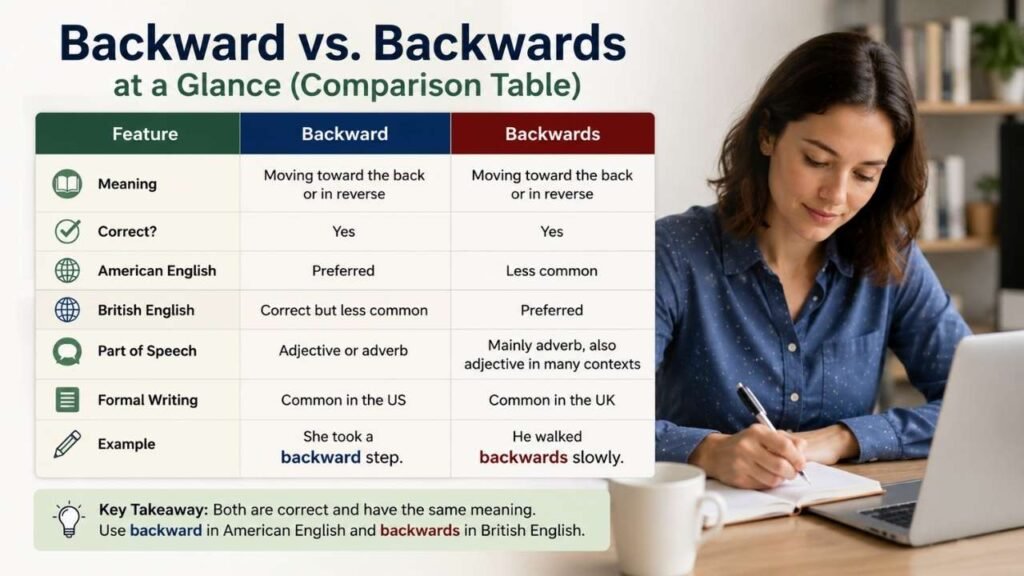
Before looking at the details, here’s a simple comparison of backward vs. backwards. Both words have the same meaning and are grammatically correct, but their preferred use depends on the type of English you are writing. Backward is more common in American English, while backwards is widely used in British English.
In most cases, they can be used interchangeably without changing the meaning of the sentence. If you’re writing for an international audience, choose one spelling and stay consistent throughout your work.
Just as writers often check the Plural of Chef to avoid common grammar mistakes, understanding these regional spelling differences can make your writing clearer and more professional.
| Feature | Backward | Backwards |
| Meaning | Moving toward the back or in reverse | Moving toward the back or in reverse |
| Correct? | Yes | Yes |
| American English | Preferred | Less common |
| British English | Correct but less common | Preferred |
| Part of Speech | Adjective or adverb | Mainly adverb, also adjective in many contexts |
| Formal Writing | Common in the US | Common in the UK |
| Example | She took a backward step. | He walked backwards slowly. |
What Does “Backward” Mean?
The word backward means toward the back, in reverse, or opposite to the usual direction. It can also describe someone or something that is behind in progress or development. In American English, backward is the preferred spelling in both everyday and formal writing.
It works as both an adjective and an adverb, making it useful in many situations. For example, you might say, “The car rolled backward,” or “He took a backward glance.”
If you’ve ever learned the difference between Allude vs Elude, you already know that small changes in English words can affect usage. The same idea applies here—choosing the correct regional spelling helps your writing feel more natural.
Examples:
- The child took one backward step.
- Please move backward a little.
- The company made a backward move after the policy changed.
What Does “Backwards” Mean?
Backwards has the same basic meaning as backward. It describes moving toward the back, in reverse, or facing the opposite direction. The main difference is that backwards is the preferred form in British English, although it is also understood by American readers.
Many people ask, “backwards or backward” or “is backward or backwards correct?” The answer is that both are correct, and the choice usually depends on your audience. If you are writing for readers in the United Kingdom, backwards often sounds more natural.
Whatever spelling you choose, stay consistent throughout your article, email, or report to keep your writing smooth and professional.
Examples:
- She walked backwards without looking.
- The clock seemed to move backwards.
- He leaned backwards to avoid the branch.
Backward vs. Backwards: What’s the Difference?
The main difference between backward and backwards is regional preference, not meaning. Both words mean moving in the opposite direction or toward the back, and both are grammatically correct. In most situations, they are interchangeable without changing the sentence’s meaning.
However, backward is the preferred spelling in American English, while backwards is more common in British English. This is why many writers ask, “backward vs. backwards in American English” or “backward vs. backwards in British English.” If you’re writing for a specific audience, use the spelling that matches their regional English.
The most important rule is to remain consistent throughout your writing instead of switching between both forms.
Backward or Backwards in American English vs. British English
One of the easiest ways to choose between backward and backwards is to consider your audience. In American English, style guides and publishers generally prefer backward in both formal and everyday writing. In British English, backwards is the more familiar spelling and appears frequently in books, newspapers, and conversations.
Even though each region has a favorite form, readers understand both spellings without confusion. If you’re writing for an international audience, either choice is acceptable as long as you use it consistently.
Understanding these regional preferences helps answer questions like “should I write backward or backwards?” and “when to use backward or backwards?” while making your writing sound natural to your intended readers.
Is Backward or Backwards More Common?
The answer depends on where English is being used. Backward is more common in the United States, while backwards appears more often in the United Kingdom and many other countries that follow British English.
This difference comes from regional language preferences rather than grammar rules. Online, you’ll find both spellings in books, articles, and websites because writers follow different English standards.
If you are writing for school, work, or a business, it’s a good idea to match the spelling style your audience expects. Whether you choose backward or backwards, using the same form throughout your document creates a polished and professional piece of writing.
Can Backward and Backwards Be Used Interchangeably?
Yes, backward and backwards can usually be used interchangeably because they share the same meaning. Whether you say someone walked backward or walked backwards, the message remains the same.
The only real difference is the regional preference between American English and British English. However, if you’re following a company style guide, school requirement, or publisher’s guidelines, you should use the preferred spelling consistently.
This avoids distracting readers with mixed spellings. When deciding which spelling should you use, think about who will read your work first. Choosing the version that matches your audience and keeping it consistent is the simplest way to write clearly and confidently.
Common Expressions Using Backward or Backwards
Both backward and backwards appear in many everyday expressions. Since they have the same meaning, the choice usually depends on whether you’re using American English or British English.
Learning these common phrases helps you understand when to use backward or backwards in real conversations and writing. For example, “take a step backward” means to lose progress or reconsider a decision, while “walk backwards” means moving in reverse.
You may also hear phrases like “bend over backwards,” which means making a great effort to help someone. These expressions are common in books, news articles, and daily speech, so becoming familiar with them will improve both your writing and your understanding of English.
Examples:
- Take a step backward before making a decision.
- She walked backwards across the room.
- They bent over backwards to help us.
- Looking backward, we learned many lessons.
Common Mistakes to Avoid
Many writers make simple mistakes when using backward and backwards because they believe one spelling is always wrong. In reality, both are correct. The biggest mistake is mixing the two spellings in the same article or document without a reason.
Some people also ignore their audience and use a spelling that does not match the regional style they are writing for.
To avoid these problems, choose either backward or backwards based on your readers and stay consistent. This simple habit makes your writing look polished, professional, and easier to follow.
Example Sentences in Everyday English
Reading real examples is one of the easiest ways to understand the difference between backward and backwards. Notice how the spelling changes depending on the audience, while the meaning stays the same.
In American English, you might write, “Please move backward so everyone can see the stage.” In British English, the same idea could be written as, “Please move backwards a little.” Other examples include, “The bicycle rolled backward down the hill” and “She looked backwards before crossing the road.”
These examples show that both words are natural and correct. The best choice depends on the type of English you are using and keeping the same spelling throughout your writing.
Backward vs. Backwards: Which Should You Use?
If you’re still wondering “should I write backward or backwards?”, the answer is simple. Choose backward if you are writing in American English, and choose backwards if your audience uses British English.
Both spellings are correct, so there is no need to worry about one being grammatically wrong. Your goal should be to match your readers’ expectations and use the same spelling consistently from beginning to end. If you’re writing for an international audience, either form is acceptable, provided you do not switch between them.
Following this simple rule will help you write with confidence and avoid confusion in school assignments, business documents, blogs, and everyday communication.
FAQs
Is backward or backwards correct?
Yes. Both backward and backwards are correct. The preferred spelling depends on whether you use American or British English.
What is the difference between backward and backwards?
The main difference is regional usage. Backward is preferred in American English, while backwards is more common in British English.
Can I use backward and backwards interchangeably?
Yes. In most situations, they have the same meaning and can be used interchangeably.
Which spelling is used in American English?
Backward is the standard and more common spelling in American English.
Which spelling is used in British English?
Backwards is generally preferred in British English, although backward is also understood.
Do backward and backwards have different meanings?
No. They share the same meaning and differ mainly in regional preference.
Which spelling should I use in formal writing?
Use the spelling that matches your audience’s regional English and keep it consistent throughout your document.
Conclusion
Choosing between backward and backwards is easier than it may seem. Both words are correct, and they share the same meaning. The key difference is that backward is preferred in American English, while backwards is more common in British English.
Instead of worrying about which spelling is right, focus on who your audience is and use one form consistently. Whether you’re writing an email, article, report, or school assignment, following the regional preference will make your writing sound more natural.
Now that you understand backward vs. backwards, you can confidently choose the correct spelling and avoid one of the most common English usage questions.