
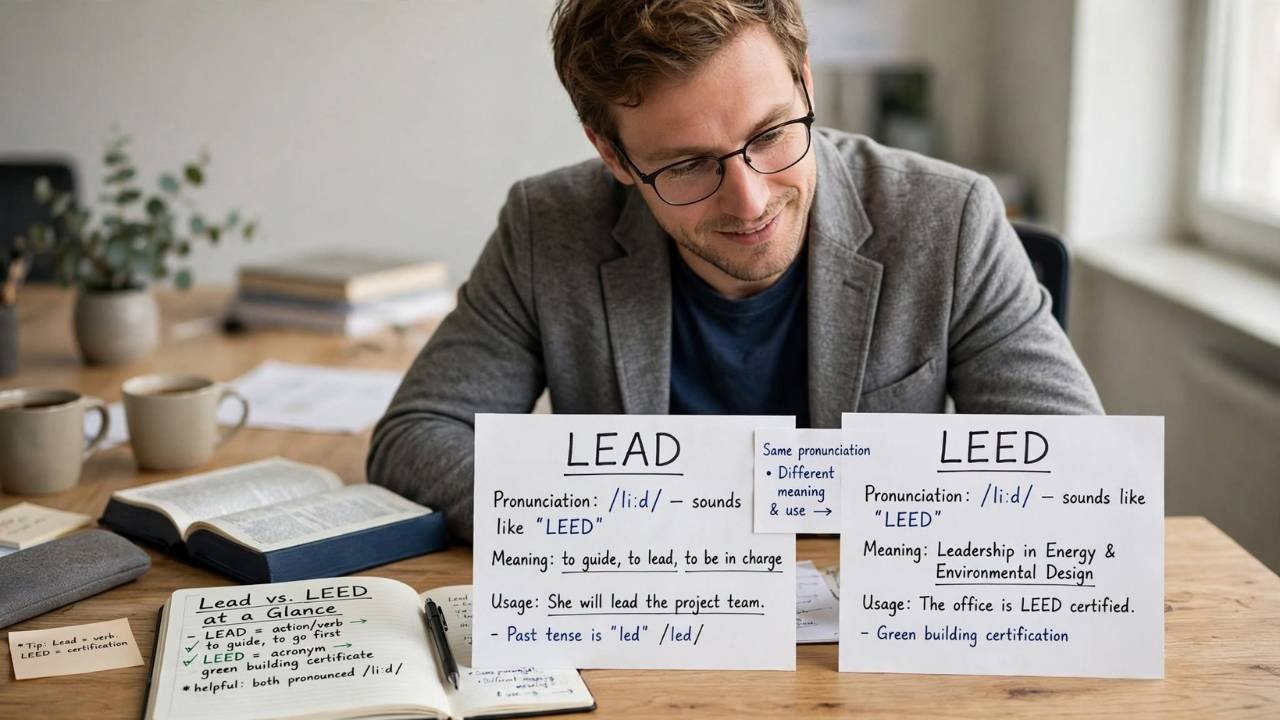
Have you ever wondered whether Lead and LEED mean the same thing? At first glance, they look and even sound similar in some situations, which is why many people search for Lead or LEED and get confused. In reality, they are completely different.
Lead is an English word with several meanings and pronunciations, while LEED is an acronym for Leadership in Energy and Environmental Design, a globally recognized green building certification program. Understanding the difference between Lead and LEED can help you avoid spelling mistakes, grammar errors, and misunderstandings.
In this guide, you’ll learn the meaning of lead, the meaning of LEED, correct pronunciation, grammar rules, common examples, and simple tips to remember when to use each one. By the end, you’ll feel confident using both terms correctly.
Quick Answer
Lead is an English word that can be a verb, noun, or the name of a metal, while LEED stands for Leadership in Energy and Environmental Design, a green building certification developed by the U.S. Green Building Council (USGBC). Although lead and LEED may sound alike in some contexts, they have completely different meanings, uses, and spelling.
Lead vs. LEED at a Glance
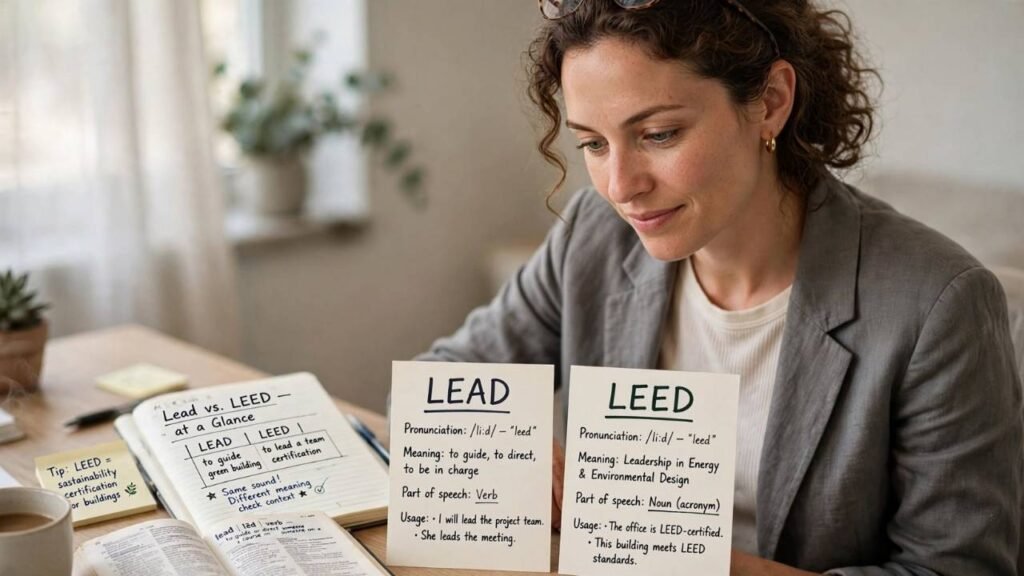
Although Lead and LEED may look similar, they have completely different meanings. Lead is an English word that can be a verb, noun, or the name of a metal. It can also have two different pronunciations depending on its meaning.
On the other hand, LEED stands for Leadership in Energy and Environmental Design, a well-known green building certification developed by the U.S. Green Building Council (USGBC). It is always written in capital letters because it is an acronym.
If you’re comparing Lead vs. LEED, remember that one belongs to English grammar and vocabulary, while the other belongs to construction and sustainability. Knowing this simple difference helps you choose the correct word every time.
| Feature | Lead | LEED |
| Meaning | An English word with several meanings | Leadership in Energy and Environmental Design |
| Type | Noun, verb, or metal | Acronym |
| Pronunciation | LEED or LED, depending on meaning | Always LEED |
| Capitalization | Usually lowercase | Always uppercase |
| Common Use | Grammar, writing, speaking | Green building certification |
What Does “Lead” Mean?
The word lead has more than one meaning, making it one of the most interesting words in English. As a verb, lead means to guide, direct, or show the way. For example, A good teacher can lead students toward success.
As a noun, it can refer to the first position, an advantage in a competition, or an important role. Lead is also the name of a heavy metal, which is pronounced differently from the verb. Because lead has multiple meanings and pronunciations, many learners find it confusing.
If you’re also learning about verb forms, our guide on Led or Lead explains when to use each tense correctly with clear examples.
What Does “LEED” Mean?
LEED stands for Leadership in Energy and Environmental Design, a globally recognized green building certification system. It was created by the U.S. Green Building Council (USGBC) to encourage environmentally friendly construction and sustainable design.
Buildings can earn LEED certification by meeting standards for energy efficiency, water conservation, indoor air quality, and the use of sustainable materials. Unlike lead, LEED is not an English vocabulary word. It is an acronym, which is why it is always written in capital letters.
If you see LEED-certified building or LEED certification, the topic is about construction and environmental sustainability, not grammar or spelling. Understanding this difference helps prevent common writing mistakes.
Why People Confuse Lead and LEED
Many people confuse Lead and LEED because they are often pronounced the same when lead is used as a verb. However, their meanings are completely different. Lead is a common English word, while LEED is an acronym used in the building industry.
Another reason for the confusion is that people searching online may not know whether LEED is a spelling of lead or a separate term. In reality, LEED is never a replacement for lead.
Paying attention to capitalization, context, and meaning makes it much easier to choose the correct word. Learning commonly confused words can also improve your writing, just like understanding the difference in Hustle or Hussle.
Pronunciation Guide: How to Say Lead and LEED Correctly
One reason lead causes confusion is that it has two pronunciations. When lead means to guide, it is pronounced /liːd/, which sounds exactly like LEED. However, when lead refers to the metal, it is pronounced /lɛd/, which sounds like led.
The acronym LEED is always pronounced /liːd/ because it represents Leadership in Energy and Environmental Design. A simple way to remember this is to think about the meaning before saying the word.
If you’re talking about guiding someone, use the LEED sound. If you’re talking about the metal, use the LED sound. Context always helps you choose the correct pronunciation.
When Should You Use Lead?
Use lead whenever you are talking about guiding, directing, or being in front. It is the present tense of the verb, so it describes actions happening now or in the future. For example, She will lead the team during the meeting, and Good communication can lead to better results.
As a noun, lead can also describe an advantage, such as Our team has a five-point lead. In addition, lead is the correct spelling for the heavy metal used in products like batteries and protective equipment.
Always consider the sentence’s meaning before choosing the word. This simple habit helps you use lead confidently and avoid common grammar and spelling mistakes.
Is LEED Ever a Replacement for Lead?
The simple answer is no. LEED is never a replacement for lead in English grammar or everyday writing. Lead is an English word that can be a verb, noun, or the name of a metal, while LEED is an acronym for Leadership in Energy and Environmental Design.
If you are writing about guiding a group, taking the first position, or referring to the metal, you should always use lead. Use LEED only when discussing green building certification, sustainable construction, or LEED-certified buildings.
Understanding the purpose of each word makes it much easier to avoid mistakes. Always look at the context before deciding which spelling is correct.
Common Mistakes with Lead, Led, and LEED
Many writers make mistakes because lead, led, and LEED are closely related in spelling or pronunciation. A common error is using lead instead of led when talking about a past action.
Remember, led is the past tense of lead, while lead is the present tense. Another mistake is writing LEED when referring to the verb lead. Since LEED is an acronym, it should only appear when discussing Leadership in Energy and Environmental Design.
Some people also forget that lead the metal is pronounced like led, not LEED. Reading your sentence carefully and checking its meaning can help you avoid these common grammar and spelling mistakes.
Easy Tricks to Remember the Difference
You can remember the difference between lead, led, and LEED with a few simple tricks. Think of LEED as an acronym, so it is always written in capital letters and relates to green building certification.
If you are talking about guiding someone today or in the future, use lead. If the action already happened, use led because it is the past tense of lead. Another useful tip is to remember that lead the verb and LEED are both pronounced /liːd/, while lead the metal sounds like led.
These small memory tricks can help you choose the correct word quickly and write with greater confidence.
Examples of Lead, Led, and LEED in Sentences
Seeing each word in a sentence is one of the easiest ways to understand its correct use. Here are a few simple examples:
- Lead: Maria will lead the project next month.
- Lead: Our team has a comfortable lead in the competition.
- Lead (metal): The old pipe contained lead, so it was replaced.
- Led: The guide led the visitors through the museum.
- Led: Her experience led to a better decision.
- LEED: The company built a LEED-certified office to improve energy efficiency.
- LEED: The architect explained the benefits of LEED certification during the meeting.
FAQs
Is LEED a word?
No. LEED is an acronym for Leadership in Energy and Environmental Design, not a regular English word.
What does LEED stand for?
It stands for Leadership in Energy and Environmental Design, a green building certification program.
Is lead pronounced LEED?
Yes, when lead means to guide, it is pronounced /liːd/. When it refers to the metal, it is pronounced /lɛd/.
What is the past tense of lead?
The past tense of lead is led.
Can LEED replace lead in writing?
No. LEED and lead have completely different meanings and should never replace each other.
Why is LEED written in capital letters?
Because it is an acronym, not a standard English word.
Is lead a noun or a verb?
Lead can be both a noun and a verb, depending on the sentence.
What is the difference between lead and LEED?
Lead is an English word with multiple meanings, while LEED is a certification system for sustainable buildings.
Conclusion
Although Lead and LEED may sound similar, they serve completely different purposes. Lead is an English word used as a verb, noun, and the name of a metal, while LEED refers to Leadership in Energy and Environmental Design, a globally recognized green building certification.
Understanding their meaning, pronunciation, capitalization, and usage helps you avoid common grammar and spelling mistakes. Whenever you’re unsure, think about the context. If you’re discussing language, writing, or everyday communication, lead is usually the correct choice.
If you’re talking about sustainable construction or certified buildings, use LEED. Keeping this simple distinction in mind will help you write more accurately and confidently.