
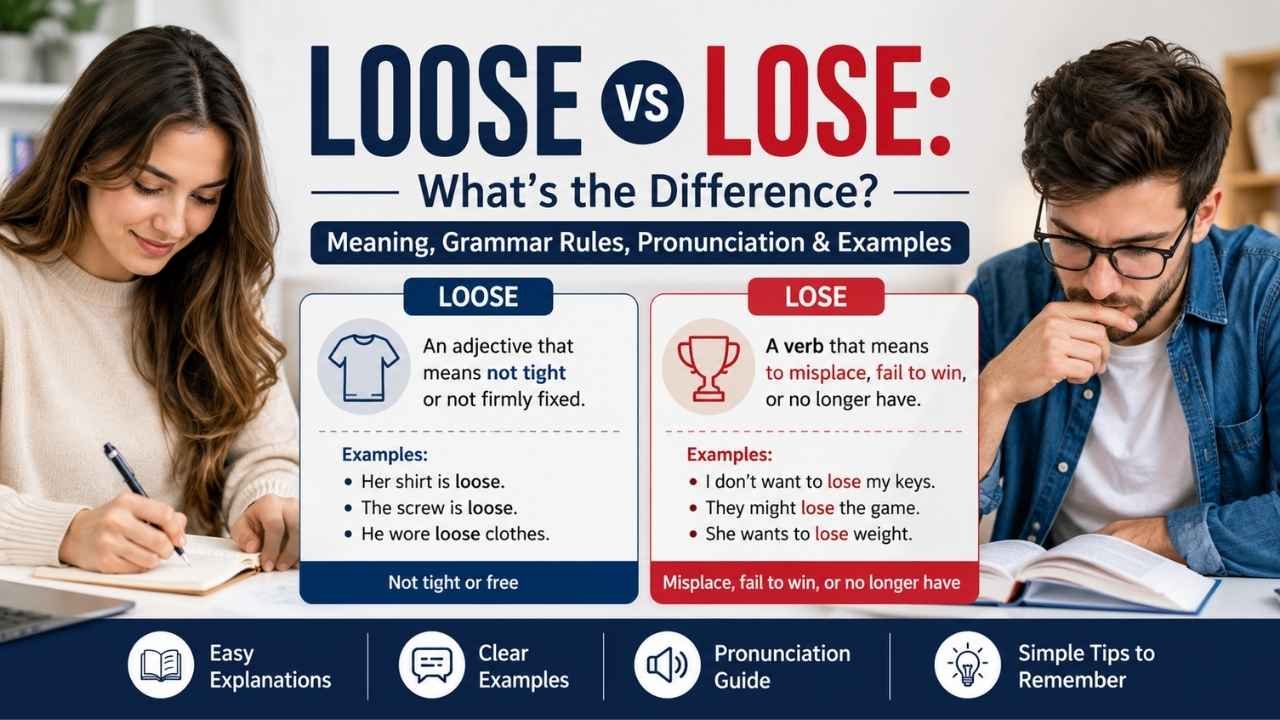
Have you ever wondered whether to write loose vs lose? You’re not alone. Loose vs lose is one of the most common grammar and spelling mistakes in English because the two words look and sound similar. However, they have different meanings, pronunciations, and grammar rules.
Knowing the difference between loose and lose will help you write more clearly and avoid embarrassing errors in emails, school assignments, and everyday conversations.
In this guide, you’ll learn the meaning of loose and lose, when to use each word, how to remember the correct spelling, and see plenty of sentence examples. Whether you’re an English learner or a native speaker, this easy-to-follow guide will help you use lose and loose with confidence every time.
Quick Answer
The difference between loose and lose is that lose is a verb meaning to misplace, fail to win, or no longer have something. Loose is usually an adjective meaning not tight or firmly fixed. You lose your keys or lose weight, but you wear loose clothes or have a loose tooth. Their pronunciation also differs.
Loose vs Lose at a Glance (Comparison Table)
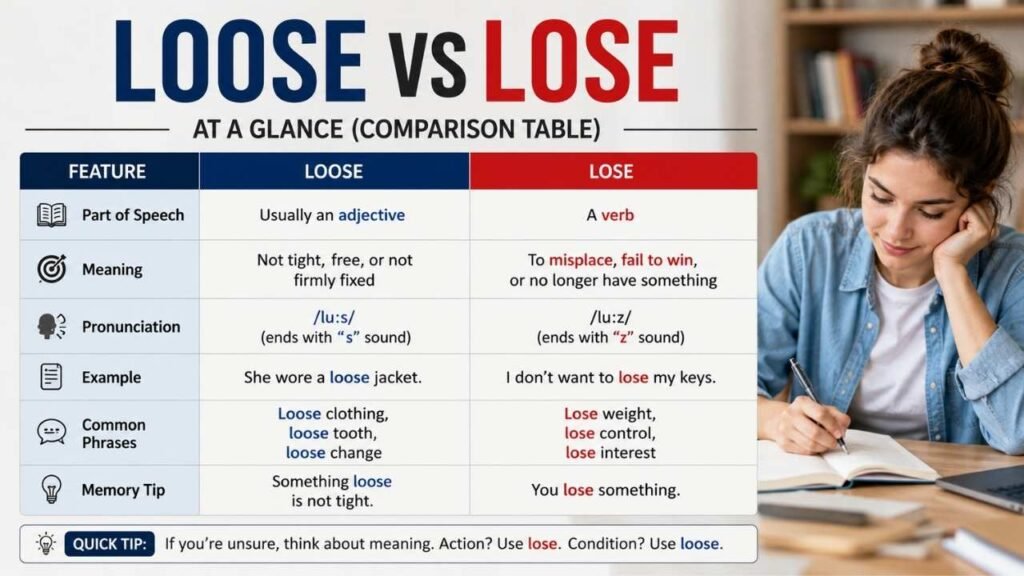
Many people mix up loose and lose because the words look alike, but they have different meanings and grammar roles. The table below gives you a quick comparison to help you remember the correct usage.
If you often wonder whether to write lose or loose, this summary makes the choice much easier. Learning the difference between loose and lose can improve your writing, reduce common spelling mistakes, and build confidence in everyday English.
Whether you’re writing an email, completing homework, or creating professional content, knowing which word fits the sentence is important. Read the table carefully, then continue with the detailed explanations below to understand lose meaning, loose meaning, pronunciation, and correct usage.
| Feature | Lose | Loose |
| Part of Speech | Verb | Usually an adjective |
| Meaning | To misplace, fail to win, or no longer have something | Not tight, free, or not firmly fixed |
| Pronunciation | /luːz/ | /luːs/ |
| Example | I don’t want to lose my keys. | She wore a loose jacket. |
| Common Phrases | lose weight, lose control, lose interest | loose clothing, loose tooth, loose change |
| Memory Tip | You lose something. | Something loose is not tight. |
What Does “Lose” Mean?
Lose is a verb that means to no longer have something, fail to win, or misplace an object. It describes an action rather than a condition. For example, you can lose your wallet, lose a football match, or lose interest in a hobby.
Because it is a verb, lose shows something happening. Many English learners accidentally write loose instead of lose, especially in phrases like “lose weight.” Remember, the correct expression is always lose weight, not loose weight.
Understanding the lose definition and using it in the right context will help you avoid one of the most common grammar mistakes in English. Practice using lose in different sentences to make it feel natural.
What Does “Loose” Mean?
Loose is usually an adjective that describes something not tight, firmly attached, or securely fixed. You might wear loose clothing, notice a loose button, or have a loose tooth. Unlike lose, this word does not describe an action.
Instead, it tells you about the condition of a person or object. Learning the loose definition makes it easier to choose the correct spelling while writing.
Although loose can also be used as a verb in certain situations, such as “to loose an arrow,” that meaning is uncommon in modern everyday English. In most conversations and writing, you’ll use loose as an adjective. Understanding loose meaning helps you avoid confusing it with lose.
What Is the Difference Between Loose and Lose?
The difference between loose and lose comes down to meaning, grammar, spelling, and pronunciation. Lose is a verb that means to misplace something, fail to win, or no longer have something.
Loose, on the other hand, is usually an adjective that means not tight or securely attached. Although the words look similar, they are used in completely different situations. For example, you lose your keys, but your shoelaces become loose.
Remembering whether the word describes an action or a condition can help you choose the correct one. If you enjoy learning about commonly confused English words, you may also find our guide on Artist vs Artisan helpful, as it explains another pair of words that are often misunderstood.
Loose vs Lose Pronunciation Explained
One reason people confuse loose vs lose is that their pronunciations are very similar. Lose is pronounced /luːz/, ending with a “z” sound, while loose is pronounced /luːs/, ending with a soft “s” sound.
This small difference can be difficult to hear, especially for English learners. Listening carefully and saying both words aloud is a great way to remember them. Reading example sentences can also improve your pronunciation and confidence.
Keep in mind that pronunciation alone should not determine your spelling. Always think about the meaning first. If the word describes an action, choose lose. If it describes something not tight, choose loose.
Grammar Rules for Using Loose and Lose Correctly
The easiest grammar rule is to remember that lose is a verb, while loose is usually an adjective. Verbs describe actions, and adjectives describe nouns. For example, “I don’t want to lose my phone” is correct because lose shows an action.
“My backpack strap is loose” is also correct because loose describes the strap. Before writing either word, ask yourself whether you’re talking about doing something or describing something. This simple habit can prevent many spelling mistakes.
If you’re interested in improving your writing further, our article on Repetition vs Parallelism explains how these two writing techniques work and when to use each one effectively.
Common Mistakes People Make with Loose and Lose
Many writers confuse loose and lose because the words have similar spellings and nearly identical pronunciations. The most common mistake is writing “loose weight” instead of “lose weight.”
Since lose is a verb, it should be used whenever you mean to misplace something, fail to win, or reduce weight. Loose, on the other hand, describes something that is not tight. Other common errors include phrases like “I don’t want to loose my keys” or “Our team was loose yesterday.”
Reading your sentence carefully before publishing or sending it can help you spot these mistakes. The more you practice, the easier it becomes to choose the correct word naturally.
Easy Memory Tricks to Remember Loose vs Lose
If you often mix up lose and loose, a simple memory trick can help. Think about the extra “o” in loose. That extra letter makes the word feel looser, which matches its meaning of not tight.
On the other hand, lose has only one “o,” reminding you that when you lose something, it is gone. Another easy tip is to remember common phrases.
You always lose a game, lose your phone, or lose weight, but you wear loose clothes, tie a loose knot, or find loose change in your pocket. Repeating these examples aloud makes the difference easier to remember in everyday writing and conversation.
Loose vs Lose in Sentences
Reading examples is one of the best ways to understand the difference between loose and lose. Here are a variety of correct sentences.
Lose: I don’t want to lose my passport. We may lose the match if we don’t practice. She hopes to lose five kilograms this year. Please don’t lose your receipt. They could lose the opportunity. Loose: His shirt is loose after losing weight.
The dog has a loose collar. I found some loose coins in my bag. One wheel feels loose. Her hair was loose in the wind. These examples show that lose expresses an action, while loose describes a condition or appearance.
Practice Quiz: Can You Choose the Correct Word?
Now it’s time to test your understanding of loose vs lose. Choose the correct word for each sentence.
1. I don’t want to (lose/loose) my wallet.
2. This jacket feels too (lose/loose).
3. They might (lose/loose) the championship.
4. My bicycle chain is (lose/loose).
5. She wants to (lose/loose) a few pounds.
Answers: 1. lose 2. loose 3. lose 4. loose 5. lose.
If you answered them all correctly, you’ve understood the basic grammar rules and correct usage of these commonly confused English words. If not, review the comparison table and examples before trying again.
Similar Words People Often Confuse
Just like loose vs lose, many English words look or sound alike but have completely different meanings. Learning these pairs can improve your writing and reduce common grammar mistakes. Some popular examples include affect vs effect, then vs than, advice vs advise, breath vs breathe, and complement vs compliment.
Each pair has different meanings, grammar roles, and sentence uses. The best way to master them is by learning the definition, pronunciation, and real-life examples instead of relying only on spelling.
Building this habit will strengthen your vocabulary and make your writing clearer, whether you’re preparing school assignments, professional emails, or everyday messages.
FAQs
Is it “lose weight” or “loose weight”?
The correct phrase is lose weight because lose is the verb that means to reduce or no longer have something.
Is “loose” a verb?
In modern everyday English, loose is usually an adjective meaning not tight. It can be a verb in rare or literary contexts, but that use is uncommon.
Is “lose” an adjective?
No. Lose is a verb. It describes an action, such as lose a game, lose your keys, or lose interest.
Why do people confuse loose and lose?
They are often confused because they have similar spellings and similar pronunciations, even though their meanings and grammar are different.
How do you pronounce lose and loose?
Lose is pronounced /luːz/ with a “z” sound, while loose is pronounced /luːs/ with an “s” sound.
Can spell check always catch this mistake?
Not always. Since both lose and loose are correctly spelled English words, spell check may not detect the error if the wrong word still forms a grammatically valid sentence.
Conclusion
Understanding the difference between loose and lose is easier once you remember their meanings and grammar roles. Lose is a verb that means to misplace something, fail to win, or no longer have something, while loose is usually an adjective that describes something not tight.
Paying attention to the context of your sentence will help you choose the correct word every time. Reading examples, practicing with short quizzes, and using simple memory tricks are excellent ways to avoid this common English grammar mistake.
With regular practice, you’ll use lose and loose confidently in conversations, emails, schoolwork, and professional writing, making your communication clearer and more accurate.