

Many English learners confuse since vs sense because they sound similar, but they have completely different meanings. Knowing the difference between since and sense can help you avoid common writing mistakes and communicate more clearly.
Since is usually used to talk about time or to give a reason, while sense refers to understanding, feeling, or one of the five senses. Although these words may seem alike in pronunciation, they are not interchangeable.
In this guide, you’ll learn when to use since, when to use sense, their meanings, grammar rules, and plenty of since vs sense examples. You’ll also discover common mistakes, simple memory tricks, and practical tips to help you choose the correct word with confidence in both speaking and writing.
Quick Answer
Since and sense are different words with different meanings. Since is used to refer to time (from a particular point until now) or to mean because. Sense refers to understanding, meaning, judgment, or one of the five senses. If you’re unsure whether to use since or sense, remember that since relates to time or reason, while sense relates to perception or understanding.
What’s the Main Difference Between Since and Sense?
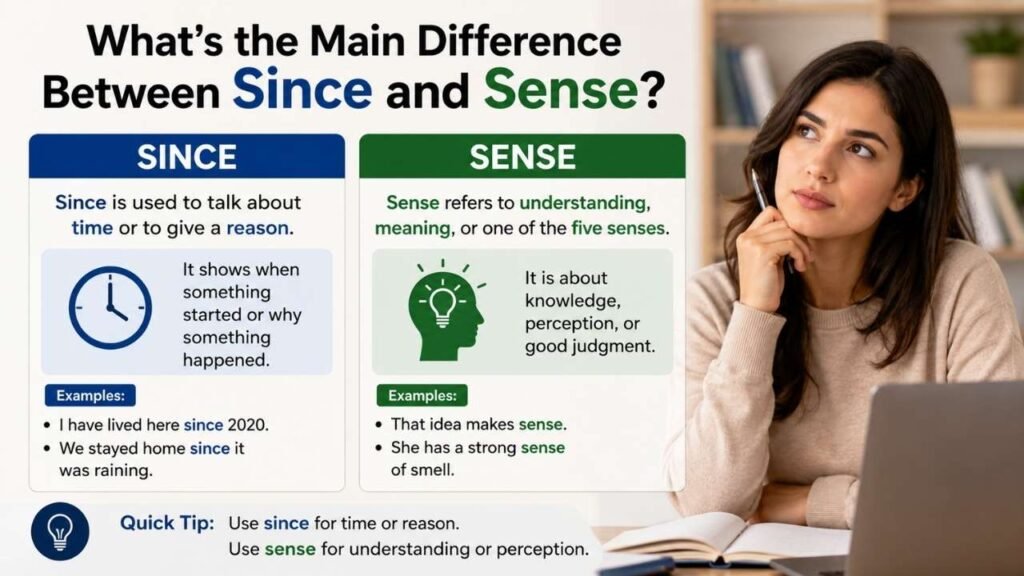
The main difference between since and sense is that they have different meanings and different jobs in a sentence. Since is used to talk about time or to give a reason. For example, you can say, “I have lived here since 2020,” or “I stayed home since it was raining.”
On the other hand, sense refers to understanding, meaning, good judgment, or one of the five senses. For example, “That idea makes sense,” or “Your sense of smell is very strong.”
Although these words sound similar, they are not interchangeable. Learning the difference between since and sense will help you write more clearly and avoid common grammar mistakes.
| Word | Meaning | Example |
| Since | Refers to time or means because | I have known her since childhood. |
| Sense | Refers to understanding or perception | Your explanation makes sense. |
What Does “Since” Mean?
Since is a common English word that can work as a preposition, conjunction, or adverb. Most often, it shows the starting point of time, such as “I have worked here since Monday.” It can also mean because, especially when giving a reason.
For example, “We left early since the weather was getting worse.” Knowing when to use since is important because its meaning depends on the sentence. It connects ideas smoothly and is widely used in both speaking and writing.
If you’re interested in learning more grammar topics, you may also enjoy our guide on the Past Tense of Tear, which explains another commonly confused English rule with simple examples.
Since as a Preposition
As a preposition, since shows the starting point of an action or event that continues until now. It is usually followed by a specific point in time, such as a year, date, or day. For example, “She has lived in London since 2019.”
Here, since tells us when the action began. It often appears with the present perfect tense, making it an important grammar word for everyday English. Remember that since answers the question “From when?”
If you are talking about the beginning of a period that continues to the present, since is the correct choice. This usage is very common in conversations, emails, and formal writing.
Since as a Conjunction
Since also works as a conjunction, joining two parts of a sentence. In this role, it can express time or reason. When talking about time, it means “from the moment that.” For example, “She has been happier since she changed jobs.” It can also mean because, as in “We canceled the trip since it was raining.”
The meaning usually becomes clear from the context. This makes since a flexible and useful word in English. Understanding this grammar rule helps you avoid confusion and write more natural sentences. Always read the full sentence to know whether since refers to time or cause.
Since Meaning “Because”
In many sentences, since simply means because. It explains why something happened instead of talking about time. For example, “I stayed indoors since it was very hot outside.” In this sentence, since gives the reason for staying indoors. This meaning is common in both spoken and written English, although because is sometimes more direct.
When using since to show a reason, make sure your sentence is clear so readers do not mistake it for a time expression. If you enjoy learning about confusing English terms, you can also read our guide on Up to Date or Up-to-Date to understand another grammar rule that many writers often mix up.
What Does “Sense” Mean?
Sense is a word that refers to understanding, awareness, good judgment, or the ability to feel and notice things. It is mainly used as a noun, but it can also be a verb. For example, “Your idea makes sense” means your idea is logical and easy to understand. We also talk about the five senses—sight, hearing, smell, taste, and touch.
As a verb, sense means to notice or become aware of something, such as “I could sense that she was worried.” Learning what sense means and when to use sense will help you choose the correct word and avoid confusing it with since.
Sense as a Noun
Most of the time, sense is used as a noun. It can describe understanding, good judgment, or one of the five human senses. For example, “That explanation makes sense” means it is logical and easy to understand. You can also say, “She has a good sense of humor,” or “Dogs have a strong sense of smell.”
In each example, sense has a different meaning, but it always relates to understanding or perception. Because sense has several uses, it is important to read the full sentence to understand its meaning. This makes sense a versatile and useful word in everyday English.
Sense as a Verb
Although less common, sense can also be used as a verb. In this form, it means to notice, detect, or become aware of something, often without direct proof. For example, “I could sense that something was wrong,” or “Animals can sense danger before humans do.” Here, sense describes a feeling or awareness rather than physical seeing or hearing.
This usage is common when talking about emotions, changes, or situations that are difficult to explain. Understanding sense as a verb helps you recognize it in books, conversations, and everyday writing. It also makes it easier to understand the complete difference between since and sense.
Since vs Sense: Side-by-Side Comparison
The since vs sense comparison becomes much easier when you look at their meanings side by side. Although these words sound similar, they are used in completely different situations. Since is connected with time or reason, while sense is connected with understanding, meaning, or perception.
They are not interchangeable, so choosing the correct one depends on what you want to express. If your sentence talks about when something started or why something happened, use since. If it talks about logic, feelings, or the five senses, use sense. The table below gives a quick overview to help you remember the difference between since and sense whenever you are writing or speaking.
| Feature | Since | Sense |
| Meaning | Refers to time or means because | Refers to understanding, perception, or judgment |
| Part of Speech | Preposition, conjunction, adverb | Noun, verb |
| Common Use | Talking about time or giving a reason | Talking about meaning, awareness, or the five senses |
| Example | I have lived here since 2021. | Your explanation makes sense. |
When Should You Use “Since”?
You should use since when talking about time or giving a reason. If an action started at a specific point and continues until now, since is the correct word. For example, “She has worked here since January.” You can also use since to explain why something happened, such as “We stayed home since it was raining.”
Reading the whole sentence will usually tell you which meaning is intended. If the sentence answers “From when?” or “Why?”, since is probably the right choice. Learning when to use since will improve your grammar and help you write clear, natural English in school, work, and everyday conversations.
When Should You Use “Sense”?
Use sense when you are talking about understanding, meaning, awareness, or perception. If something is logical, you can say, “It makes sense.” If you are referring to one of the five senses, such as sight or hearing, sense is also the correct word. As a verb, it means to notice or feel something without being told directly.
For example, “I could sense that everyone was excited.” Before choosing sense, ask yourself whether the sentence is about understanding or feeling instead of time. Knowing when to use sense helps you avoid confusing it with since and makes your writing more accurate.
Common Mistakes People Make with Since and Sense
A common mistake is using sense when since is needed, or using since when sense is correct. This usually happens because the two words sound similar. For example, writing “I have lived here sense 2020″ is incorrect. The correct sentence is “I have lived here since 2020.”
Likewise, writing “That explanation makes since” is wrong because the correct word is sense. A simple way to avoid this mistake is to check the meaning of your sentence. If it talks about time or reason, choose since. If it talks about understanding or perception, choose sense. This habit will improve your writing over time.
Is “Since” or “Sense” Correct? How to Choose the Right Word
If you’re wondering is it since or sense, the answer depends on the meaning of your sentence. Choose since if you are talking about time or giving a reason. Choose sense if you are talking about understanding, logic, awareness, or the five senses. A quick question can help you decide.
Does your sentence answer “Since when?” or “Why?” If yes, use since. Does it mean “Is it logical?” or “Can it be felt or understood?” If yes, use sense. Thinking about the meaning instead of the pronunciation is the easiest way to select the correct word every time.
Easy Memory Tricks to Remember Since vs Sense
A simple memory trick can help you remember the difference between since and sense. Think of the letter “T” in time. Whenever your sentence is about time, choose since. If the sentence is about understanding, remember the phrase “makes sense.”
You have probably heard it many times in conversations, so it is easy to recall. Another tip is to ask yourself whether you are explaining when, why, or what is logical. If it is when or why, use since. If it is about logic, meaning, or feelings, use sense. These simple tricks make it easier to choose the correct word without confusion.
Pronunciation: Since vs Sense
The words since and sense are pronounced very similarly, which is one reason people often confuse them. In everyday speech, many speakers pronounce them almost the same, especially in fast conversations. However, their spellings and meanings are completely different.
This is why you should never choose a word based only on how it sounds. Instead, focus on what the sentence means. Ask yourself whether you are talking about time, a reason, understanding, or perception. Even native English speakers sometimes double-check these words while writing. Paying attention to the context is the best way to use the correct spelling every time.
Since vs Sense in Real-Life Sentences
Looking at real examples is one of the best ways to understand since vs sense.
- I have been studying English since last year.
- We left early since the roads were busy.
- Your answer makes sense to me.
- She has a great sense of humor.
- I could sense that he was nervous.
- They have been friends since childhood.
- It makes sense to save money every month.
- The baby recognized its mother’s voice through the sense of hearing.
These examples show that since is used for time or reason, while sense is used for understanding, awareness, or perception.
Mini Quiz: Test Your Understanding
Choose the correct word in each sentence.
- I have lived here _____ 2022.
- That explanation makes a lot of _____.
- We stayed indoors _____ it was snowing.
- Dogs have a strong _____ of smell.
- I could _____ that something was wrong.
Answers:
- Since
- Sense
- Since
- Sense
- Sense
If you answered all five correctly, you have a good understanding of when to use since and when to use sense. If not, review the examples above and try again. Practice is the best way to remember these commonly confused words.
FAQs
Is it since or sense?
Use since for time or because, and use sense for understanding, meaning, or perception.
Can since mean because?
Yes. Since can introduce a reason, just like because, although it often sounds slightly more formal.
Is sense ever used to show time?
No. Sense is never used to refer to time. It relates to understanding, awareness, or the five senses.
Are since and sense homophones?
They are near-homophones because they sound very similar, but they have different spellings and meanings.
How can I remember the difference?
Remember that since is linked to time or reason, while sense is linked to logic, understanding, or perception.
Quick Summary
The difference between since and sense is simple once you understand their meanings. Since is used to talk about time or to give a reason, while sense refers to understanding, awareness, good judgment, or the five senses. Although they sound alike, they should never replace each other in a sentence.
A helpful trick is to remember that since answers “when” or “why,” while sense answers “does it make sense?” Reading your sentence carefully before choosing the word will help you avoid mistakes. With regular practice and real-life examples, using since and sense correctly will soon become natural.
Conclusion
Understanding since vs sense is an important step toward writing clear and accurate English. While these words may sound similar, they have different meanings, different grammar roles, and different uses.
Since is used for time and reason, whereas sense is used for understanding, perception, and awareness. By learning their meanings, studying examples, and using simple memory tricks, you can avoid common mistakes with confidence. Whenever you are unsure, think about the message you want to express before choosing the word.
The more you practice, the easier it becomes to use since and sense correctly in everyday conversations, emails, school assignments, and professional writing.