
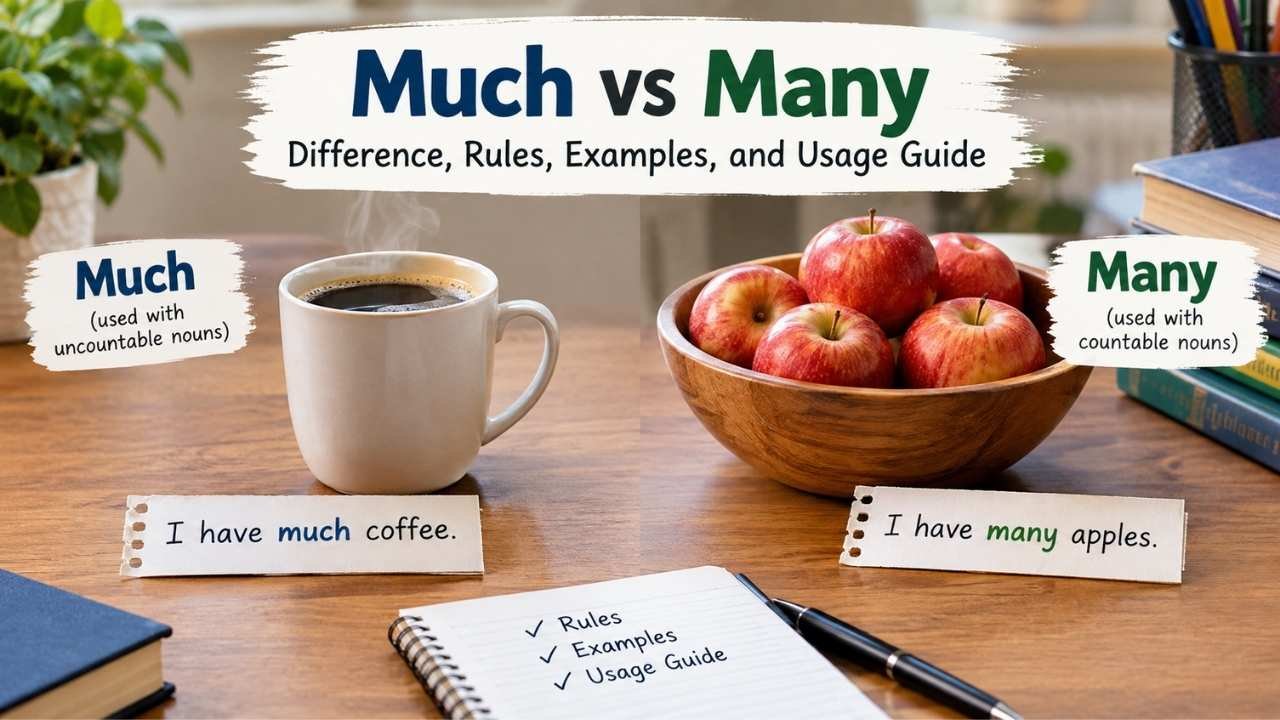
Understanding the difference between much vs many can be confusing, especially for English learners. Both words talk about quantity, but they are used in different situations. The main difference between much and many depends on the type of noun they describe.
We use much with uncountable nouns like time, money, and information, while we use many with countable plural nouns like books, people, and ideas. Learning the correct much vs many grammar rules can help you write and speak English more naturally.
In this guide, we will explain the difference between much and many, their meanings, usage rules, examples, and common mistakes so you can use these words correctly in everyday English.
Quick Answer
Much and many are both used to talk about quantity, but they are used with different types of nouns. Much is used with uncountable nouns like water, time, and money. Many is used with countable plural nouns like books, students, and ideas. Use how much for amounts and how many for numbers.
What Does Much Mean in English?
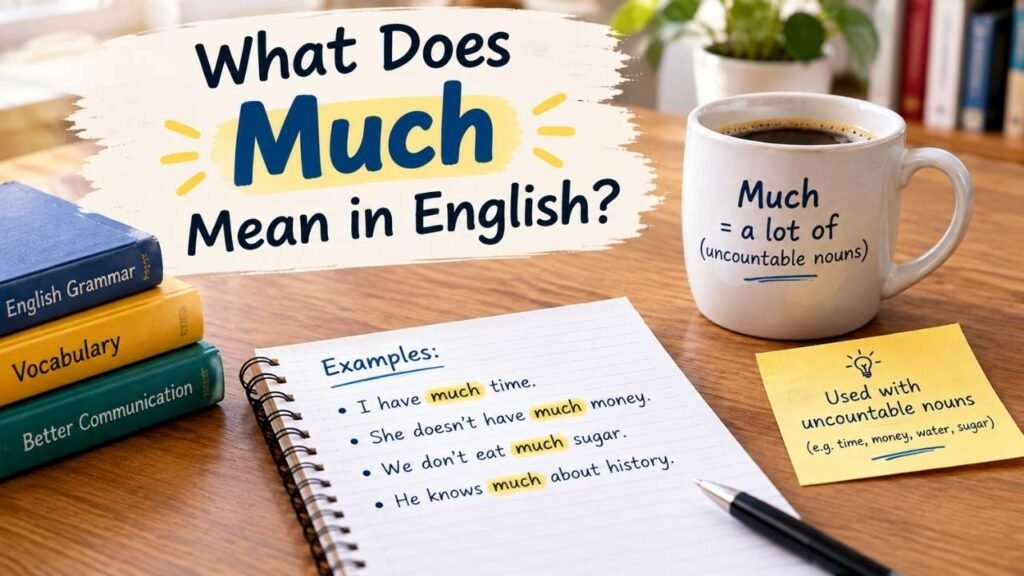
The word much means a large amount of something and is mainly used with uncountable nouns. These nouns cannot usually be counted as separate items. For example, we say much water, much time, and much information because these things are measured as amounts rather than numbers.
In English grammar, much often appears in questions and negative sentences. Examples include: “How much money do you need?” and “I do not have much time.”
Although much is grammatically correct in positive sentences, native speakers often use alternatives like “a lot of” in daily conversation. Learning the meaning of much helps you understand when to use it naturally.
What Does Many Mean in English?
The word many means a large number of something and is used with countable plural nouns. These are nouns that can be counted individually, such as books, people, cars, or questions.
For example, we say many students, many ideas, and many opportunities because each item can be counted. The word many is common in questions, negative sentences, and positive statements.
Examples include: “How many books do you have?” and “Many people enjoy learning English.” Understanding the meaning of many helps avoid common grammar mistakes. Remember that many focuses on the number of items, while much focuses on the amount of something.
Much vs Many: Key Differences at a Glance
The main difference between much and many is the type of noun they describe. Much is used for uncountable nouns, while many is used for countable plural nouns. This simple rule can help you choose the correct word in most situations.
For example, we say much information because information cannot be counted individually, but we say many facts because facts can be counted. We also use much time but many hours because hours are separate units.
Understanding this difference is important for clear English communication. When learning grammar topics, it also helps to compare related language concepts, such as Conjunction vs Contraction, because small differences can change meaning and usage.
Much vs Many Rules: When Should You Use Each One?
The basic much vs many grammar rules are easy to remember once you understand noun types. Use much before uncountable nouns when you talk about an amount. Examples include much advice, much knowledge, and much work.
Use many before plural countable nouns when you talk about numbers, such as many friends, many questions, and many examples. Both words are often used with words like “how,” “too,” and “so.”
For example, “How much sugar do you need?” and “How many students are in the class?” Understanding these patterns will help you avoid mistakes and improve your English writing. Similar sound-based language topics, like Assonance vs Rhyme, can also help learners notice differences between words.
Countable vs Uncountable Nouns: The Main Rule Behind Much and Many
The most important rule for using much and many is understanding the difference between countable and uncountable nouns. Countable nouns are things we can count using numbers, such as one book, two books, or three students.
These nouns usually work with many because they have plural forms. For example, we can say many books and many people. On the other hand, uncountable nouns describe things we cannot count separately, such as water, money, time, and information.
These nouns are used with much. For example, we say much water and much information. Knowing this simple rule makes it easier to choose between much vs many in everyday English.
How to Use Much and Many in Questions
One of the most common uses of much and many is in questions. When asking about an amount, we use how much with uncountable nouns.
For example, “How much milk do you need?” or “How much time do we have?” When asking about a number, we use how many with countable plural nouns.
For example, “How many students are in the classroom?” or “How many books did you buy?” The difference between how much and how many depends on whether the answer will be an amount or a number. Learning this rule will help you create correct questions and improve your understanding of much vs many grammar rules.
Using Much and Many in Negative Sentences
Both much and many are commonly used in negative sentences. In these sentences, they help explain that there is a small amount or a small number of something. We use much with uncountable nouns, and many with countable plural nouns.
For example, “I don’t have much money” means I have a small amount of money. Similarly, “She doesn’t have many friends” means she has a small number of friends. These examples show how much and many work differently depending on the noun type.
Remember that money, time, and advice are usually uncountable, while friends, books, and ideas are countable.
Can You Use Much in Positive Sentences?
Many learners wonder if much can be used in positive sentences. The answer is yes, but it is less common in everyday conversation. Grammatically, sentences like “I have much knowledge about this topic” are correct.
However, native speakers often prefer more natural alternatives like a lot of or lots of. For example, instead of saying “I have much experience,” many people say “I have a lot of experience.”
The word much is more common in formal writing, academic language, and certain expressions. Understanding this difference helps you use English more naturally and avoid sounding too formal in casual conversations.
Much vs Many vs A Lot Of: What Is the Difference?
The difference between much, many, and a lot of depends on the noun and the situation. Much is used with uncountable nouns, while many is used with countable plural nouns. The phrase a lot of can be used with both types of nouns and is very common in everyday English.
For example, we say much time, many hours, and a lot of time. We can also say many books and a lot of books. Although much and many are correct, native speakers often choose a lot of in positive sentences because it sounds more natural. Understanding these differences helps you communicate clearly.
Common Mistakes When Using Much and Many
Common Mistakes When Using Much and Many
Many English learners make mistakes when choosing between much and many because they may forget whether a noun is countable or uncountable. For example, the following sentences show some common errors:
❌ Much people attended the event.
✅ Many people attended the event.
Another common mistake is using many with an uncountable noun:
❌ Many information was provided.
✅ Much information was provided.
The same rule applies when asking about countable nouns. We say:
❌ How much books do you have?
✅ How many books do you have?
A simple way to remember the rule is that people, books, and ideas can be counted, so they take many. In contrast, information, advice, and money are uncountable and usually take much. Checking the noun first can help you avoid these common grammar mistakes.
Much and Many Examples in Everyday English
Using real examples is one of the best ways to understand much vs many. Here are some common sentences:
Much examples:
- I don’t have much time today.
- How much water should I drink?
- She doesn’t need much help.
Many examples:
- There are many students in the school.
- How many questions are on the test?
- Many people enjoy reading.
These examples show that much talks about an amount, while many talks about a number. In daily conversations, these words appear frequently, so learning their correct usage can improve both speaking and writing skills. Practicing with simple sentences is an effective way to remember the rules.
Practice Exercise: Choose Much or Many
Testing yourself is a great way to improve your understanding of much vs many. Choose the correct word in each sentence:
- How ___ money do you need?
- How ___ books are on the table?
- I don’t have ___ time today.
- There are ___ students in the classroom.
- She doesn’t have ___ information about the topic.
Answers:
- much
- many
- much
- many
- much
Practice exercises help you recognize whether a noun shows an amount or a number. With regular practice, choosing between much and many becomes easier and more natural.
FAQs
What is the difference between much and many?
Much is used with uncountable nouns, while many is used with countable plural nouns.
Is much used with countable nouns?
No, much is generally used with uncountable nouns like time, money, and water.
Is many used with uncountable nouns?
No, many is used with plural countable nouns like books, people, and ideas.
Can I use much in positive sentences?
Yes, but it often sounds formal. Many speakers prefer “a lot of” in casual English.
What is the difference between how much and how many?
How much asks about an amount, while how many asks about a number.
Which is correct: much people or many people?
The correct phrase is many people because people can be counted.
Can money be used with much or many?
Money is uncountable, so we use much money, not many money.
Conclusion
Understanding the difference between much vs many becomes easier when you remember one simple rule: much is used with uncountable nouns, and many is used with countable plural nouns. We use much for amounts like time, money, water, and information, while we use many for numbers like books, people, ideas, and questions.
Although both words talk about quantity, using the correct one helps your English sound clearer and more natural. Remember to check the noun before choosing between much and many.
With regular practice and by learning common examples, you can avoid mistakes and improve your grammar skills. Whether you are writing, speaking, or learning English, mastering these two words will make your communication more accurate.