
If you’ve ever wondered about the plural of axe, you’re not alone. Many English learners and native speakers ask whether the correct form is axes, axeses, or something else. The answer is simple, but it often causes confusion because axes can also be the plural of axis.
Understanding the difference depends on the context in which the word is used. You may also notice two spellings—axe and ax—which adds another layer of uncertainty. In this guide, you’ll learn the correct axe plural, the difference between axe vs. ax, and the grammar rule behind it.
We’ll also cover examples of axes in a sentence, explain common mistakes, and help you use the word with confidence in both British English and American English.
Quick Answer
The plural of axe is axes. This is the correct plural form in both British English (axe) and American English (ax). Although axes can also be the plural of axis, the meaning is clear from the context. If you’re wondering what is the plural of axe, the answer is always axes, and it is the standard form used in modern English.
What Does “Axe” Mean?
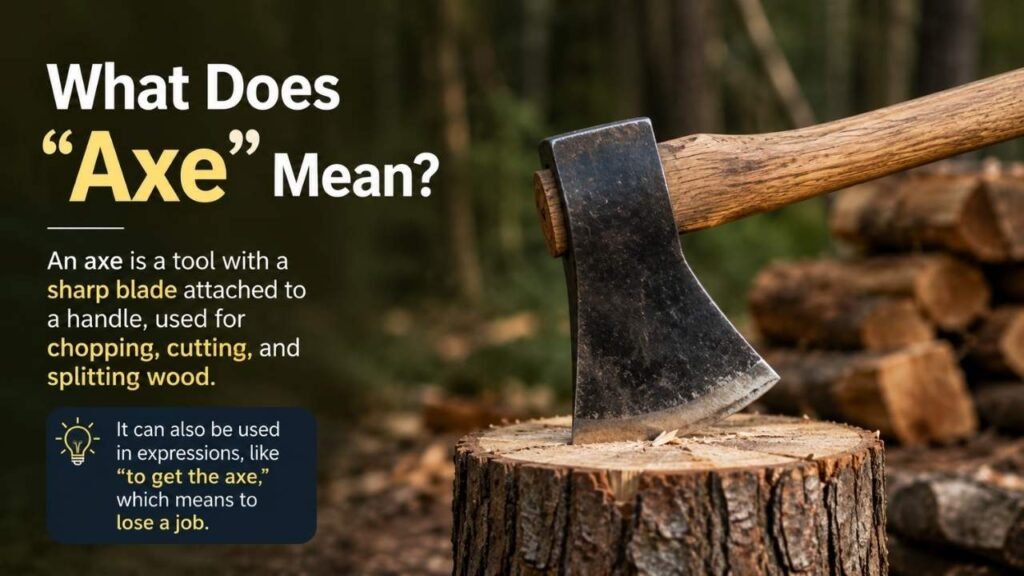
An axe is a countable noun that refers to a tool with a sharp metal blade attached to a wooden or metal handle. People use an axe for cutting wood, chopping trees, splitting logs, or shaping timber. In British English, the preferred spelling is axe, while American English often uses ax.
Both words have the same meaning and differ only in spelling. Besides its literal meaning, the word can also appear in figurative expressions, such as “to get the axe,” which means to lose a job or have something canceled.
Understanding the meaning of axe makes it easier to learn the plural of axe and use axes correctly in everyday writing and conversation.
What Is the Plural of Axe?
The plural of axe is axes. If you are asking, “What is the plural of axe?”, the correct answer is always axes. This rule applies whether you use the British English spelling axe or the American English spelling ax.
Since axe is a regular countable noun, its plural follows the normal English spelling pattern. You simply replace the ending with -es, forming axes. For example, you can say, “The workers carried several axes into the forest.“
If you enjoy learning similar grammar topics, you may also like our guide on Follow Up or Follow-Up, which explains another common English usage question in a clear and simple way.
Axe vs. Ax: What’s the Difference?
Many learners wonder about axe vs. ax because both spellings are correct. The main difference is the region where they are commonly used. Axe is the standard spelling in British English, while ax is more common in American English.
However, both dictionaries and style guides recognize each spelling, and neither changes the meaning of the word. No matter which version you choose, the plural form is always axes. It is best to stay consistent throughout your writing instead of switching between spellings.
If you’re interested in improving your grammar further, our article on Content vs Context explains another pair of commonly confused English words and when to use each correctly.
Why Is the Plural “Axes”?
The word axe becomes axes because it follows a common English plural noun rule. Many nouns ending with an “e” and an “x” sound take -es to form the plural. This spelling makes the word easier to pronounce and follows standard English grammar rules.
The same pattern appears in words like box → boxes and fox → foxes. Although some learners wonder if another axe plural exists, axes is the only correct standard form.
Dictionaries, grammar books, and language experts all agree on this spelling. Once you understand this rule, using the plural of axe becomes simple and natural in both speaking and writing.
Is “Axes” Ever Confusing?
Yes, axes can sometimes confuse readers because it has two different meanings. It is the plural of axe, but it is also the plural of axis, which is a mathematical or scientific term. Even though both words share the same spelling, the meaning becomes clear from the sentence.
For example, “The firefighters carried heavy axes” clearly refers to cutting tools, while “The graph has two axes” refers to lines on a chart. This is why context is important when reading or writing English.
Understanding this difference helps you avoid mistakes and use axes confidently in school assignments, professional writing, and everyday conversations.
Examples of “Axes” in Sentences
Seeing axes in real sentences is one of the best ways to remember the plural of axe. Here are a few simple examples. The campers packed two axes before heading into the forest. Several axes were displayed in the history museum.
The workers sharpened their axes before cutting firewood. The firefighters carried heavy axes to break through the door. In each sentence, axes refers to more than one axe or ax.
Remember that although axes can also be the plural of axis, the surrounding words make the meaning clear. Reading and writing examples like these will help you use the correct axe plural naturally and confidently in everyday English.
Common Mistakes People Make
Many learners make small mistakes when using the plural of axe. One common error is writing axe when they actually mean more than one tool. Another mistake is thinking the plural should be axeses or another unusual spelling.
The only correct plural form is axes. Some people also confuse axes with the plural of axis, even though the meaning is different. Another mistake is mixing axe and ax in the same piece of writing.
Choose one spelling and use it consistently. Paying attention to these details will improve your English grammar, make your writing clearer, and help readers understand exactly what you mean.
Similar Nouns That Follow the Same Plural Pattern
The plural of axe follows the same pattern as many other English nouns that add -es to form the plural. Learning these words together makes the grammar rule easier to remember.
Here are a few common examples: box → boxes, fox → foxes, church → churches, match → matches, and bush → bushes. Like axe → axes, these words take -es instead of just -s. They are all countable nouns that follow standard English grammar rules.
Practicing these examples together helps you recognize similar spelling patterns and improves your confidence when forming plural nouns in both writing and everyday conversation.
Pronunciation of Axe and Axes
Correct pronunciation is just as important as correct spelling. The word axe is pronounced as /æks/, while axes is pronounced as /ˈæk.sɪz/. The extra syllable in axes makes it easy to hear that the word is plural.
Whether you write axe in British English or ax in American English, the pronunciation of the plural remains almost the same. Listening to native speakers or dictionary audio recordings can help you become more comfortable with these words.
Saying them aloud while reading example sentences is another simple way to improve your pronunciation and remember the correct plural of axe.
Quick Comparison Table
The table below gives a quick overview of the singular and plural forms, making it easy to remember the correct spelling.
| Singular | Plural | Region |
| axe | axes | British English |
| ax | axes | American English |
Both spellings are correct, but they are used in different regions. The important point is that the plural of axe and the plural of ax are both axes. If you are writing for a British audience, use axe. If your audience is mainly American, ax is also acceptable.
Staying consistent with your chosen spelling will make your writing look more professional and easier to read.
FAQs
Is axes the correct plural of axe?
Yes. Axes is the only correct plural of axe in modern English.
Is ax a correct spelling?
Yes. Ax is commonly used in American English, while axe is more common in British English.
Can axes have more than one meaning?
Yes. Axes can refer to more than one axe or more than one axis. The sentence context tells you which meaning is intended.
Should I use axe or ax?
Use the spelling that matches your audience, but stay consistent throughout your writing.
Conclusion
The plural of axe is axes, and this rule applies whether you use axe or ax. While the two spellings reflect different regional preferences, their plural form stays the same. It is also helpful to remember that axes can refer to either multiple cutting tools or multiple axes in mathematics, depending on the context.
By understanding the grammar rule, practicing with real examples, and avoiding common mistakes, you can use this word with confidence.
Whenever someone asks, “What is the plural of axe?”, you’ll know that axes is the correct answer and the standard form accepted in modern English grammar.