
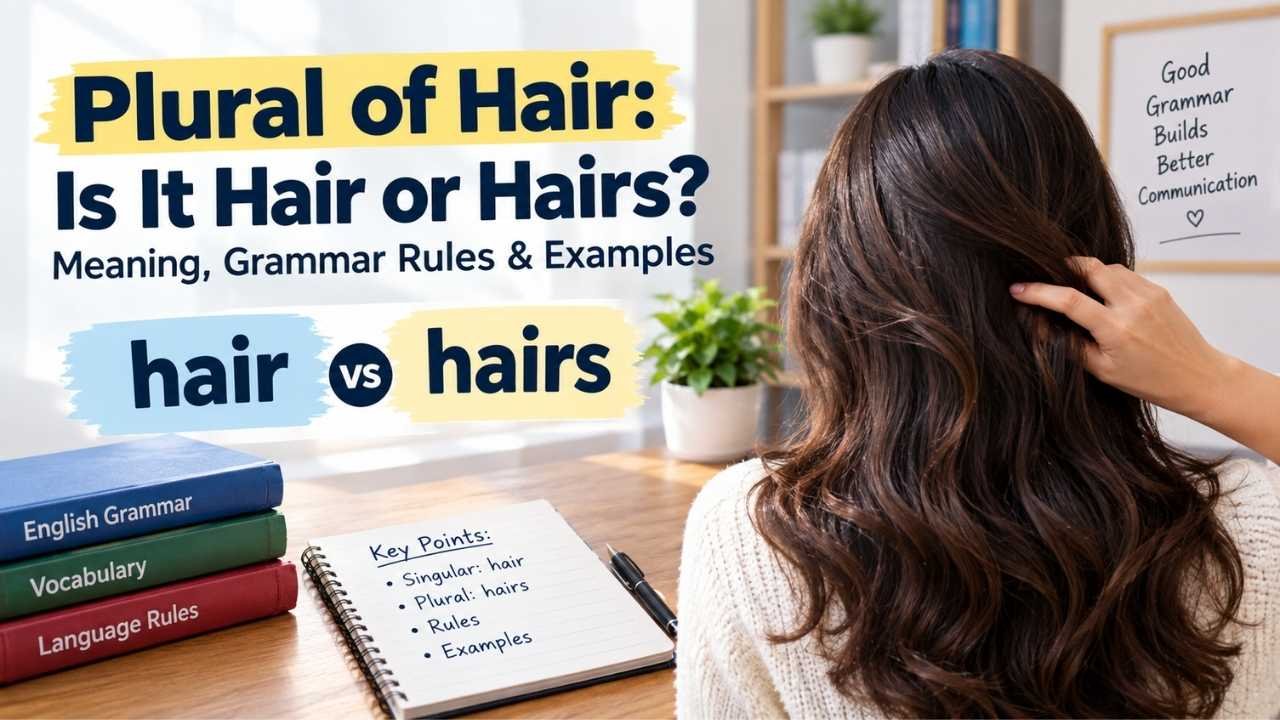
Have you ever wondered what the plural of hair is? Many English learners ask whether the correct form is hair or hairs, and the answer can be confusing because both are correct in different situations. In everyday English, hair usually refers to all the hair on a person’s head or body, while hairs refers to individual strands that can be counted.
Understanding this small grammar rule can help you speak and write more naturally. In this guide, you’ll learn what is the plural of hair, the difference between hair vs. hairs, and whether hair is countable or uncountable.
We’ll also explain when to use hair and when to use hairs, share simple grammar rules, provide plenty of real-life examples, and point out common mistakes so you can use both forms with confidence.
Quick Answer
The plural of hair can be hair or hairs, depending on the context. Hair usually acts as an uncountable noun when referring to all the hair on a person’s head or body. Hairs is the plural form used for individual strands that can be counted. Knowing the difference between hair vs. hairs helps you use both forms correctly in everyday English.
What Does “Hair” Mean?
Hair is a noun that refers to the thin strands growing from the skin of humans and many animals. In most situations, hair describes all the strands together as one whole, which is why it usually acts as an uncountable noun.
For example, we say, “She has long hair,” instead of “She has long hairs.” However, when talking about separate strands, the meaning changes. Learning the hair meaning makes it easier to understand the plural of hair and use it correctly in different situations.
If you enjoy learning about English word forms, you may also like our guide on the Plural of Axe, which explains another interesting plural rule in English grammar.
What Is the Plural of Hair?
Many learners ask, “What is the plural of hair?” The answer depends on what you are describing. In everyday English, hair often stays the same because it refers to all the hair on a person’s head or body as a group.
However, hairs is the correct plural form of hair when you mean individual strands that can be counted. For example, “There are two hairs on my shirt” is correct because you can count each strand.
Understanding this simple grammar rule helps you avoid mistakes and improves your writing. Knowing when to use hairs and when to keep hair unchanged is an important part of learning English naturally.
Hair vs. Hairs: What’s the Difference?
The difference between hair vs. hairs is easier than many people think. Hair refers to hair as a whole, while hairs refers to individual strands. Imagine someone says, “Your hair looks beautiful.”
They are talking about the person’s hairstyle or all the hair together. Now imagine someone notices a few hairs on a pillow. In this case, each strand is counted separately. This is why both forms are correct, depending on the situation.
Understanding the difference between hair and hairs will help you choose the right word with confidence. Just as understanding Content vs Context improves communication, knowing this grammar difference helps make your English clearer and more accurate.
Is “Hair” Countable or Uncountable?
One reason people get confused is that hair can be both countable and uncountable depending on the meaning. Usually, hair is an uncountable noun because it refers to all the hair on someone’s head or body.
You cannot normally count it this way. However, when you talk about individual strands, it becomes countable, and the plural is hairs.
For example, “She has beautiful hair” uses the uncountable form, while “I found three hairs in the sink” uses the countable form. Understanding is hair countable or uncountable is one of the most important grammar rules for using this word correctly in everyday English.
When Should You Use “Hair”?
Use hair whenever you are talking about someone’s hairstyle, the hair on their head, body hair in general, or the concept of hair as a whole. Since it usually works as an uncountable noun, you do not add an -s in these situations.
For example, “His hair is curly,” “My hair grows quickly,” and “She washed her hair this morning” are all correct. These examples show when to use hair naturally in everyday conversation and writing.
Remember that hair focuses on the complete collection rather than individual strands. Once you understand this rule, deciding between hair and hairs becomes much easier and more natural.
When Should You Use “Hairs”?
Use hairs when you are talking about individual strands that you can count. This usually happens when only a few strands are being mentioned instead of all the hair together.
For example, you might say, “I found two hairs on my jacket,” or “The scientist examined several hairs under a microscope.” In both examples, each strand is counted separately. This is the correct answer for anyone wondering is hairs grammatically correct.
Yes, it is correct when referring to countable strands. Knowing when to use hairs helps you avoid common grammar mistakes and makes your English sound more natural, accurate, and confident in both speaking and writing.
Examples of Hair and Hairs in Sentences
The best way to understand hair vs. hairs is by seeing both words in real-life examples. Use hair when talking about all the hair on a person’s head or body. Use hairs when referring to separate strands that can be counted.
Here are a few examples: She has long, shiny hair. His hair turned gray over the years. I found two hairs on my sweater. The dog left a few hairs on the couch. The scientist studied several hairs under a microscope.
These examples show what is the plural of hair and make it easier to remember the rule. Reading and practicing sentences like these will help you use both forms naturally in everyday English.
Common Grammar Mistakes with Hair
Many English learners make mistakes because they are unsure when to use hair and when to use hairs. One common error is saying, “She has beautiful hairs.” This is incorrect because you are talking about all the hair together, so hair should be used.
Another mistake is saying, “There is a hair on my shirt,” when several strands are visible. In that case, hairs is the better choice if you are counting them.
Some learners also ask, “Can hair be plural?” The answer is yes, but only when referring to individual strands. Remembering whether hair is countable or uncountable will help you avoid these common grammar mistakes.
Hair in Common Expressions and Idioms
The word hair appears in many popular English expressions and idioms. Learning these phrases helps you understand how native speakers use the word in daily conversations. For example, “split hairs” means to argue about very small details that are not important.
“Let your hair down” means to relax and enjoy yourself after working hard. If someone says, “keep your hair on,” they mean “stay calm.” Another common expression is “make your hair stand on end,” which describes something very scary.
You may also hear “bad hair day,” which refers to a day when your hair is difficult to manage or when everything seems to go wrong. These expressions always use hair, not hairs.
Hair in Scientific, Medical, and Beauty Contexts
In science, medicine, and the beauty industry, both hair and hairs are used, but their meanings are slightly different. Doctors and scientists often examine individual hairs when studying health conditions, DNA, or hair growth.
They count each strand separately, so the plural hairs is correct. In beauty salons, however, people usually talk about hair as a whole. For example, a stylist may say, “Your hair needs more moisture,” because they are discussing all of your hair together.
Understanding these professional examples helps explain the difference between hair and hairs and shows that choosing the correct form always depends on the context and the meaning you want to express.
Quick Grammar Tips to Remember
Remembering the plural of hair becomes easy once you know one simple rule. If you are talking about all the hair on someone’s head or body, use hair because it usually acts as an uncountable noun. If you are talking about separate strands that you can count, use hairs.
A helpful memory trick is this: one hairstyle, many strands. The hairstyle is hair, while the individual strands are hairs.
Before choosing a word, ask yourself, “Am I describing all the hair together or counting separate strands?” This quick question will help you choose the correct form and improve your grammar in both speaking and writing.
FAQs
Is hairs grammatically correct?
Yes. Hairs is correct when referring to individual strands that can be counted.
What is the plural of hair?
The plural can be hair or hairs, depending on the context and meaning.
Is hair singular or plural?
Hair is usually treated as a singular uncountable noun, but it can have the plural form hairs when talking about individual strands.
Can I say “three hairs”?
Yes. Since you are counting separate strands, three hairs is the correct expression.
Why is hair usually uncountable?
Because it normally refers to all the hair on a person’s head or body as one whole instead of individual strands.
What is the difference between hair and hairs?
Hair refers to the complete collection, while hairs refers to countable strands.
Can hairs be used in formal writing?
Yes. It is common in scientific, medical, and technical writing when discussing individual strands.
Conclusion
Understanding the plural of hair is much easier once you know the difference between hair and hairs. In most everyday situations, hair is an uncountable noun that refers to all the hair on a person’s head or body.
When you are counting individual strands, hairs becomes the correct plural form. This simple rule helps you avoid common grammar mistakes and makes your English sound more natural.
Whenever you are unsure, think about whether you are describing the whole collection or counting separate strands. With regular practice and real-life examples, you’ll quickly know when to use hair and when to use hairs, giving you greater confidence in both speaking and writing.