
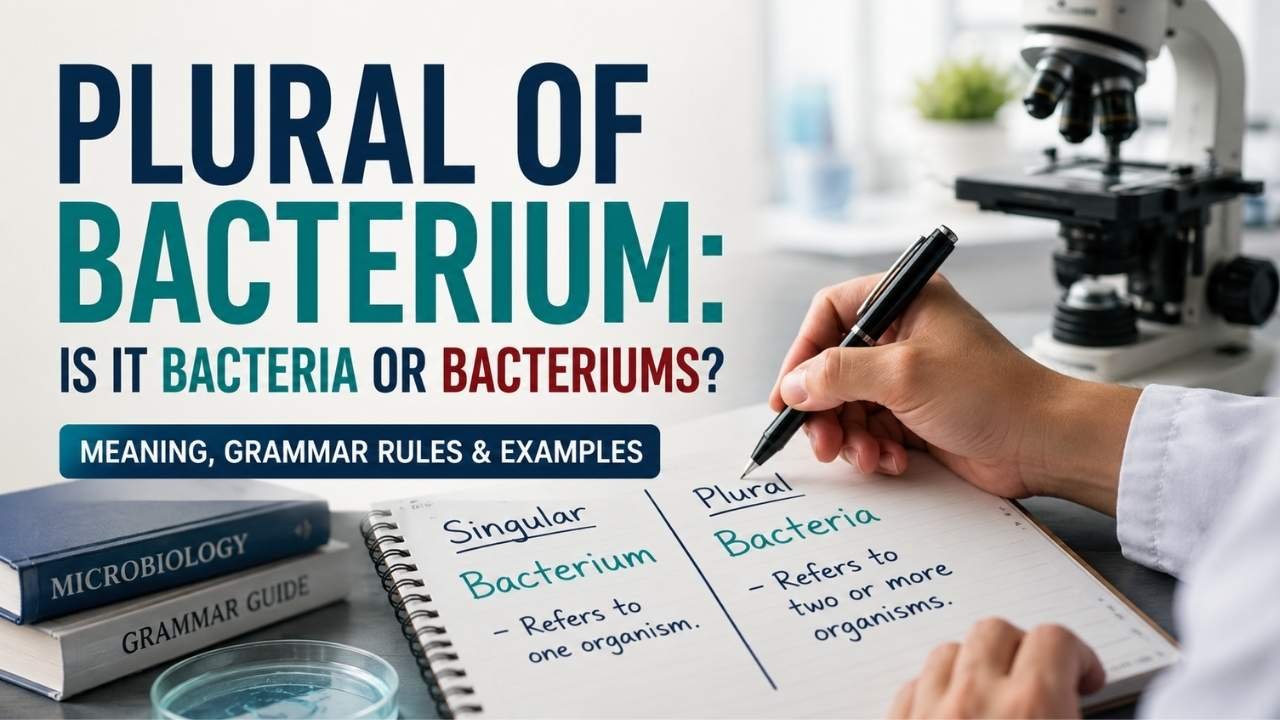
Have you ever wondered whether the plural of bacterium is bacteria or bacteriums? This question often confuses students, writers, and even professionals because bacteria is commonly used in everyday conversations, while bacterium appears more often in scientific writing. Understanding the difference is important if you want to use these terms correctly.
In simple words, bacterium is the singular form, and bacteria is the standard plural form. In this guide, you’ll learn the meaning of bacterium, the meaning of bacteria, why this word follows a unique grammar rule, and how to avoid common mistakes.
We’ll also compare bacterium vs. bacteria, explain why bacteria is plural, and provide clear sentence examples to help you use both words with confidence in academic, professional, and everyday English.
Quick Answer
The plural of bacterium is bacteria. A bacterium refers to a single microscopic organism, while bacteria refers to two or more. This plural form comes from Latin grammar, where many nouns ending in -um change to -a in the plural. Using bacteria correctly helps improve both scientific and everyday English writing.
What Does Bacterium Mean?

A bacterium is a single microscopic organism that belongs to a large group of living things called bacteria. It is so small that you need a microscope to see it. Some bacteria are helpful because they support digestion, make food like yogurt, and help break down waste in nature.
Others can cause illnesses and infections. Knowing the meaning of bacterium makes it easier to understand why its plural form is different. Since bacterium refers to only one organism, it is always treated as a singular noun.
When talking about more than one, you should use bacteria instead. If you enjoy learning the differences between similar terms, you may also like our guide on Analogy vs Simile, which explains another commonly confused pair of words.
What Is the Plural of Bacterium?
The correct plural of bacterium is bacteria. This is the standard form used in scientific writing, schools, dictionaries, and everyday English. Although some people wonder whether bacteriums is correct, bacteria is the accepted plural because the word comes from Latin.
In Latin, many nouns ending in -um change to -a in the plural. That is why bacterium becomes bacteria instead of adding -s. Learning this grammar rule helps you avoid common writing mistakes and improves your confidence when using scientific terms.
Whether you are writing a school assignment, reading a biology book, or creating professional content, using bacteria as the plural form is the correct and widely accepted choice.
Is Bacteria Singular or Plural?
Many people ask, “Is bacteria singular or plural?” The answer is simple: bacteria is plural, while bacterium is singular. If you are talking about one microscopic organism, use bacterium. If you mean two or more, use bacteria. This difference also affects your verbs.
For example, you would write, “The bacterium grows quickly,” but “The bacteria grow quickly.” Matching the correct noun with the correct verb makes your writing clear and grammatically correct.
In everyday conversation, people sometimes use bacteria as if it were singular, but this is not considered correct in formal English. Remembering this simple rule will help you communicate more accurately in both academic and general writing.
| Singular | Plural |
| Bacterium | Bacteria |
Bacterium vs. Bacteria: What’s the Difference?
The difference between bacterium vs. bacteria is easy to understand once you know that one is singular and the other is plural. Bacterium refers to one microscopic organism, while bacteria refers to two or more organisms.
The meaning does not change, only the number does. This is similar to words like child and children, where the plural form looks different from the singular. Understanding this difference helps you avoid grammar mistakes and makes your writing sound more professional.
If you enjoy learning about commonly confused words, you might also find our article on Trash vs Garbage helpful. Like bacterium and bacteria, it explains when different words should be used and how context affects their meaning.
| Feature | Bacterium | Bacteria |
| Number | Singular | Plural |
| Meaning | One microscopic organism | Two or more microscopic organisms |
| Grammar | Singular noun | Plural noun |
| Example | The bacterium was observed. | The bacteria were observed. |
Why Does Bacterium Become Bacteria?
The reason bacterium becomes bacteria is that the word comes from Latin. In Latin, many nouns ending in -um change to -a when they become plural. This grammar rule has been kept in English, especially for scientific and academic words.
That is why the plural of bacterium is bacteria, not bacteriums. Understanding this pattern also helps you learn other similar words more easily. While many English nouns simply add -s or -es, some words borrowed from Latin keep their original plural forms.
Once you know this rule, it becomes much easier to remember the correct form and avoid common grammar mistakes in both everyday and professional writing.
How to Use Bacterium and Bacteria in Sentences
Knowing the difference between bacterium and bacteria is only the first step. You should also know how to use each word correctly in sentences. Use bacterium when talking about one microorganism and bacteria when referring to more than one. Choosing the correct form makes your writing clear and grammatically correct.
Examples with bacterium:
- The bacterium was found in the water sample.
- Scientists examined a bacterium under a microscope.
- Each bacterium has its own structure.
Examples with bacteria:
- The bacteria grow quickly in warm conditions.
- Some bacteria help produce yogurt and cheese.
- Doctors tested the bacteria to identify the infection.
Common Mistakes to Avoid
Many writers make small mistakes when using bacterium and bacteria, but they are easy to avoid once you understand the grammar rule. One common mistake is using bacteria as a singular noun.
For example, writing “The bacteria is dangerous” is incorrect. The correct sentence is “The bacterium is dangerous” for one organism or “The bacteria are dangerous” for more than one. Another mistake is writing bacteriums instead of bacteria.
Although it may sound natural, bacteria is the accepted plural form in standard English. Always make sure your subject and verb agree. Following these simple rules will make your writing more accurate, especially in scientific, academic, and professional contexts.
Similar Latin Plurals You Should Know
The plural of bacterium follows the same pattern as many other Latin words used in English. Learning these words together can help you remember the grammar rule more easily. Instead of adding -s, these nouns change their endings to form the plural. You will often see these words in education, science, medicine, and professional writing.
| Singular | Plural |
| Bacterium | Bacteria |
| Datum | Data |
| Criterion | Criteria |
| Medium | Media |
| Curriculum | Curricula |
| Memorandum | Memoranda |
Recognizing these patterns makes it easier to use irregular plural nouns correctly and improves both your grammar and vocabulary.
How Scientists Use the Terms Differently from Everyday English
In everyday conversations, people often use bacteria to talk about germs in general. For example, someone might say, “The bacteria on the kitchen counter should be cleaned.” While this is common, scientists use the terms more precisely.
In biology and microbiology, bacterium always refers to one microscopic organism, and bacteria always refers to more than one. Scientific papers, research articles, and medical reports follow this rule carefully because accuracy is important.
Using the correct form helps prevent confusion, especially when describing experiments or discussing diseases. Whether you are writing a school report or reading scientific information, understanding the difference between bacterium and bacteria will make the content easier to understand and your writing more reliable.
Pronunciation of Bacterium and Bacteria
Correct pronunciation helps you speak with confidence, especially during presentations, classes, or discussions. Although bacterium and bacteria look similar, they are pronounced slightly differently.
| Word | Pronunciation |
| Bacterium | bak-TEER-ee-um |
| Bacteria | bak-TEER-ee-uh |
The biggest difference is in the ending. Bacterium ends with “-um,” while bacteria ends with “-uh.” Listening to native speakers or using an online dictionary with audio can help you master the pronunciation.
Saying these words correctly also makes it easier to remember that bacterium is singular and bacteria is plural.
FAQs
What is the plural of bacterium?
The correct plural of bacterium is bacteria. It follows a Latin grammar rule where nouns ending in -um usually change to -a in the plural.
Is bacteria singular or plural?
Bacteria is a plural noun. The singular form is bacterium.
Can I say bacteriums?
In standard English and scientific writing, bacteria is the accepted plural. Bacteriums is rarely used and is generally avoided.
What does bacterium mean?
A bacterium is a single microscopic organism that can be helpful or harmful, depending on its type.
Why is bacteria plural?
The word comes from Latin, where many nouns ending in -um form their plural by changing to -a.
How do I use bacterium in a sentence?
Example: The bacterium was identified during the laboratory test.
How do I use bacteria in a sentence?
Example: The bacteria were growing rapidly in the warm environment.
Are all bacteria harmful?
No. Many bacteria are beneficial and play important roles in digestion, food production, and maintaining healthy ecosystems.
Key Takeaways
Understanding the plural of bacterium is simple once you know the basic grammar rule. Bacterium refers to one microscopic organism, while bacteria refers to two or more. Because the word comes from Latin, its plural changes from -um to -a instead of adding -s.
Remember to match your verbs correctly by writing “the bacterium is” and “the bacteria are.”
Using these forms properly improves your grammar and helps you communicate clearly in academic, scientific, and everyday writing. Keeping this rule in mind will help you avoid one of the most common mistakes involving scientific vocabulary.
Conclusion
The plural of bacterium is bacteria, and using these terms correctly is important for both clear communication and proper grammar. Although many people confuse the two forms, the rule is easy to remember: bacterium is singular, and bacteria is plural.
Since these words come from Latin, they follow a special plural pattern that is common in scientific vocabulary. By learning their meanings, understanding the grammar rule, and practicing with real examples, you can use both words confidently in any situation.
Whether you are writing a school assignment, reading scientific articles, or improving your English skills, knowing the difference between bacterium and bacteria will help you write more