
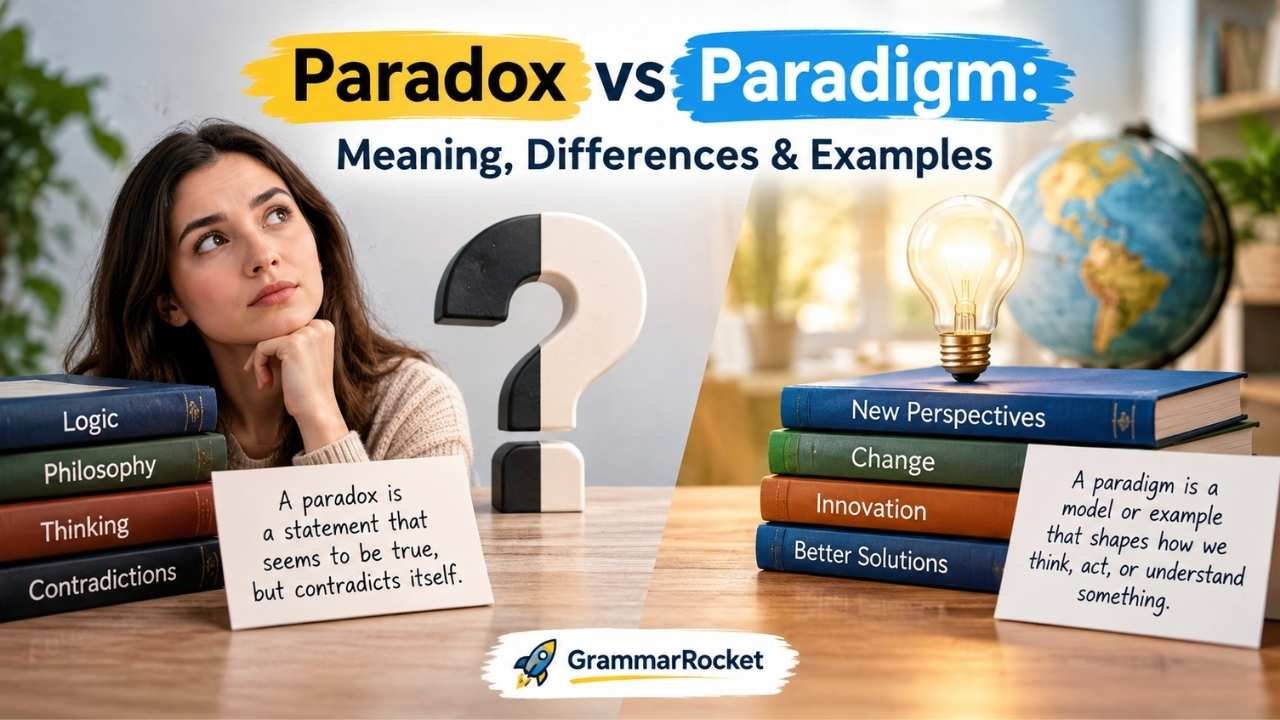
Have you ever come across the words paradox vs paradigm and wondered if they mean the same thing? Although they may look and sound somewhat similar, they describe completely different ideas.
Understanding the difference between paradox and paradigm can help you communicate more clearly in school, at work, and in everyday conversations. A paradox is a statement or situation that seems contradictory but may reveal a deeper truth, while a paradigm is a model, pattern, or way of thinking that shapes how people understand the world.
In this guide, you’ll learn the paradox meaning, paradigm meaning, clear definitions, practical examples, and tips on how to use paradox and paradigm correctly. By the end, you’ll confidently know when to use each word and avoid one of the most common vocabulary mix-ups.
Quick Answer
The difference between paradox and paradigm is simple: a paradox is a statement or situation that appears to contradict itself but may contain a deeper truth, while a paradigm is a model, framework, or way of thinking that shapes how people understand ideas or solve problems. They are not interchangeable and are used in different contexts.
Paradox vs. Paradigm at a Glance
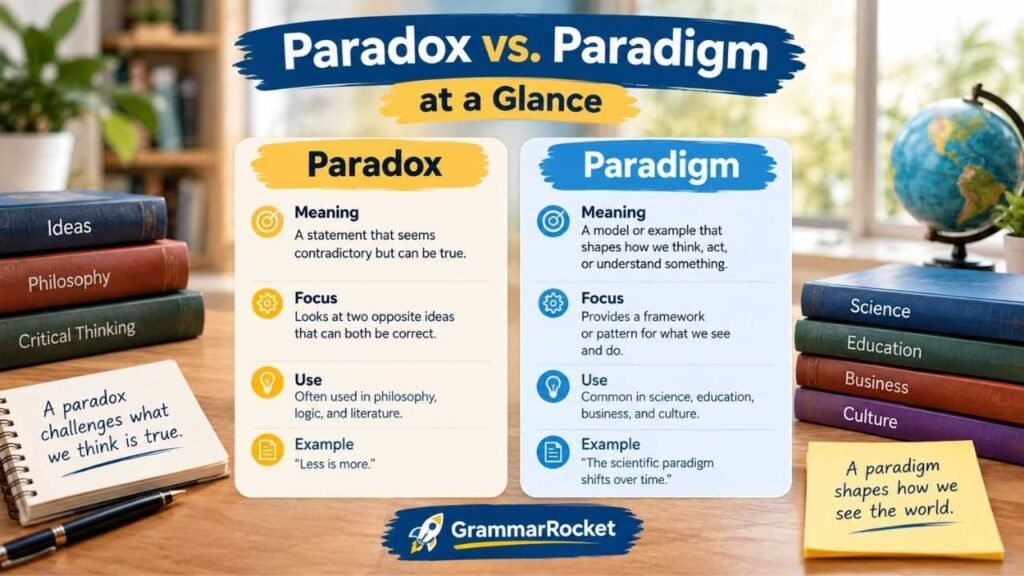
Although paradox and paradigm are sometimes confused because of their similar spelling, they have very different meanings. A paradox is a statement or situation that seems impossible or contradictory but may actually reveal a deeper truth.
A paradigm, on the other hand, is a model, framework, or way of thinking that guides how people understand ideas or solve problems. If you are wondering what is the difference between paradox and paradigm, the easiest way to remember it is that one challenges logic, while the other shapes thinking.
They are not interchangeable and are used in different contexts, including literature, science, philosophy, education, and business. The comparison table below gives a quick overview before we explore each word in detail.
| Feature | Paradox | Paradigm |
| Meaning | A statement or situation that seems contradictory but may be true | A model, framework, or pattern of thinking |
| Purpose | Challenges logic or reveals a hidden truth | Helps explain or organize ideas |
| Common Fields | Literature, philosophy, logic | Science, education, business, psychology |
| Example | “Less is more.” | The scientific method is a common paradigm. |
| Interchangeable? | No | No |
What Does “Paradox” Mean?
A paradox is a statement, idea, or situation that appears to contradict itself but may contain a hidden truth. The paradox meaning comes from the Greek word paradoxos, which means “contrary to expectation.”
You will often see paradoxes in literature, philosophy, logic, and everyday conversations because they encourage people to think more deeply. A famous example is “The only constant is change.”
At first, the sentence sounds impossible, but it expresses an important truth about life. Learning the paradox definition with examples makes it easier to recognize this figure of speech in reading and writing. If you enjoy exploring literary devices, you may also like our guide on Oxymoron vs. Juxtaposition, which explains another pair of commonly confused terms.
What Does “Paradigm” Mean?
A paradigm is a model, pattern, or way of thinking that influences how people understand the world. The paradigm meaning is often connected with science, education, business, and psychology, where people use established frameworks to solve problems or explain ideas.
One of the most common expressions is paradigm shift, which describes a major change in thinking or accepted beliefs. For example, moving from printed books to digital learning changed the educational paradigm in many places.
Understanding the paradigm definition with examples helps you see why this word is different from paradox. While paradox questions what seems true, a paradigm provides a structure for understanding reality. Both words are useful, but they serve completely different purposes.
The Key Differences Between Paradox and Paradigm
The difference between paradox and paradigm becomes clear when you compare their purpose and usage. A paradox presents an apparent contradiction that encourages deeper thinking, while a paradigm offers a framework or model that shapes ideas and decisions.
For example, saying “silence speaks louder than words” is a paradox because it sounds contradictory but carries meaning. In contrast, a company following a customer-first business model is working within a paradigm.
Knowing how to use paradox and paradigm correctly helps you communicate with confidence in both academic and everyday writing. If you enjoy learning about precise word usage, you might also find our article on the Plural of Prosthesis helpful, as it explains another commonly misunderstood English term.
When Should You Use “Paradox”?
Use paradox when you want to describe a statement or situation that seems impossible at first but reveals a deeper truth after careful thought. Writers often use paradoxes to make readers stop and think, while speakers use them to express complex ideas in a memorable way.
You may find a paradox in literature, philosophy, speeches, and even daily conversations. For example, “The more you learn, the more you realize how little you know” is a well-known paradox.
It sounds contradictory but expresses a meaningful idea about knowledge. If you are unsure when to use paradox, ask yourself whether the statement appears to conflict with itself while still making sense after closer examination.
When Should You Use “Paradigm”?
Use paradigm when talking about a model, framework, or established way of thinking. This word is common in science, education, technology, business, and social studies because it explains how people organize knowledge or approach problems.
For example, remote work has created a new workplace paradigm for many companies around the world. The phrase paradigm shift is especially popular because it describes a major change in beliefs, methods, or systems.
If you are wondering how to use paradigm, think about whether you are referring to a pattern or structure rather than a contradiction. Choosing the right word helps your writing sound more accurate and professional while avoiding confusion between these two similar-looking terms.
Can Paradox and Paradigm Ever Be Confused?
Yes, paradox and paradigm are often confused, especially by English learners and new writers. The main reason is that the words have a similar spelling and both appear in academic writing. However, their meanings are completely different.
A paradox is an apparent contradiction that may reveal a deeper truth, while a paradigm is a framework or model used to understand ideas or solve problems. They are not synonyms and should never be used interchangeably. If you are unsure which word to choose, think about the context.
Are you describing a surprising contradiction? Use paradox. Are you referring to a way of thinking or an established model? Use paradigm. This simple check can help you avoid common vocabulary mistakes.
Common Mistakes and Incorrect Usage
Many people make mistakes because they focus on how the words look instead of what they mean. One common error is using paradigm when talking about a surprising contradiction. For example, saying, “The statement is a paradigm,” is incorrect if you mean it seems impossible but is true.
The correct word is paradox. Another mistake is calling a scientific model a paradox when it is actually a paradigm. Before choosing a word, ask yourself whether you are describing a contradiction or a framework.
Reading paradox vs. paradigm examples can also improve your understanding. With regular practice, you will learn to recognize the correct word quickly and use it naturally in both writing and conversation.
Memory Trick to Remember the Difference
A simple memory trick can make it easy to remember the difference between paradox and paradigm. Think of the letter “X” in paradox as representing a crossing or conflict. A paradox contains ideas that seem to clash, even though they may reveal a deeper truth.
Now think of the letter “M” in paradigm as standing for model. A paradigm is a model or framework that guides how people think or work.
You can also remember that paradigm shift refers to changing a model, not solving a contradiction. These easy word connections help you remember paradox meaning and paradigm meaning whenever you see the words in books, articles, or everyday conversations.
Related Terms You Shouldn’t Confuse
Besides paradox and paradigm, several other English terms are commonly mixed up. A paradox is different from an oxymoron, which joins two opposite words, such as “deafening silence.” It is also different from irony, where the actual result is different from what people expect. Likewise, a paradigm is not exactly the same as a model or a theory.
A model is often a practical representation, while a theory explains why something happens. A paradigm is broader because it shapes the overall way people think about a subject.
Understanding these related terms builds a stronger vocabulary and helps you choose the most accurate word in every situation.
FAQs
Is paradox the same as paradigm?
No. A paradox is an apparent contradiction that may contain a deeper truth, while a paradigm is a model or framework for understanding ideas.
Can paradox and paradigm be used interchangeably?
No. They have different meanings and are used in different situations. Choosing the correct word depends on the context.
What is a paradigm shift?
A paradigm shift is a major change in the way people think, understand, or approach a subject. It often happens in science, business, education, and technology.
What is a famous paradox?
One well-known paradox is “Less is more.” Although it sounds contradictory, it suggests that simplicity can often produce better results.
Where is paradox commonly used?
A paradox appears in literature, philosophy, speeches, and everyday language to express ideas that encourage deeper thinking.
Where is paradigm commonly used?
A paradigm is widely used in science, psychology, business, education, and technology to describe a guiding model or pattern of thinking.
How can I remember the difference?
Remember that paradox involves a contradiction, while paradigm refers to a model or framework. The memory trick in this guide makes them easier to distinguish.
Conclusion
Understanding the difference between paradox and paradigm is easier once you focus on what each word represents. A paradox challenges your thinking by presenting an idea that seems contradictory but may reveal an important truth.
A paradigm, on the other hand, provides a framework or way of thinking that helps explain concepts and solve problems. Although the words look somewhat alike, they have very different meanings and should never be used interchangeably.
By learning their definitions, studying real-life examples, and practicing their use in different contexts, you can improve your vocabulary and write with greater confidence. The next time you see these words, you’ll know exactly which one fits the situation and why.