
Knowing when to use a hyphen can make your writing clearer and easier to understand. A hyphen (-) is a small punctuation mark, but it plays a big role in English grammar. It connects words to form compound words and compound adjectives, helping readers understand your meaning without confusion.
For example, high-quality product and well-known author are much clearer than writing the words separately. However, hyphen rules are not always simple. Some words need a hyphen only in certain situations, while others never do.
Different style guides and dictionaries may also recommend different forms. In this guide, you’ll learn when to use a hyphen, when not to use a hyphen, common grammar rules, practical examples, and the most frequent mistakes to avoid. By the end, you’ll feel confident using hyphens correctly in everyday writing.
Quick Answer
A hyphen (-) joins two or more words to create a compound word or compound adjective, making your writing clearer and easier to read. Use a hyphen in compound modifiers before a noun, certain prefixes, numbers from twenty-one to ninety-nine, and some fractions. Do not use a hyphen where grammar rules or your chosen style guide say it isn’t needed.
What Is a Hyphen?
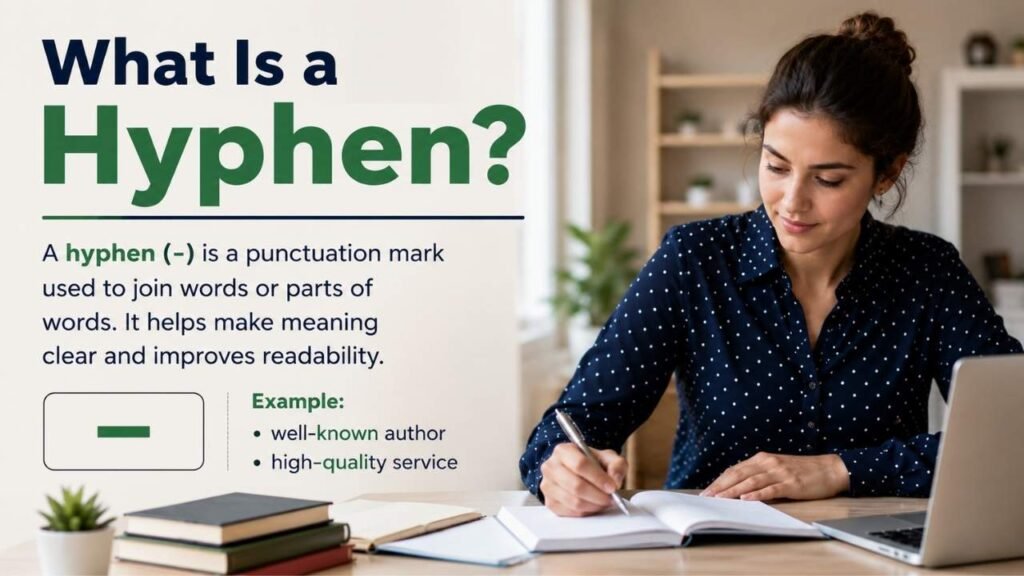
A hyphen (-) is a punctuation mark that joins two or more words to create a compound word or compound adjective. Its main purpose is to make writing clearer and prevent confusion. For example, well-known author describes an author, while the author is well known does not need a hyphen.
Learning when to use a hyphen helps readers understand your meaning quickly. You may also see hyphens in compound numbers, certain prefixes, and some fractions. Although dictionaries and style guides sometimes have different preferences, the basic hyphen rules remain the same.
Understanding these rules will improve your grammar and make your writing look more polished and professional in school, business, and everyday communication.
Why Hyphens Matter in Writing
Using a hyphen correctly improves both clarity and readability. It helps readers understand which words belong together and prevents sentences from having two possible meanings. For example, small-business owner clearly refers to the owner of a small business, while small business owner could confuse some readers.
Good hyphen use also makes your writing look more professional. Whether you’re writing emails, blog posts, reports, or academic papers, following hyphen grammar rules creates smoother communication.
If you enjoy learning about grammar and word usage, you might also like our guide on Paradox vs. Paradigm, which explains another pair of commonly confused terms. Small punctuation choices, including the proper use of hyphens, can make a big difference in how your message is understood.
When to Use a Hyphen
Knowing when to use a hyphen is one of the most important grammar skills. In general, use a hyphen with compound adjectives before a noun, such as high-quality product or full-time employee.
Hyphens are also used in compound numbers from twenty-one to ninety-nine, some fractions used as adjectives, and certain prefixes like self-employed or ex-president. They can also help avoid confusion in words like re-enter, where the hyphen improves readability.
Since dictionaries and style guides sometimes differ, checking a trusted source is always helpful. Just as grammar rules explain the Plural of Prosthesis, hyphen rules also follow patterns that become easier to understand with regular practice and real-life examples.
When NOT to Use a Hyphen
Just as important as knowing when to use a hyphen is understanding when not to use one. Do not use a hyphen after a linking verb. For example, write The report is up to date, not The report is up-to-date.
Avoid adding hyphens after adverbs ending in -ly, such as highly respected teacher or carefully planned event. Many compound words also become closed words over time, like notebook or today, so they no longer need a hyphen.
When in doubt, check a current dictionary or your preferred style guide. Avoiding unnecessary hyphens keeps your writing clean, natural, and easy to understand while following accepted English grammar rules.
Hyphen Rules for Compound Adjectives
A compound adjective is made of two or more words that work together to describe a noun. When a compound adjective comes before a noun, it usually needs a hyphen. Here are some common examples:
- well-written article
- high-quality product
- long-term plan
- full-time employee
- fast-moving train
- up-to-date information
These hyphens show that the words work together as a single description. However, when the same phrase comes after the noun, the hyphen is usually removed.
Correct Examples:
- The article is well written.
- The product is high quality.
- The employee works full time.
- The information is up to date.
This simple rule helps prevent confusion and makes your writing more natural. Learning how compound adjectives work is one of the easiest ways to master hyphen usage and write with greater confidence.
Hyphen Rules with Prefixes and Numbers
Hyphens are often used with prefixes and numbers to improve clarity. Many words with prefixes, such as self-employed, ex-president, all-inclusive, and co-owner, require a hyphen.
A hyphen is also helpful when a prefix creates confusion, as in re-enter or co-operate (depending on the style guide). For numbers, use a hyphen when writing compound numbers from twenty-one to ninety-nine, such as thirty-five or eighty-eight. Fractions used as adjectives also take a hyphen, for example, a two-thirds majority or a one-half share.
Although some compounds become closed words over time, checking a reliable dictionary or your preferred style guide will help you use hyphens correctly and consistently.
Hyphen vs. En Dash vs. Em Dash
Many writers confuse a hyphen (-) with an en dash (–) and an em dash (—), but each has a different purpose. A hyphen joins words, such as well-known speaker or high-quality service.
An en dash usually shows a range, like pages 20–30 or Monday–Friday. An em dash creates a pause or adds emphasis in a sentence—like this example. Mixing these punctuation marks can make your writing look incorrect.
Remember that a hyphen connects words, an en dash connects ranges or relationships, and an em dash separates ideas. Understanding the difference helps you write more accurately and gives your work a polished, professional appearance.
Common Hyphen Mistakes (With Corrections)
Even experienced writers make hyphen mistakes, but most are easy to fix. One common error is using a hyphen after a linking verb. Write The policy is up to date, not The policy is up-to-date. Another mistake is adding a hyphen after adverbs ending in -ly.
For example, write highly skilled worker, not highly-skilled worker. Some writers also confuse compound words with compound adjectives, leading to unnecessary hyphens.
Always check whether the words come before the noun or after it. If you’re unsure, consult a trusted dictionary or style guide. Following these simple rules will help you avoid common punctuation errors and make your writing clear and consistent.
Style Guide Differences (AP, Chicago, APA & MLA)
Different style guides sometimes recommend different hyphenation rules. AP Style often removes hyphens from words that have become widely accepted, while The Chicago Manual of Style usually follows dictionary entries and may prefer more hyphenated compounds.
APA Style focuses on clarity and uses hyphens for many compound modifiers before nouns. MLA Style also relies on standard dictionary spellings and emphasizes consistency throughout a document.
Because these guides do not always agree, you may see both email and e-mail or other acceptable variations. The most important rule is to choose one style guide and apply it consistently across your writing to maintain a professional appearance.
Hyphenation in British vs. American English
Some hyphenated words differ between British English and American English. Over time, many compounds that once needed a hyphen have become closed words, especially in American English.
British English may keep a hyphen in some cases where American English does not. Dictionary preferences can also vary, so one source may list cooperate, while another accepts co-operate.
These differences are normal and do not usually change the meaning of the word. If you are writing for an international audience, choose the variety of English that matches your readers and stay consistent. Consistency is more important than switching between British and American spelling or hyphenation styles.
Frequently Hyphenated Words (A–Z Table)
The table below lists some of the most common hyphenated words used in everyday English. Remember that some of these words lose their hyphen when they appear after the noun, while others always keep it.
| Hyphenated Word | Example |
| all-inclusive | all-inclusive resort |
| editor-in-chief | editor-in-chief of the magazine |
| ex-president | ex-president of the company |
| full-time | full-time employee |
| high-quality | high-quality materials |
| long-term | long-term project |
| self-employed | self-employed designer |
| up-to-date | up-to-date information |
| well-being | focus on well-being |
| well-known | well-known scientist |
Checking a reliable dictionary is the best way to confirm whether a word should always keep its hyphen.
Practice Quiz: Can You Spot the Correct Hyphen?
Test your understanding of hyphen rules with these simple questions.
1. Which sentence is correct?
A. She is a well known writer.
B. She is a well-known writer. ✅
2. Which sentence is correct?
A. The report is up-to-date.
B. The report is up to date. ✅
3. Which phrase is correct?
A. highly-skilled teacher
B. highly skilled teacher ✅
4. Which number is written correctly?
A. twenty one
B. twenty-one ✅
If you answered these correctly, you’re already becoming more confident with hyphen usage and everyday grammar.
FAQs
Do all compound adjectives need a hyphen?
No. Most compound adjectives need a hyphen only when they come before a noun. After the noun, the hyphen is usually removed.
When should I not use a hyphen?
Avoid using a hyphen after linking verbs, after adverbs ending in -ly, and with words that have become closed compounds.
What is the difference between a hyphen and a dash?
A hyphen joins words, an en dash shows ranges, and an em dash separates ideas or adds emphasis.
Should I hyphenate numbers?
Yes. Use hyphens in compound numbers from twenty-one to ninety-nine.
Do prefixes always need a hyphen?
No. Many prefixes do not need one, but some, such as self-, ex-, or words like re-enter, use hyphens for clarity.
Why do dictionaries show different hyphenation?
Different dictionaries and style guides have different preferences. Always follow one trusted source consistently.
Is hyphenation the same in British and American English?
Not always. Some words are hyphenated differently, so use the style that matches your audience.
Conclusion
Learning how to use a hyphen correctly makes your writing clearer, more professional, and easier to understand.
By knowing when to use a hyphen, when not to use one, and how compound adjectives, prefixes, and numbers work, you can avoid many common grammar mistakes. It also helps to understand the difference between a hyphen, an en dash, and an em dash, since each serves a different purpose.
Remember that dictionaries and style guides may not always agree, so consistency is important. With regular practice and the examples in this guide, you’ll be able to use hyphens confidently in academic, professional, and everyday writing.