
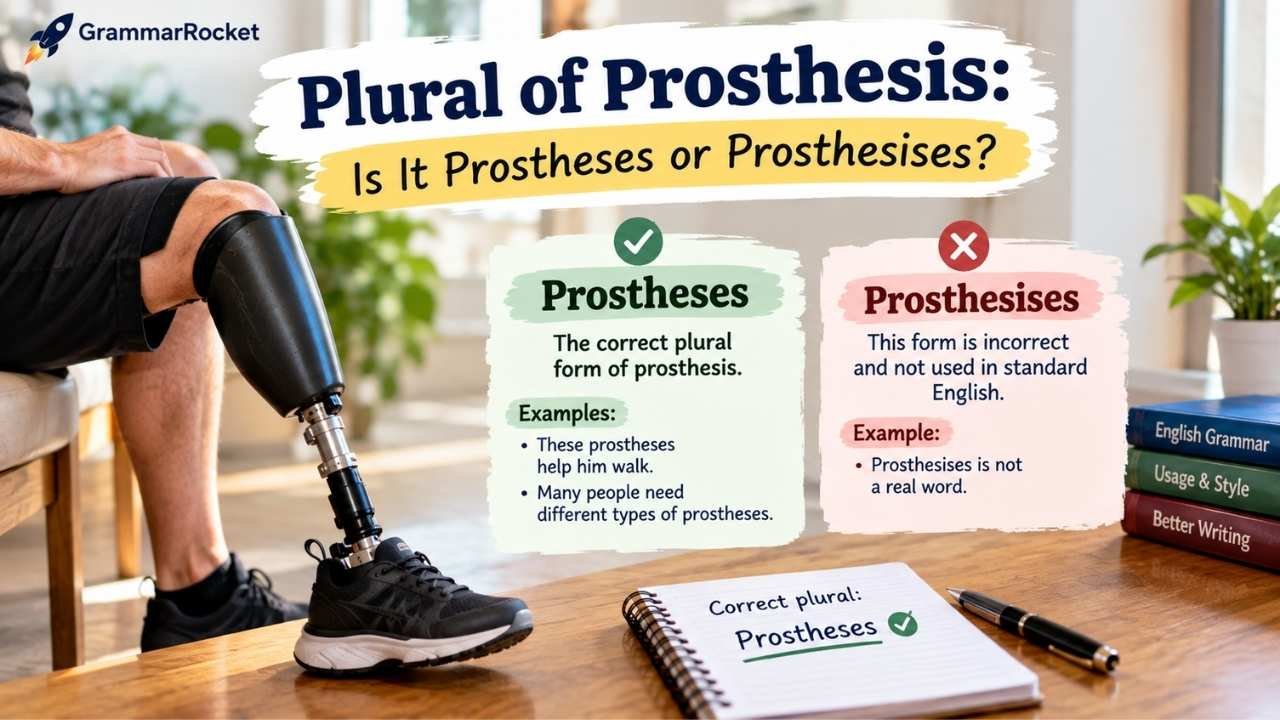
If you’ve ever wondered about the plural of prosthesis, you’re not alone. Many English learners, students, and even native speakers ask whether the correct plural is prostheses or something else. Because prosthesis is a word with Greek origins, its plural follows a different grammar rule than most English nouns.
Understanding the plural form of prosthesis is useful for writing, speaking, and reading medical or academic content with confidence. In this guide, you’ll learn what the plural of prosthesis is, why it changes to prostheses, and how to use both words correctly in everyday and professional sentences.
We’ll also explain the difference between prosthesis vs. prostheses, share easy grammar tips, provide clear examples, and answer common questions so you can avoid mistakes and remember the correct form with ease.
Quick Answer
The plural of prosthesis is prostheses. The singular word prosthesis refers to an artificial body part or prosthetic device, while prostheses refers to more than one. This is an irregular plural noun that follows a Greek-origin grammar rule, where nouns ending in -is change to -es, just like analysis → analyses and thesis → theses.
What Does Prosthesis Mean?

A prosthesis is an artificial body part or prosthetic device that replaces a missing or damaged body part. It is commonly used in medicine to help people regain movement, improve daily life, or restore appearance.
For example, an artificial leg, arm, eye, or dental replacement can all be called a prosthesis. Understanding the prosthesis meaning also makes it easier to learn the plural form of prosthesis correctly.
Since this word often appears in healthcare, science, and education, knowing how to use it in both singular and plural forms is important. If you enjoy learning about unique English grammar rules, you may also like our guide on Alliteration vs Consonance, which explains another commonly confused language topic in a simple way.
What Is the Plural of Prosthesis?
The plural of prosthesis is prostheses. Many people mistakenly write prosthesises, but that spelling is incorrect. Because prosthesis comes from Greek, it follows a special grammar rule where nouns ending in -is change to -es in the plural.
This makes prostheses the only correct plural form of prosthesis. You should use prosthesis when referring to one artificial body part and prostheses when talking about two or more.
Learning the difference between prosthesis vs. prostheses helps you write more accurately in both academic and everyday situations. Remember this simple rule whenever you come across similar Greek-origin words in English grammar.
Singular vs. Plural of Prosthesis (Comparison Table)
The table below makes it easy to understand the singular and plural of prosthesis. It also shows when to use each word correctly in a sentence.
| Form | Word | Meaning | Example |
| Singular | Prosthesis | One artificial body part or device | The patient received a new prosthesis after surgery. |
| Plural | Prostheses | Two or more artificial body parts or devices | Modern prostheses help many people live active lives. |
This quick comparison is useful if you ever wonder what is the plural of prosthesis. Like many irregular nouns, the spelling changes instead of simply adding -s or -es. If you’re interested in similar grammar patterns, our article on the Plural of Phylum explains another Greek-derived word with an unusual plural form.
Why Does Prosthesis Become Prostheses?
The reason prosthesis becomes prostheses is its Greek origin. Many English words borrowed from Greek keep their original plural pattern. Instead of adding -s, nouns ending in -is usually change to -es.
This rule also applies to words like analysis → analyses, diagnosis → diagnoses, thesis → theses, and crisis → crises. Since prosthesis belongs to the same group, its correct plural is prostheses.
Knowing this pattern makes it easier to recognize and remember other irregular plural nouns. Rather than memorizing each word separately, you can learn the rule once and apply it whenever you see another Greek-derived noun ending in -is.
How to Pronounce Prosthesis and Prostheses
Correct pronunciation helps you use these words with confidence. Prosthesis is commonly pronounced as pros-THEE-sis, while prostheses is pronounced pros-THEE-seez. Notice that the ending changes when the word becomes plural.
Many learners focus only on the spelling, but saying the words aloud is another great way to remember the difference between prosthesis and prostheses. Listening to native speakers or dictionary audio can also improve your pronunciation.
Whether you are discussing a prosthetic device, reading medical material, or practicing English grammar, using the correct pronunciation makes your communication clearer and more natural.
Prosthesis vs. Prostheses: What’s the Difference?
The difference between prosthesis and prostheses is simple. Prosthesis is the singular noun, meaning one artificial body part or prosthetic device. Prostheses is the plural noun, meaning two or more artificial body parts or devices.
The meaning stays the same, but the number changes. For example, you would say, “The athlete uses a prosthesis,” but “The clinic designs advanced prostheses.” Remembering this difference helps you avoid common grammar mistakes in writing and conversation.
Whenever you ask yourself, “What is the plural of prosthesis?” the answer is always prostheses, never prosthesises.
Example Sentences Using Prosthesis and Prostheses
Seeing words in context is one of the easiest ways to remember them. Use prosthesis when talking about one artificial body part, and use prostheses when referring to two or more. Here are a few examples:
- The patient received a new prosthesis after the accident.
- The doctor adjusted the prosthesis to improve comfort.
- Modern prostheses allow many people to walk and run with confidence.
- The hospital provides custom prostheses for children and adults.
- Researchers continue to improve prosthetic devices and prostheses through new technology.
These examples show the correct singular and plural of prosthesis in everyday and medical situations. Reading and practicing sentences like these will help you remember the plural form of prosthesis naturally.
Common Mistakes People Make
Many writers make small mistakes when using prosthesis and prostheses, especially if they are unfamiliar with irregular plural nouns. The most common error is writing prosthesises, but this is not a correct English word.
Another mistake is confusing prosthesis with prosthetic. A prosthesis is the artificial body part itself, while prosthetic is an adjective that describes something related to a prosthesis, such as a prosthetic leg or prosthetic arm.
Some people also use the singular word when they should use the plural. To avoid these errors, remember that prosthesis means one, while prostheses means more than one.
Other Greek Words That Follow the Same Rule
The plural of prosthesis is easier to remember when you learn similar words. Many Greek-origin words ending in -is change to -es in their plural forms. Here are some common examples:
| Singular | Plural |
| Analysis | Analyses |
| Diagnosis | Diagnoses |
| Thesis | Theses |
| Crisis | Crises |
| Ellipsis | Ellipses |
| Prosthesis | Prostheses |
These words all follow the same grammar pattern. Once you understand this rule, it becomes much easier to recognize and use other Greek plural words correctly in both writing and conversation.
Grammar Tips to Remember the Correct Plural
A simple trick can help you remember the correct plural of prosthesis. Whenever you see a Greek-derived noun ending in -is, think about changing the ending to -es instead of adding -s. This rule works for prosthesis → prostheses, thesis → theses, and several other words.
Another helpful tip is to read example sentences and practice saying the words aloud. Repetition makes the spelling and pronunciation easier to remember. If you are unsure, check a trusted dictionary before using the word in formal writing.
Learning one grammar pattern instead of memorizing each word separately will save time and improve your confidence when using irregular plural nouns.
FAQs
What is the plural of prosthesis?
The correct plural of prosthesis is prostheses.
Is prosthesises a correct word?
No. Prosthesises is incorrect. The only accepted plural is prostheses.
What does prosthesis mean?
A prosthesis is an artificial body part that replaces a missing or damaged body part.
Why does prosthesis become prostheses?
It follows a Greek-origin grammar rule where nouns ending in -is change to -es in the plural.
What is the difference between prosthesis and prostheses?
Prosthesis means one artificial body part, while prostheses refers to more than one.
Is prosthetic the same as prosthesis?
No. Prosthetic is usually an adjective, while prosthesis is a noun.
Are there other words like prosthesis?
Yes. Examples include analysis, diagnosis, thesis, and crisis, which all follow the same plural pattern.
Conclusion
The plural of prosthesis is prostheses, and it follows a common Greek-origin grammar rule that changes -is to -es. Although the spelling may seem unusual at first, it becomes much easier to remember once you understand the pattern.
Knowing the difference between prosthesis, prostheses, and prosthetic will help you communicate more clearly in everyday conversations, academic writing, and medical contexts.
By practicing the example sentences, learning the grammar rule, and remembering similar words like analysis and thesis, you can use these terms with confidence. Whenever you wonder what is the plural of prosthesis, you’ll know that prostheses is the only correct answer.